
Close Menu
    Facebook X (Twitter) Instagram
    SciTechDaily
    • Biology
    • Chemistry
    • Earth
    • Health
    • Physics
    • Science
    • Space
    • Technology
    Facebook X (Twitter) Pinterest YouTube RSS
    SciTechDaily
    Home»Space»Kepler-76b: A Hot Jupiter With Superrotation
    Space

    Kepler-76b: A Hot Jupiter With Superrotation

    By Harvard-Smithsonian Center for AstrophysicsMay 28, 2013No Comments2 Mins Read
    Facebook Twitter Pinterest Telegram LinkedIn WhatsApp Email Reddit
    Share
    Facebook Twitter LinkedIn Pinterest Telegram Email Reddit
    Kepler 76b A Hot Jupiter with Superrotation
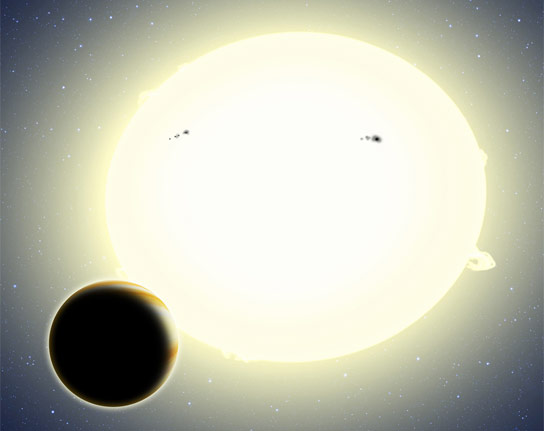
    Einstein’s exoplanet, Kepler-76b, is a Jupiter-sized planet discovered using an effect of Einstein’s relativity. It orbits its star every 1.5 days. Credit: David A. Aguilar, CfA

    Researchers used the BEEER algorithm to identify a hot Jupiter in the Kepler light curve, Kepler-76b.

    Eight hundred and eighty nine exoplanets (planets around stars other than our Sun) have been discovered to date. Most of them were found using the Kepler satellite, which spots small dips in a star’s light as an orbiting planet periodically blocked our view (a “transit”). The satellite recently halted its operations due to a faulty gyroscope, and so its mission could possibly be over, but there remain a large dataset of possible other exoplanets for study. Meanwhile, NASA has selected a new mission for development: TESS (the Transiting Exoplanet Survey Satellite), on which CfA astronomers, who have played active roles in exoplanet research, continue their leadership.

    The Kepler dataset has been steadily mined for transiting planets. In a dramatic first, CfA astronomer Dave Latham and four of his colleagues have discovered a new planet in the Kepler data by searching not for transits but for a less well-known effect of Einstein’s relativity: relativistic beaming. (Latham is being honored this week with a conference entitled, “Exoplanets in the Post-Kepler Era.”)

    The effect can occur when an orbiting planet induces a slight wobble in the star’s motion with a corresponding modulation of stellar brightness. The effect in an exoplanet context was first predicted by two CfA astronomers in 2003, Avi Loeb and Scott Gaudi, in a paper the referee claimed would never lead to practical results; the variation in the brightness is typically only a few parts per ten thousand.

    The new planet has a mass about twice that of Jupiter, orbits its star every 1.5 days, and (thanks to follow-up observations using other observatories) has a hot atmosphere with fast-moving jet-stream winds. The new result not only adds another exoplanet to the growing catalog, it demonstrates the ability of relativistic effects to discover and study exoplanets, and the power of very high-precision stellar monitoring.

    Reference: “BEER analysis of Kepler and CoRoT light curves: I. Discovery of Kepler-76b: A hot Jupiter with evidence for superrotation” by Simchon Faigler, Lev Tal-Or, Tsevi Mazeh, Dave W. Latham and Lars A. Buchhave, 12 June 2023, The Astrophysical Journal.
    DOI: 10.1088/0004-637X/771/1/26

    Never miss a breakthrough: Join the SciTechDaily newsletter.
    Follow us on Google and Google News.

    Astronomy Astrophysics CoRoT Exoplanet Harvard-Smithsonian Center for Astrophysics Kepler Space Telescope
    Share. Facebook Twitter Pinterest LinkedIn Email Reddit

    Related Articles

    The Nearest Potentially Habitable Planet is Roughly Nine Light-Years Away

    Kepler Detects A Super-Earth Transiting the Bright K-Dwarf HIP 116454

    Architecture of Kepler’s Multi-Transiting Systems

    BEER Algorithm Identifies Exoplanet Kepler-76b

    Water Planets in the Habitable Zone: A Closer Look at Kepler 62e and 62f

    Scientists Detected Exoplanetary System With Regularly Aligned Orbits Similar to Our Solar System

    Two Planets Separated by Less Than 5 Earth Moon Distances

    Astronomers Obtain Precise Measurements of the Two Kepler-16 Stars

    NASA’s Kepler Mission Discovers 11 New Extrasolar Systems with 26 Exoplanets

    Leave A Reply Cancel Reply

    • Facebook
    • Twitter
    • Pinterest
    • YouTube

    Don't Miss a Discovery

    Subscribe for the Latest in Science & Tech!

    Trending News

    Artificial Sweeteners May Harm Future Generations, Study Suggests

    Splashdown! NASA Artemis II Returns From Record-Breaking Moon Mission

    What If Consciousness Exists Beyond Your Brain

    Scientists Finally Crack the 100-Million-Year Evolutionary Mystery of Squid and Cuttlefish

    Beyond “Safe Levels”: Study Challenges What We Know About Pesticides and Cancer

    Researchers Have Found a Dietary Compound That Increases Longevity

    Scientists Baffled by Bizarre “Living Fossil” From 275 Million Years Ago

    Your IQ at 23 Could Predict Your Wealth at 27, Study Finds

    Follow SciTechDaily
    • Facebook
    • Twitter
    • YouTube
    • Pinterest
    • Newsletter
    • RSS
    SciTech News
    • Biology News
    • Chemistry News
    • Earth News
    • Health News
    • Physics News
    • Science News
    • Space News
    • Technology News
    Recent Posts
    • Beef vs. Chicken: Surprising Results From New Prediabetes Study
    • Alzheimer’s Breakthrough: Scientists Discover Key Protein May Prevent Toxic Protein Clumps in the Brain
    • Scientists Discover New Way To Make Protein Shakes Taste Better
    • Scientists Break Optical Limits With Quantum Dot-Powered Nanoscopy
    • Scientists Shrink a Lab Spectrometer to the Size of a Grain of Sand
    Copyright © 1998 - 2026 SciTechDaily. All Rights Reserved.
    • Science News
    • About
    • Contact
    • Editorial Board
    • Privacy Policy
    • Terms of Use

    Type above and press Enter to search. Press Esc to cancel.