
Close Menu
    Facebook X (Twitter) Instagram
    SciTechDaily
    • Biology
    • Chemistry
    • Earth
    • Health
    • Physics
    • Science
    • Space
    • Technology
    Facebook X (Twitter) Pinterest YouTube RSS
    SciTechDaily
    Home»Space»NASA’s LRO Views Chang’e 3 Lander
    Space

    NASA’s LRO Views Chang’e 3 Lander

    By NASADecember 31, 2013No Comments4 Mins Read
    Facebook Twitter Pinterest Telegram LinkedIn WhatsApp Email Reddit
    Share
    Facebook Twitter LinkedIn Pinterest Telegram Email Reddit
    NASA Views Chinese Lander Site
    This animated GIF shows the Chinese Chang’e lander (large white dot in the center of the second image) and Yutu rover (smaller white dot below the lander). The individual images were taken by the Lunar Reconnaissance Orbiter Camera Narrow Angle Camera. Credit: NASA/GSFC/Arizona State University

    NASA’s Lunar Reconnaissance Orbiter has captured the first images of the Chinese Chang’e 3 lander on the Moon.

    Chang’e 3 landed on Mare Imbrium (Sea of Rains) just east of a 450 m (1,500 ft) diameter impact crater on 14 December 2013. Soon after landing, a small rover named Yutu (or Jade Rabbit in English) was deployed and took its first tentative drive onto the airless regolith. At the time of the landing, LRO’s orbit was far from the landing site so images of the landing were not possible. Ten days later on 24 December, LRO approached the landing site, and LROC was able to acquire a series of six LROC Narrow Angle Camera ( NAC ) image pairs during the next 36 hours (19 orbits). The highest resolution image was possible when LRO was nearly overhead on 25 December 03:52:49 UT (24 December 22:52:49 EST). At this time LRO was at an altitude of ~150 km (93 mi) above the site, and the pixel size was 150 cm (59 in).

    LROC NAC View of Chang'e 3 Lander
    LROC NAC view of the Chang’e 3 lander (large arrow) and rover (small arrow) just before sunset on their first day of lunar exploration. LROC NAC M1142582775R, image width 576 m, north is up. Credit: NASA/GSFC/Arizona State University

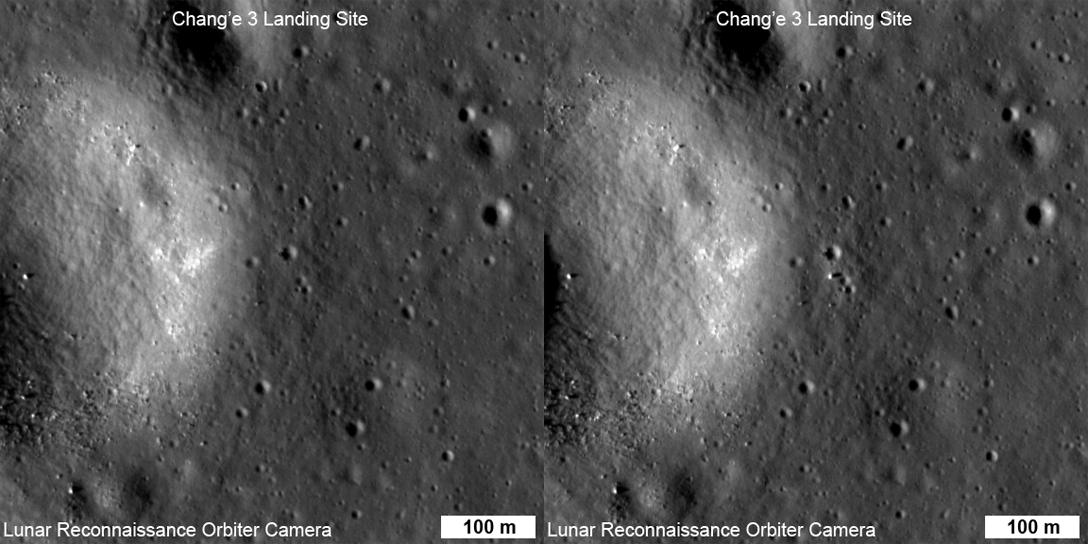
    The rover is only about 150 cm wide, yet it shows up in the NAC images for two reasons: the solar panels are very effective at reflecting light so the rover shows up as two bright pixels, and the Sun is setting thus the rover casts a distinct shadow (as does the lander). Since the rover is close to the size of a pixel, how can we be sure we are seeing the rover and not a comparably sized boulder? Fortuitously, the NAC acquired a “before” image (M1127248516R) of the landing site, with nearly identical lighting, on June 30, 2013. By comparing the before and after landing site images, the LROC team confirmed the position of the lander and rover, and derived accurate map coordinates for the lander (44.1214°N, 340.4884°E, 2640 meters elevation ).
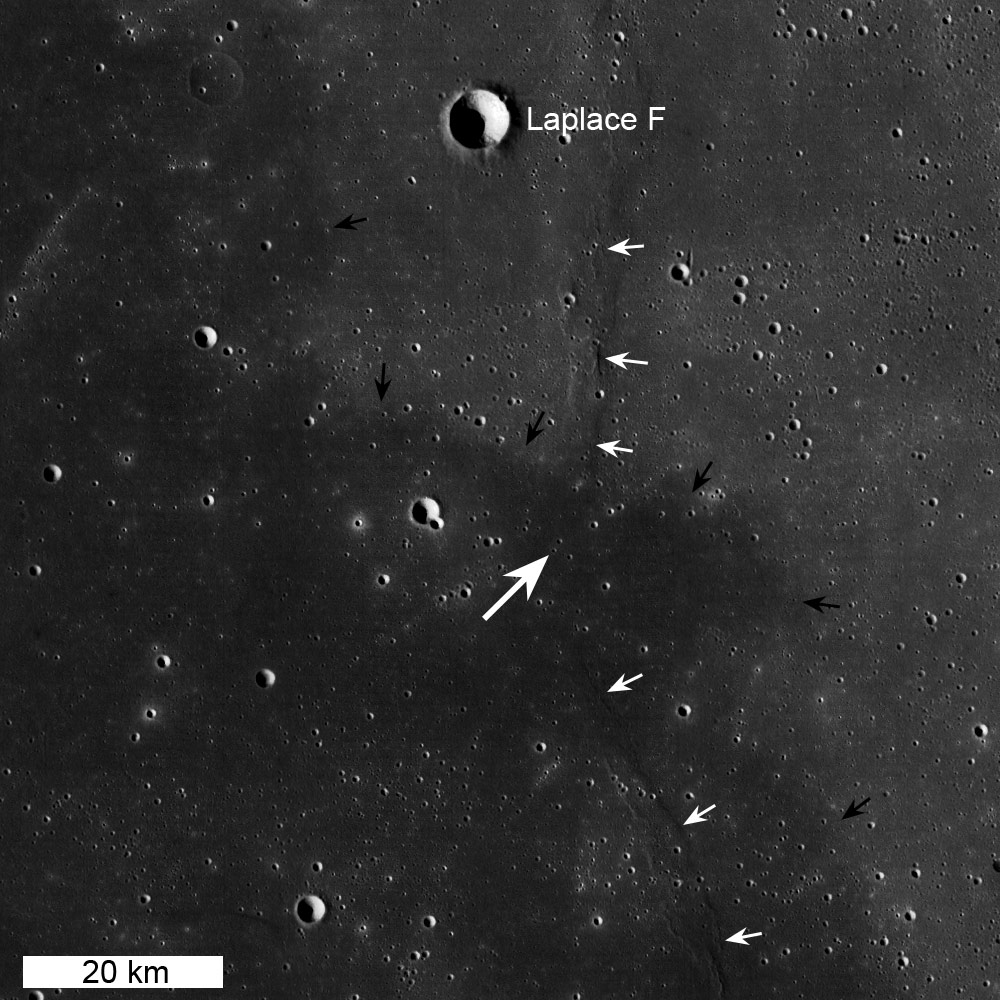
    Chinese Chang e Lander on the Moon
    LROC WAC context mosaic for the Chang’e 3 landing site (large white arrow); small white arrows indicate wrinkle ridge and small black arrows delimit the boundary between the “red” mare (northeast) and “blue” mare (southwest), image is 100 km wide. Credit: NASA/GSFC/Arizona State University

    The lander set down about 60 meters (200 feet) east of the rim of a 450-meter (1,500-foot) diameter impact crater (40 meters or 130 feet deep) on a thick deposit of volcanic materials. A large-scale wrinkle ridge (~100 km/62 mi long, 10 km/6.2 mi wide) cuts across the area and was formed as tectonic stress caused the volcanic layers to buckle and break along faults. Wrinkle ridges are common on the Moon, Mercury, and Mars.

    Lunar mare basalts are divided into two main spectral (color) types: “red” and “blue” (blue is perhaps a misnomer, think “less red”). Basalts on the Moon (same on Earth) are composed mainly of two minerals, pyroxene, and plagioclase, though olivine and ilmenite can sometimes occur in significant amounts. The presence of ilmenite (FeTiO 3 ) results in lower reflectance and a “less red” color thus the blue basalts. The landing site is on a blue mare (higher titanium) thought to be about 3.0 billion years old. The boundary (black arrows in above WAC mosaic) with an older (3.5 billion years) red mare is only 10 km to the north.

    Never miss a breakthrough: Join the SciTechDaily newsletter.
    Follow us on Google and Google News.

    Astronomy Chang'e 3 Lander Moon Planetary Science
    Share. Facebook Twitter Pinterest LinkedIn Email Reddit

    Related Articles

    Lunar Far Side Mystery Linked to Massive Ancient Impact

    The Moon Was Hit Again: NASA Scientists Discover a Newly Formed Crater

    Io’s Volcanoes Are Not Located Where Scientists Expected

    Pre-existing Mineral Deposits on the Moon Can Survive Lunar Impacts

    Presence of Water in the Primary Crust Indicates That the Early Moon Was Wet

    Saturn-Like Rings May Have Formed Solar System’s Moons

    New Theoretical Models Salvage Moon-Forming Impact Theory

    Simulation May Explain Saturnian System

    Catalog of Moon’s Craters May Reveal Ice Beyond Moon’s Poles

    Leave A Reply Cancel Reply

    • Facebook
    • Twitter
    • Pinterest
    • YouTube

    Don't Miss a Discovery

    Subscribe for the Latest in Science & Tech!

    Trending News

    Scientists Discover Game-Changing New Way To Treat High Cholesterol

    This Small Change to Your Exercise Routine Could Be the Secret to Living Longer

    Scientists Discover 430,000-Year-Old Wooden Tools, Rewriting Human History

    AI Could Detect Early Signs of Alzheimer’s in Under a Minute – Far Before Traditional Tests

    What if Dark Matter Has Two Forms? Bold New Hypothesis Could Explain a Cosmic Mystery

    This Metal Melts in Your Hand – and Scientists Just Discovered Something Strange

    Beef vs. Chicken: Surprising Results From New Prediabetes Study

    Alzheimer’s Breakthrough: Scientists Discover Key Protein May Prevent Toxic Protein Clumps in the Brain

    Follow SciTechDaily
    • Facebook
    • Twitter
    • YouTube
    • Pinterest
    • Newsletter
    • RSS
    SciTech News
    • Biology News
    • Chemistry News
    • Earth News
    • Health News
    • Physics News
    • Science News
    • Space News
    • Technology News
    Recent Posts
    • Revolutionary Imaging Technique Unlocks Secrets of Matter at Extreme Speeds
    • Where Does Mass Come From? Scientists Find Evidence of a New Exotic Nuclear State
    • Quantum Breakthrough: Unhackable Keys Sent Over 120 km Using Quantum Dots
    • Researchers Discover Unknown Beetle Species Just Steps From Their Lab
    • Jellyfish Caught Feasting on Exploding Sea Worms for the First Time
    Copyright © 1998 - 2026 SciTechDaily. All Rights Reserved.
    • Science News
    • About
    • Contact
    • Editorial Board
    • Privacy Policy
    • Terms of Use

    Type above and press Enter to search. Press Esc to cancel.