
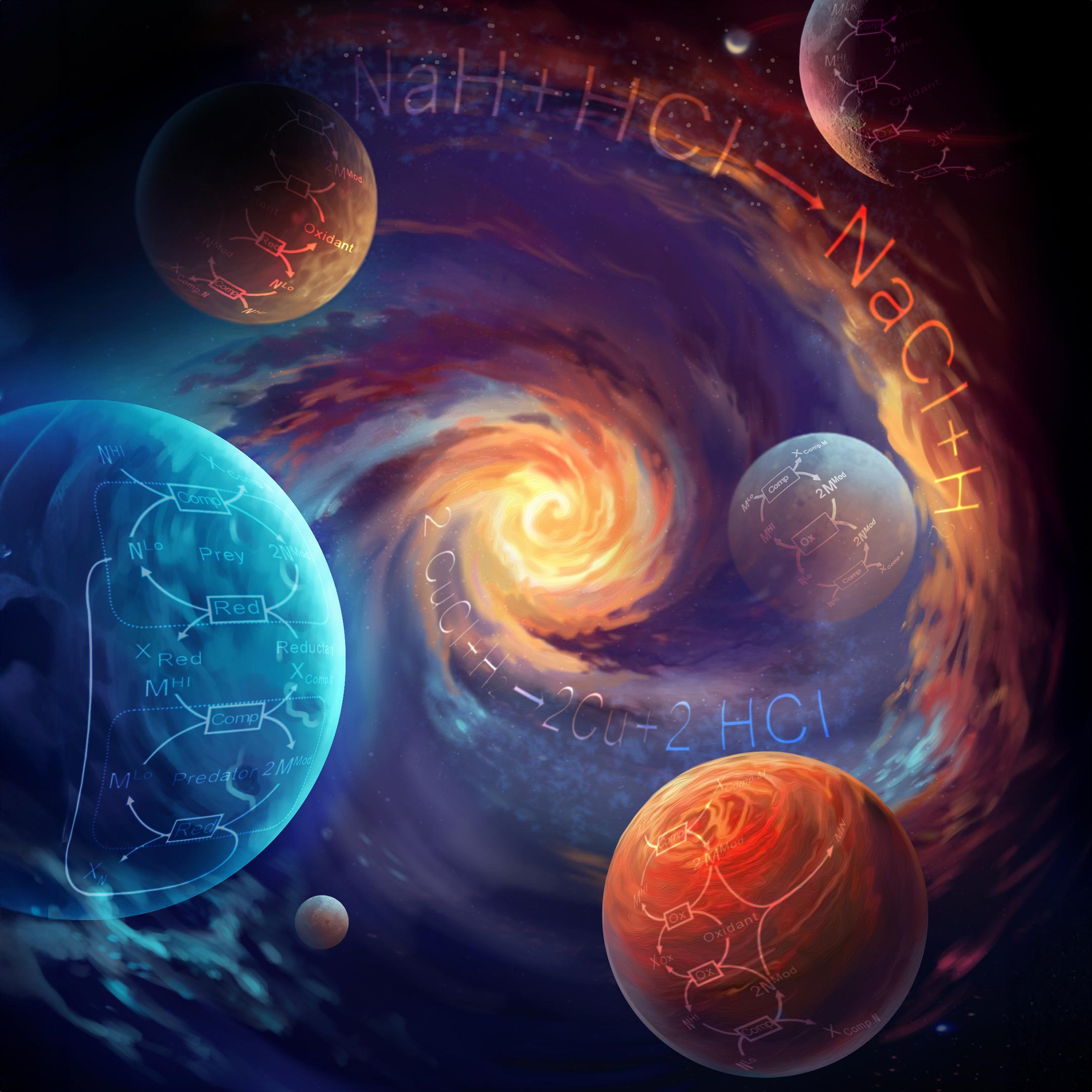
A team led by scientists has exploited the limitations of chemical combinations to write a cookbook with hundreds of recipes that have the potential to give rise to life.
Life on a faraway planet — if it’s out there — might not look anything like life on Earth. But there are only so many chemical ingredients in the universe’s pantry, and only so many ways to mix them. A team led by scientists at the University of Wisconsin–Madison has exploited those limitations to write a cookbook of hundreds of chemical recipes with the potential to give rise to life.
Their ingredient list could focus the search for life elsewhere in the universe by pointing out the most likely conditions — planetary versions of mixing techniques, oven temperatures, and baking times — for the recipes to come together.
The process of progressing from basic chemical ingredients to the complex cycles of cell metabolism and reproduction that define life, the researchers say, requires not only a simple beginning but also repetition.
“The origin of life really is a something-from-nothing process,” says Betül Kaçar, a NASA-supported astrobiologist and UW–Madison professor of bacteriology. “But that something can’t happen just once. Life comes down to chemistry and conditions that can generate a self-reproducing pattern of reactions.”
The Science Behind Chemical Reactions
Chemical reactions that produce molecules that encourage the same reaction to happen again and again are called autocatalytic reactions. In a new study published September 18 in the Journal of the American Chemical Society, Zhen Peng, a postdoctoral researcher in the Kaçar laboratory, and collaborators compiled 270 combinations of molecules — involving atoms from all groups and series across the periodic table — with the potential for sustained autocatalysis.
“It was thought that these sorts of reactions are very rare,” says Kaçar. “We are showing that it’s actually far from rare. You just need to look in the right place.”
The researchers focused their search on what are called comproportionation reactions. In these reactions, two compounds that include the same element with different numbers of electrons, or reactive states, combine to create a new compound in which the element is in the middle of the starting reactive states.

To be autocatalytic, the outcome of the reaction also needs to provide starting materials for the reaction to occur again, so the output becomes a new input, says Zach Adam, a co-author of the study and a UW–Madison geoscientist studying the origins of life on Earth. Comproportionation reactions result in multiple copies of some of the molecules involved, providing materials for the next steps in autocatalysis.
“If those conditions are right, you can start with relatively few of those outputs,” Adam says. “Every time you take a turn of the cycle you spit out at least one extra output which speeds up the reaction and makes it happen even faster.”
Autocatalysis is like a growing population of rabbits. Pairs of rabbits come together, produce litters of new rabbits, and then the new rabbits grow up to pair off themselves and make even more rabbits. It doesn’t take many rabbits to soon have many more rabbits.
Implications and Future Endeavors
Looking for floppy ears and fuzzy tails out in the universe, however, probably isn’t a winning strategy. Instead, Kaçar hopes chemists will pull ideas from the new study’s recipe list and test them out in pots and pans simulating extraterrestrial kitchens.
“We will never definitively know what exactly happened on this planet to generate life. We don’t have a time machine,” Kaçar says. “But, in a test tube, we can create multiple planetary conditions to understand how the dynamics to sustain life can evolve in the first place.”
Kaçar leads a NASA-supported consortium called MUSE, for Metal Utilization & Selection Across Eons. Her lab will focus on reactions including the elements molybdenum and iron, and she is excited to see what others cook up from the most exotic and unusual parts of the new recipe book.
“Carl Sagan said if you want to bake a pie from scratch, first you must create the universe,” Kaçar says. “I think if we want to understand the universe, first we must bake a few pies.”
Reference: “Assessment of Stoichiometric Autocatalysis across Element Groups” by Zhen Peng, Zachary R. Adam, Albert C. Fahrenbach and Betül Kaçar, 18 September 2023, Journal of the American Chemical Society.
DOI: 10.1021/jacs.3c07041
This research was funded in part by grants from NASA Astrobiology Program (80NSSC22K0546), the John Templeton Foundation (62578 and 61926), the Research Corporation for Science Advancement (28788) and the Australian Research Council (DP210102133 and FT220100757).
Never miss a breakthrough: Join the SciTechDaily newsletter.
Follow us on Google and Google News.