

Close Menu
    Facebook X (Twitter) Instagram
    SciTechDaily
    • Biology
    • Chemistry
    • Earth
    • Health
    • Physics
    • Science
    • Space
    • Technology
    Facebook X (Twitter) Pinterest YouTube RSS
    SciTechDaily
    Home»Technology»Blue OLED Advancement Set to Transform Smartphone and Large Screen Displays
    Technology

    Blue OLED Advancement Set to Transform Smartphone and Large Screen Displays

    By SciTechDailySeptember 20, 2023No Comments4 Mins Read
    Facebook Twitter Pinterest Telegram LinkedIn WhatsApp Email Reddit
    Share
    Facebook Twitter LinkedIn Pinterest Telegram Email Reddit
    Display Technology Art Concept
    Researchers from Tokyo Tech have innovated an OLED that emits blue light at a record low voltage of 1.47 V, potentially revolutionizing commercial smartphone and display technologies.

    An upconversion organic light-emitting diode (OLED) based on a typical blue-fluorescence emitter achieves emission at an ultralow turn-on voltage of 1.47 V, as demonstrated by researchers from Tokyo Tech. Their technology circumvents the traditional high voltage requirement for blue OLEDs, leading to potential advancements in commercial smartphone and large-screen displays.

    Blue light is vital for light-emitting devices and lighting applications, as well as smartphone screens and large-screen displays. However, it is challenging to develop efficient blue organic light-emitting diodes (OLEDs) owing to the high applied voltage required for their function. Conventional blue OLEDs typically require around 4 V for a luminance of 100 cd/m2; this is higher than the industrial target of 3.7 V—the voltage of lithium-ion batteries commonly used in smartphones. Therefore, there is an urgent need to develop novel blue OLEDs that can operate at lower voltages.

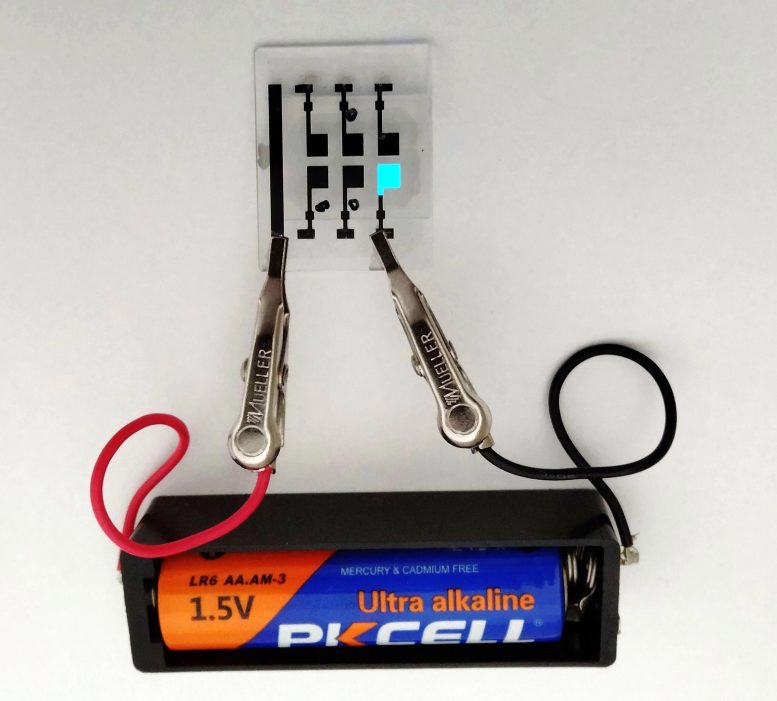
    In this regard, Associate Professor Seiichiro Izawa from Tokyo Institute of Technology and Osaka University, collaborated with researchers from University of Toyama, Shizuoka University, and the Institute for Molecular Science has recently presented a novel OLED device with a remarkable ultralow turn-on voltage of 1.47 V for blue emission and a peak wavelength at 462 nm (2.68 eV) (as shown in Figure 1). Their work will be published today (September 20) in the journal Nature Communications.
    Lighting Up a Blue Organic LED
    Figure 1. Lighting up a blue organic LED with a single AA battery. Credit Associate Professor Izawa and team

    Innovative Material Selection for Ultra-Low Voltage

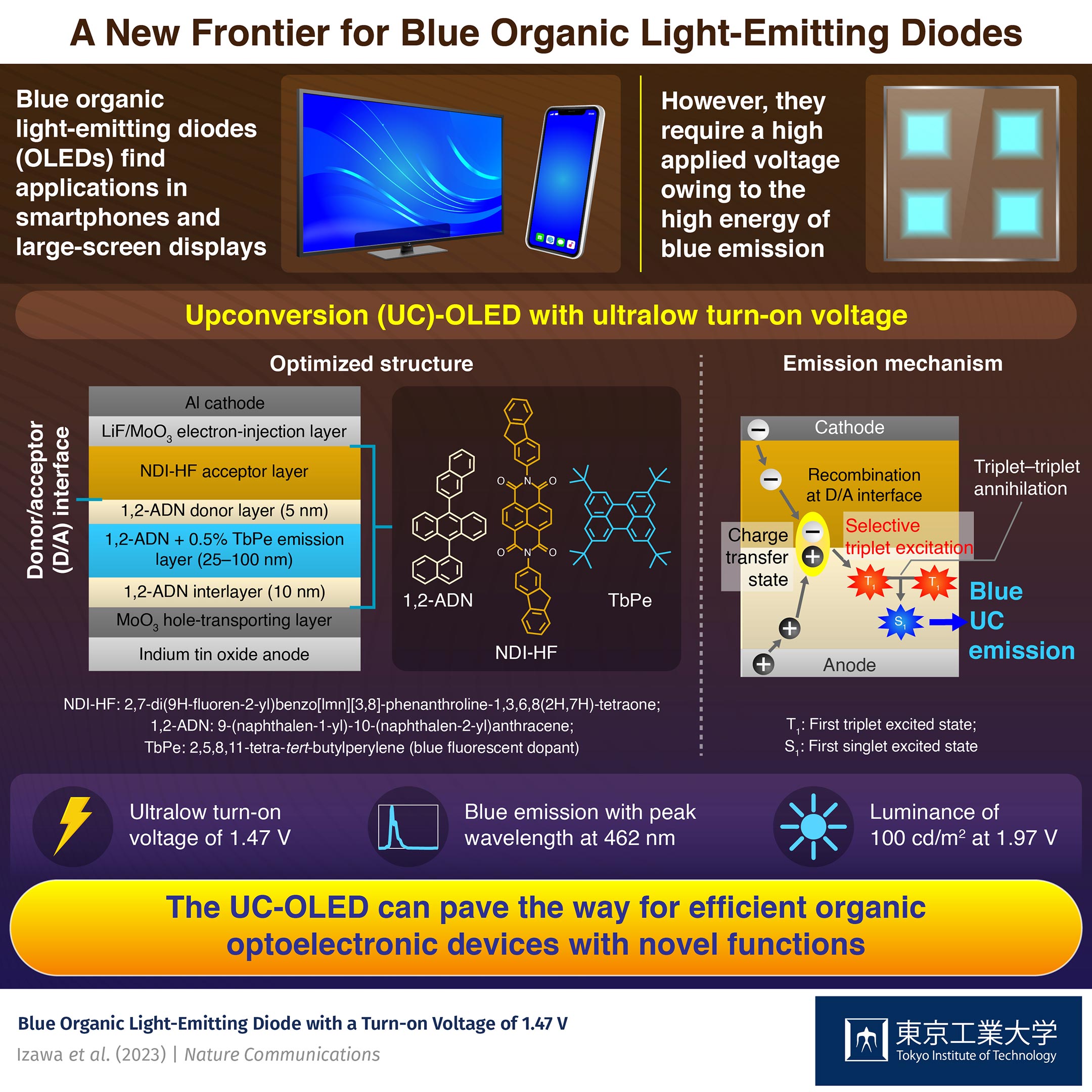
    The choice of materials used in this OLED significantly influences its turn-on voltage. The device utilizes NDI-HF (2,7-di(9H-fluoren-2-yl)benzo[lmn][3,8]-phenanthroline-1,3,6,8(2H,7H)-tetraone) as the acceptor, 1,2-ADN (9-(naphthalen-1-yl)-10-(naphthalen-2-yl)anthracene) as the donor, and TbPe (2,5,8,11-tetra-tert-butylperylene) as the fluorescent dopant. This OLED operates via a mechanism called upconversion (UC). Herein, holes and electrons are injected into donor (emitter) and acceptor (electron transport) layers, respectively. They recombine at the donor/acceptor (D/A) interface to form a charge transfer (CT) state. Dr. Izawa points out: “The intermolecular interactions at the D/A interface play a significant role in CT state formation, with stronger interactions yielding superior results.”
    New Frontier for Blue Organic Light-Emitting Diodes
    Figure 2. An upconversion organic light-emitting diode (OLED) based on a typical blue-fluorescence emitter achieves emission at an ultralow turn-on voltage of 1.47 V, as demonstrated by researchers from Tokyo Tech. Their technology circumvents the traditional high voltage requirement for blue OLEDs, leading to potential advancements in commercial smartphone and large-screen displays. Credit: Associate Professor Seichiro Izawa

    Triplet-Triplet Annihilation

    Subsequently, the energy of the CT state is selectively transferred to the low-energy first triplet excited states of the emitter, which results in blue light emission through the formation of a high-energy first singlet excited state by triplet-triplet annihilation (TTA). “As the energy of the CT state is much lower than the emitter’s bandgap energy, the UC mechanism with TTA significantly decreases the applied voltage required for exciting the emitter. As a result, this UC-OLED reaches a luminance of 100 cd/m2, equivalent to that of a commercial display, at just 1.97 V,” explains Dr. Izawa.

    In effect, this study efficiently produces a novel OLED, with blue light emission at an ultralow turn-on voltage, using a typical fluorescent emitter widely utilized in commercial displays, thus marking a significant step toward meeting the commercial requirements for blue OLEDs. It emphasizes the importance of optimizing the design of the D/A interface for controlling excitonic processes and holds promise not only for OLEDs but also for organic photovoltaics and other organic electronic devices.

    Reference: “Blue Organic Light-Emitting Diode with a Turn-on Voltage of 1.47 V” by Seiichiro Izawa, Masahiro Morimoto, Keisuke Fujimoto, Koki Banno, Yutaka Majima, Masaki Takahashi, Shigeki Naka and Masahiro Hiramoto, 20 September 2023, Nature Communications.
    DOI: 10.1038/s41467-023-41208-7

    Never miss a breakthrough: Join the SciTechDaily newsletter.
    Follow us on Google and Google News.

    LEDs OLED Tokyo Institute of Technology
    Share. Facebook Twitter Pinterest LinkedIn Email Reddit

    Related Articles

    This Flexible OLED Screen Stays Bright Even When Stretched

    Brighter and More Efficient Next-Gen LEDs: Stanford Breakthrough Comes at a Cost

    Molecular Highways: A Breakthrough in Organic Light-Emitting Diodes (OLEDs)

    Optoelectronics Nanotechnology Innovation: MIT Grows Precise Arrays of nanoLEDs

    Luminous Molecules – A New Concept in Synthesis

    Two-in-One: Quantum Dot Breakthrough Combines Laser and LED Capabilities

    Revolutionary Stretchable OLED Display Bends and Expands – “An Entirely New Display Technology”

    20 Times More Intense: New Material Will Help Improve Phone and Television Displays

    Far-Ultraviolet LED Efficiently Kills Bacteria and Viruses Without Harming People

    Leave A Reply Cancel Reply

    • Facebook
    • Twitter
    • Pinterest
    • YouTube

    Don't Miss a Discovery

    Subscribe for the Latest in Science & Tech!

    Trending News

    Breakthrough Bowel Cancer Trial Leaves Patients Cancer-Free for Nearly 3 Years

    Natural Compound Shows Powerful Potential Against Rheumatoid Arthritis

    100,000-Year-Old Neanderthal Fossils in Poland Reveal Unexpected Genetic Connections

    Simple “Gut Reset” May Prevent Weight Gain After Ozempic or Wegovy

    2.8 Days to Disaster: Scientists Warn Low Earth Orbit Could Suddenly Collapse

    Common Food Compound Shows Surprising Power Against Superbugs

    5 Simple Ways To Remember More and Forget Less

    The Atomic Gap That Could Cost the Semiconductor Industry Billions

    Follow SciTechDaily
    • Facebook
    • Twitter
    • YouTube
    • Pinterest
    • Newsletter
    • RSS
    SciTech News
    • Biology News
    • Chemistry News
    • Earth News
    • Health News
    • Physics News
    • Science News
    • Space News
    • Technology News
    Recent Posts
    • Powerful Antioxidant Found To Play a Key Role in Proper Protein Folding
    • MIT Laser Breakthrough Lets Scientists Watch Drugs Enter the Brain in Real Time
    • Study Reveals Malaria’s Hidden Role in Human Evolution
    • Scientists Print Artificial Neurons That Can Talk to the Brain
    • Bowel and Ovarian Cancers Are Dramatically Rising in Young Adults and Scientists Aren’t Sure Why
    Copyright © 1998 - 2026 SciTechDaily. All Rights Reserved.
    • Science News
    • About
    • Contact
    • Editorial Board
    • Privacy Policy
    • Terms of Use

    Type above and press Enter to search. Press Esc to cancel.