
Close Menu
    Facebook X (Twitter) Instagram
    SciTechDaily
    • Biology
    • Chemistry
    • Earth
    • Health
    • Physics
    • Science
    • Space
    • Technology
    Facebook X (Twitter) Pinterest YouTube RSS
    SciTechDaily
    Home»Technology»20 Times More Intense: New Material Will Help Improve Phone and Television Displays
    Technology

    20 Times More Intense: New Material Will Help Improve Phone and Television Displays

    By Ural Federal UniversityNovember 29, 2022No Comments3 Mins Read
    Facebook Twitter Pinterest Telegram LinkedIn WhatsApp Email Reddit
    Share
    Facebook Twitter LinkedIn Pinterest Telegram Email Reddit
    AI Materials Science Concept
    The new fluorophores may be utilized to develop new materials that will increase the brightness of displays on computers, TVs, and mobile devices.

    Researchers have created fluorophores between 2.4 and 20 times more intense than analogs.

    Scientists have created, synthesized, and analyzed a new class of fluorophores, which are luminous chemical compounds. These are the new bullet systems based on cyanopyrazine. According to research, the inclusion of cyanogroup compounds in fluorophores considerably boosts the efficiency of organic light-emitting diodes (OLED). This indicates they can be utilized to develop new materials to improve the brightness of screens used for smartphones, computers, and televisions. The researchers’ findings were recently published in the journal Dyes and Pigments.

    The research was led by Egor Verbitskiy, the director of the Postovsky Institute of Organic Synthesis Ural Branch of RAS and a member of the Laboratory of Medical Chemistry and Advanced Organic Materials at the Ural Federal University. He states that physicists were aware that introducing cyanogroups to fluorophores can enhance the OLEDs’ properties and overall efficiency.
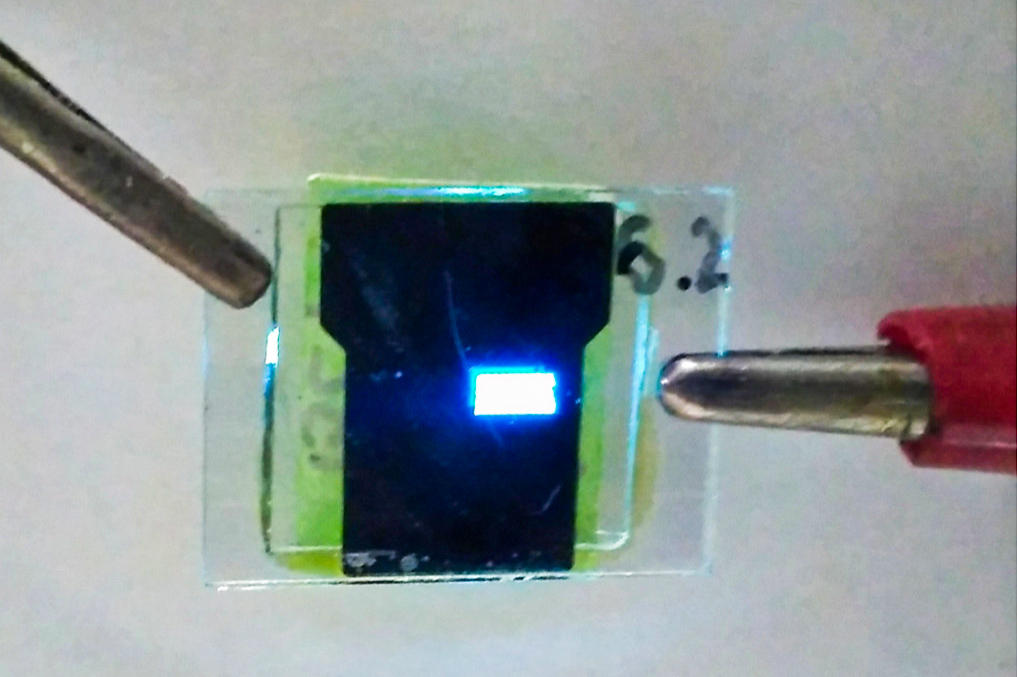
    Assembled Organic LED
    One of the assembled organic LEDs based on push-pull systems containing cyanopyrazine fragments. Credit: Ruslan Gadirov

    “Therefore, we modified the pyrazine-based push-pull system with cyanogroup and studied how this affected the photophysical properties of the fluorophores and the performance of OLEDs based on it. The phenomenon of TADF, due to the peculiarities of the structure of the initial substance, did not arise, although there are prerequisites for it. However, it turned out that the introduction of a cyanogroup intensifies intermolecular interactions, as a result of which not individual molecules but complexes of molecules begin to fluoresce.”

    He continues, “As a consequence, the increase in luminescence intensity was from 2.4 to 20 times, and the brightness of the emitted light was up to 75 times. Such results were shown by several prototype devices made by our colleagues and co-authors from Tomsk State University. It is also important that we used inexpensive and accessible compounds in our research,” says Egor Verbitskiy.

    Pyrazine and Push-Pull Systems in OLED Development

    Chemists previously established that the pyrazine ring (also known as 1,4-diazine), a compound of nitrogen, hydrogen, and carbon with a strong electron-accepting effect, is one of the most promising compounds as an acceptor (attracting electrons) part in push-pull systems.

    A study of the properties of a wide range of 1,4-diazine-based push-pull systems revealed that the addition of a benzene ring to the pyrazine cycle can improve the efficiency and brightness of the OLEDs produced. At the same time, some of the OLEDs tend to exhibit thermally activated delayed fluorescence (TADF). This is evidenced by the increase in fluorescence lifetime.

    Scientists are continuing to work on the creation of new fluorophores.

    Reference: “Impact of an ortho-cyano group on photophysical properties and performance of OLEDs based on D-A–A type pyrazine push-pull system” by Egor V. Verbitskiy, Ruslan M. Gadirov, Lubov G. Samsonova, Konstantin M. Degtyarenko, Alexander E. Kurtcevich, Elizaveta V. Sapozhnikova, Margarita V. Medvedeva, Tatyana S. Svalova, Alisa N. Kozitsina, Gennady L. Rusinov, and Valery N. Charushin, 12 September 2022, Dyes and Pigments.
    DOI: 10.1016/j.dyepig.2022.110716

    Never miss a breakthrough: Join the SciTechDaily newsletter.
    Follow us on Google and Google News.

    Computers LEDs Light Smartphone Television Ural Federal University
    Share. Facebook Twitter Pinterest LinkedIn Email Reddit

    Related Articles

    Quantum-Dot Technology Ready to Improve LCD TVs

    Scientists Develop Pocket-Size Microscope Accessory Accurate to one Hundredth of a Millimeter

    DARPA’s HACMS Program Seeks to Create New Technology

    Physicists Work on Nano Loudspeakers to Make Better MRIs, Quantum Computers

    Using Lasers to Cool Semiconductors

    The Future Of Incandescent Bulbs Not So Bright

    Samsung And T-Mobile To Launch A White Galaxy S II

    Going Shopping During the Holidays? Your Phone Might be Watching

    Hackers Attack ATT. Is Your Wireless Phone Safe?

    Leave A Reply Cancel Reply

    • Facebook
    • Twitter
    • Pinterest
    • YouTube

    Don't Miss a Discovery

    Subscribe for the Latest in Science & Tech!

    Trending News

    Scientists Warn That This Common Pet Fish Can Wreck Entire Ecosystems

    Scientists Make Breakthrough in Turning Plastic Trash Into Clean Fuel Using Sunlight

    This Popular Supplement May Interfere With Cancer Treatment, Scientists Warn

    Scientists Finally Solved One of Water’s Biggest Mysteries

    Could This New Weight-Loss Pill Disrupt the Entire Market? Here’s What You Should Know About Orforglipron

    Earth’s Crust Is Tearing Open in Africa, and It Could Form a New Ocean

    Breakthrough Bowel Cancer Trial Leaves Patients Cancer-Free for Nearly 3 Years

    Natural Compound Shows Powerful Potential Against Rheumatoid Arthritis

    Follow SciTechDaily
    • Facebook
    • Twitter
    • YouTube
    • Pinterest
    • Newsletter
    • RSS
    SciTech News
    • Biology News
    • Chemistry News
    • Earth News
    • Health News
    • Physics News
    • Science News
    • Space News
    • Technology News
    Recent Posts
    • Ancient Roman Ship Coating Reveals Secrets Hidden for 2,200 Years
    • Enormous Prehistoric Insects Puzzle Scientists
    • College Student Identifies Bizarre New Carnivorous Dinosaur Three Times Older Than T. rex
    • The Most Effective Knee Arthritis Treatments Aren’t What You Expect
    • Scientists Develop Bioengineered Chewing Gum That Could Help Fight Oral Cancer
    Copyright © 1998 - 2026 SciTechDaily. All Rights Reserved.
    • Science News
    • About
    • Contact
    • Editorial Board
    • Privacy Policy
    • Terms of Use

    Type above and press Enter to search. Press Esc to cancel.