
A Molecular Additive Enhances Next-Gen LEDs – But Shortens Their Lifespans
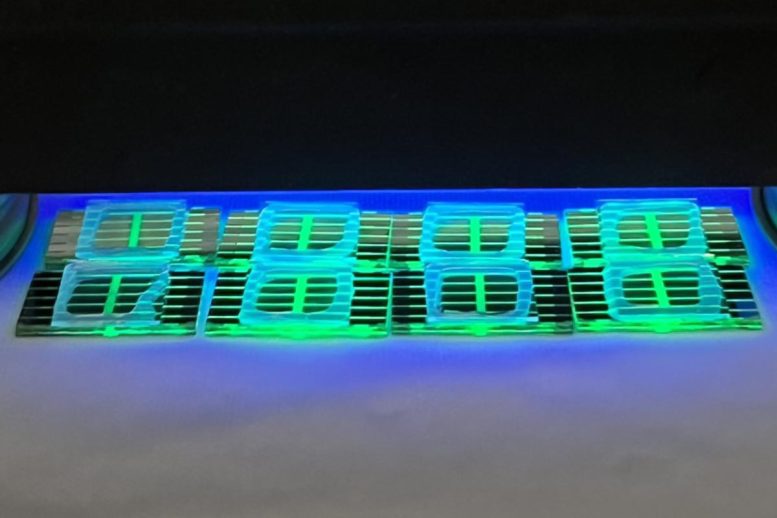
By tinkering with the material makeup of perovskite LEDs, a cheaper and more easily made type of LED, Stanford researchers achieved leaps in brightness and efficiency – but saw their lights give out after a few minutes of use.
Chances are, the screen you’re reading from glows thanks to light-emitting diodes – commonly known as LEDs. This widespread technology provides energy-efficient indoor lighting and increasingly illuminates our computer monitors, TVs, and smartphone screens. Unfortunately, it also requires a relatively laborious and expensive manufacturing process.
Stanford’s Pursuit of Affordable and Efficient Lighting
Hoping to address this shortcoming, Stanford researchers tested a method that boosted the brightness and efficiency of perovskite LEDs, or PeLEDs, a cheaper and easier-to-make alternative. Their enhancements, however, caused the lights to fizzle out within minutes, demonstrating the careful trade-offs that must be understood to advance this class of materials.
“We took some big steps towards understanding why it’s degrading. The question is, can we find a way to mitigate that while keeping the efficiency?” says Dan Congreve, assistant professor of electrical engineering and senior author on the paper, published earlier this month in the journal Device. “If we can do that, I think we can really start to work towards a viable commercial solution.”
What Makes Perovskite LEDs Different
In simplest terms, LEDs transform electrical energy into light by passing electric current through a semiconductor – layers of crystalline material that emits light with an applied electric field. But creating those semiconductors gets complex and costly compared to less energy-efficient lights like incandescents and fluorescents.
“A lot of these materials are grown on expensive surfaces such as a four-inch sapphire substrate,” says Sebastian Fernández, a PhD student in Congreve’s lab and the paper’s lead author. “Just to purchase this substrate costs a few hundred dollars.”
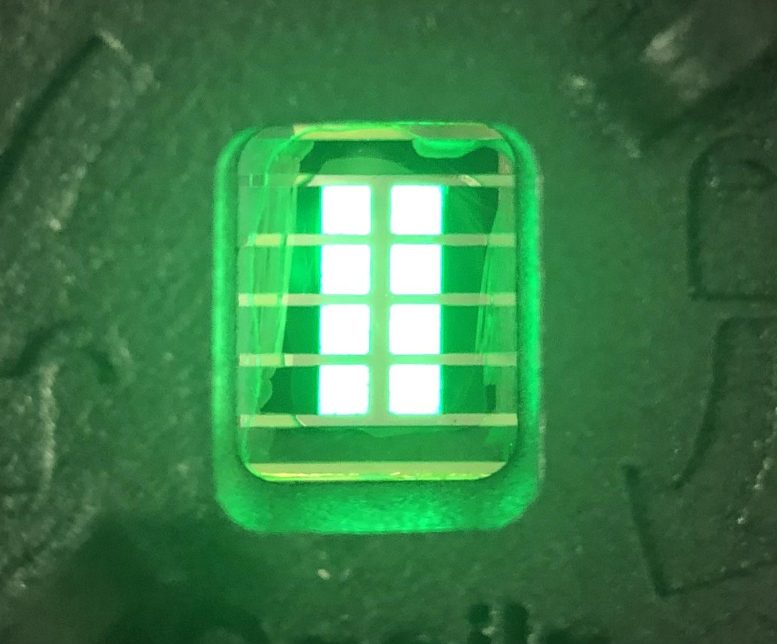
PeLEDs use a semiconductor known as metal halide perovskites, composed of a blend of different elements. Engineers can grow perovskite crystals on glass substrates, saving a significant sum compared to normal LEDs. They can also dissolve perovskites in solution and “paint” it onto glass to create a light-emitting layer, a simpler production process than regular LEDs call for.
Applications and Limitations of Perovskite LEDs
These advantages could make energy-efficient indoor lighting feasible for more of the built environment, reducing energy demand. PeLEDs could also sharpen the color purity of smartphone and TV displays. “A green is more green, a blue is more blue,” Congreve says. “You can literally see more colors from the device.”
Most PeLEDs today, however, peter out after just a few hours. And they often don’t match the energy efficiency of standard LEDs, due to random gaps in the perovskite’s atomic structure known as defects. “There should be an atom here, but there’s not,” Congreve explains. “Energy goes in there, but you don’t get light out, so it harms the overall efficiency of the device.”
Brightness Versus Longevity
To mitigate these issues, Fernández built on a technique debuted by Congreve and Mahesh Gangishetty, assistant professor of chemistry at Mississippi State University and a co-author on the paper. Many of those energy-wasting gaps in perovskites occur where atoms of lead ought to be. By replacing 30% of the perovskite’s lead with manganese atoms, which helps fill those gaps, the team more than doubled their PeLEDs’ brightness, almost tripled efficiency, and extended the lights’ lifespans from less than one minute to 37 minutes.
The technique also has the potential to move the needle on health risks. “Lead is extremely important for light emission within this material, but at the same time, lead is known to be toxic,” Fernández says. This type of lead is also water-soluble – meaning it could leak through, say, a cracked smartphone screen. “People are skeptical of commercial technology that is toxic, so that also pushed me to consider other materials.”
Further Developments and Challenges
But Fernández went one step further, mixing a phosphine oxide called TFPPO into the perovskite. “I added it and saw the efficiencies just shoot up,” he says. The additive made the lights up to five times more energy-efficient than those with only a manganese boost and brought out one of the brightest glows of any PeLED yet recorded.
But the gains came with a downside: the lights faded to half their peak brightness in just two and a half minutes. (On the other hand, the perovskites that weren’t treated with TFPPO are the version that sustained their brightness for 37 minutes.)
Understanding the Trade-Off
Fernández thinks that the transformation of electrical energy into light over time in PeLEDs with TFPPO becomes less efficient than in those without, largely due to increased obstacles related to charge transport within the PeLED. The team also suggests that while TFPPO initially fills some gaps in the perovskite’s atomic structure, those gaps quickly reopen, causing energy efficiency to drop off along with durability.
Moving forward, Fernández hopes to experiment with different phosphine oxide additives to see whether they yield different effects, and why.
“Clearly, this additive is incredible in terms of efficiency,” Fernández says. “However, its effects on stability need to be suppressed to have any hope to commercialize this material.”
Congreve’s lab is working to address other limitations of PeLEDs, too, such as their difficulty with producing violet and ultraviolet light. In another recent paper in the journal Matter led by PhD student Manchen Hu (who is also a co-author of the Device paper), the team found that by adding water to the solution in which the perovskite crystals form, they could produce PeLEDs that emitted bright violet light five times more efficiently. With further improvements, ultraviolet PeLEDs could sterilize medical equipment, purify water, and help grow indoor crops – all more affordably than current LEDs allow.
Reference: “Trade-off between efficiency and stability in Mn2+-doped perovskite light-emitting diodes” by Sebastian Fernández, William Michaels, Manchen Hu, Pournima Narayanan, Natalia Murrietta, Arynn O. Gallegos, Ghada H. Ahmed, Junrui Lyu, Mahesh K. Gangishetty and Daniel N. Congreve, 1 August 2023, Device.
DOI: 10.1016/j.device.2023.100017
Additional Stanford co-authors of this research include undergraduate student William Michaels, graduate student Pournima Narayanan, undergraduate student Natalia Murrietta, graduate student Arynn Gallegos, postdoctoral scholar Ghada Ahmed, and graduate student Junrui Lyu.
This research was funded by the Diversifying Academia, Recruiting Excellence (DARE) Fellowship, the U.S. Department of Energy, Stanford Graduate Fellowships in Science & Engineering (P. Michael Farmwald Fellow, Gabilan Fellow, and Scott A. and Geraldine D. Macomber Fellow), the National GEM Consortium, the Department of Electrical Engineering at Stanford University, and the National Science Foundation. A portion of this work was performed at the Stanford Nano Shared Facilities, supported by the National Science Foundation.
Never miss a breakthrough: Join the SciTechDaily newsletter.
Follow us on Google and Google News.
1 Comment
Brighter and more efficient LEDs will only increase light pollution that’s already devastating the insect population.