
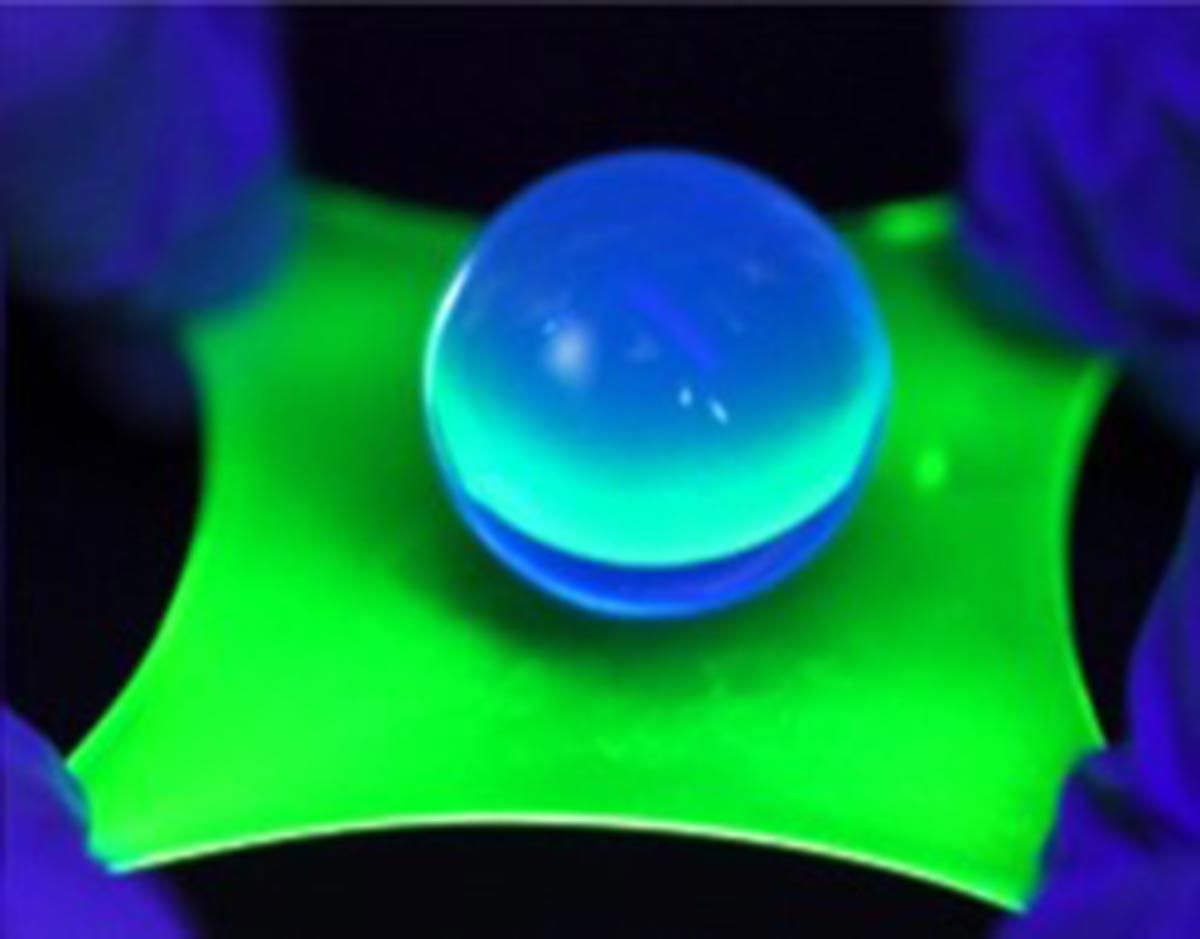
A new ultra-stretchy OLED brings glowing, wearable displays and real-time health sensors one step closer to reality.
The same organic light-emitting diode (OLED) technology used in flexible smartphones, curved computer monitors, and modern televisions may soon find a new role as wearable, skin-mounted sensors. These future devices could display real-time changes in body temperature, blood flow, or pressure directly on the skin. An international research team led by scientists at Seoul National University in the Republic of Korea and Drexel University has developed a new type of flexible and stretchable OLED that brings this possibility closer to reality.
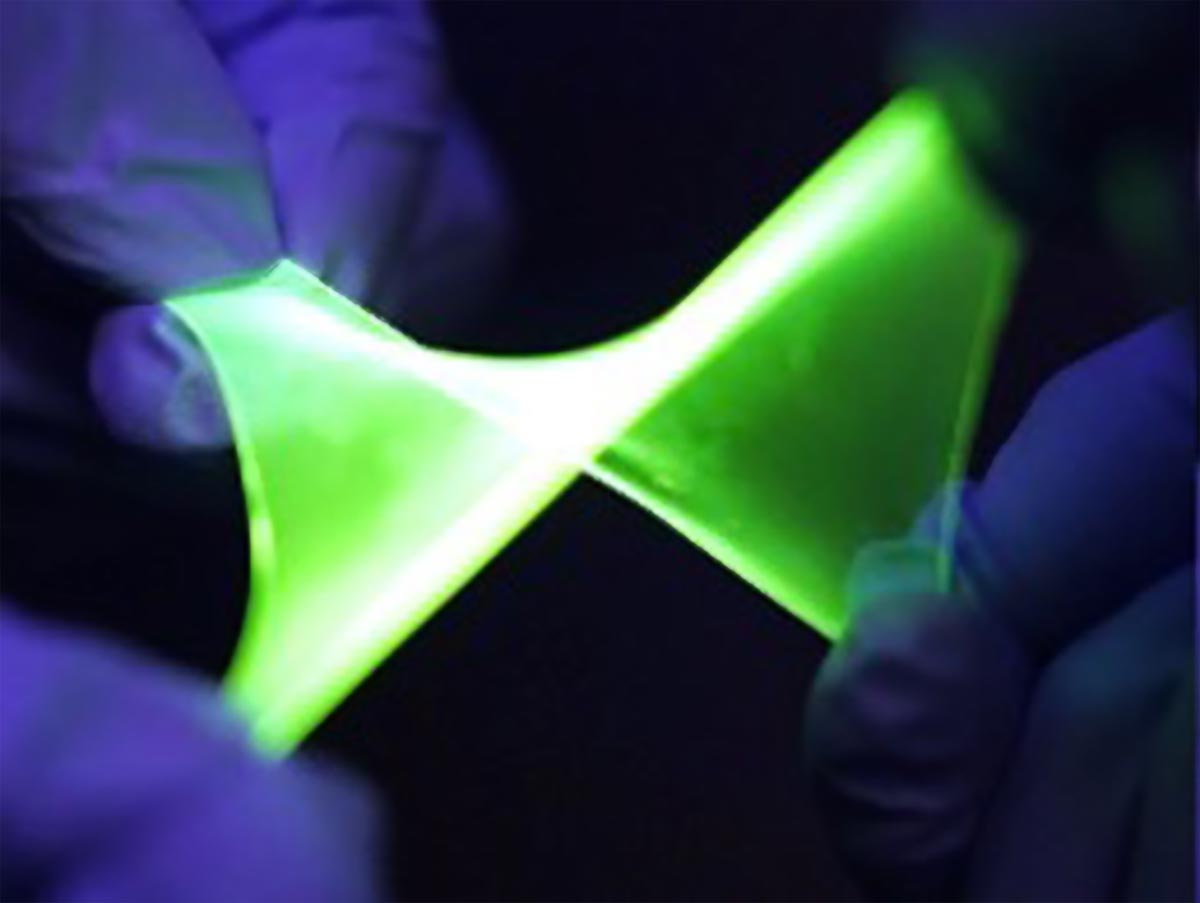
Their findings, published today (January 14) in Nature, describe an OLED design that combines a flexible phosphorescent polymer layer with transparent electrodes made from MXene nanomaterial. This new structure allows the device to stretch up to 1.6 times its original length while preserving most of its brightness.
“This study addresses a longstanding challenge in flexible OLED technology, namely, the durability of its luminescence after repeated mechanical flexion,” said Yury Gogotsi, PhD, Distinguished University and Bach professor in Drexel’s College of Engineering. “While the advances creating flexible light-emitting diodes have been substantial, progress has leveled off in the last decade due to limitations introduced by the transparent conductor layer, limiting their stretchability.”
Why Flexible OLEDs Lose Brightness
OLEDs generate light through electroluminescence. When electricity flows through the device, positive and negative charges travel between electrodes and pass through an organic polymer layer. When these charges meet, they emit light and form a particle known as an exciton before settling into a stable electrical state. The specific color produced depends on the chemical makeup of the organic layer.
Flexible OLEDs are created by layering these materials onto bendable plastic substrates, allowing them to function while folded, curved, or rolled. Although the technology dates back to the 1990s, it became widely visible in the 2010s when Samsung introduced flexible and shatter-resistant displays in curved-edge phones. Over time, however, researchers noticed that repeated bending reduced both brightness and flexibility. This decline was linked to gradual damage within the electrodes and organic materials.
“Imparting conducting materials with flexibility usually involves incorporating an insulating but stretchable polymer that hinders charge transport and, as a result, reduces light emission,” said Danzhen Zhang, PhD, a co-author and postdoctoral researcher at Northeastern University, who previously conducted key research on transparent conductive MXene films as a PhD student in Gogotsi’s lab at Drexel. “In addition, the material most commonly used in electrodes can become brittle and more likely to break the longer the OLED is flexed and stretched. This issue was addressed by using MXene-contact stretchable electrodes, which feature high mechanical robustness and tunable work function, ensuring efficient hole or electron injection.”
A New Light-Emitting Material
To overcome these limitations, the research team redesigned the light-producing layer itself. Their approach uses a specialized organic material that encourages more charge pairs to form excitons, increasing light output.
This material, known as an exciplex-assisted phosphorescent (ExciPh) layer, is naturally stretchable and chemically engineered to adjust the energy levels of moving charges. This adjustment makes it easier for charges to combine and produce light, similar to slowing a spinning ride so more people can safely jump on.
More than 57% of excitons generated in the ExciPh layer are converted into light. By comparison, the polymer layers commonly used in current OLEDs convert only 12-22% of excitons into visible emission.
To further enhance flexibility, the researchers embedded the ExciPh layer in a thermoplastic polyurethane elastomer matrix. They also redesigned the electrodes to improve how electrical charges spread throughout the device.
MXene Electrodes Improve Performance
The team created transparent, stretchable electrodes by combining MXene, a highly conductive two-dimensional nanomaterial developed at Drexel University in 2011, with silver nanowires. Together, these materials form a conductive network that helps charges move efficiently into the light-emitting polymer layer before forming excitons.
This design improves charge injection and allows the OLED to maintain brightness even as it is stretched or bent repeatedly.
“Owing to their exceptional conductivity and layered form, MXenes provide an exceptional electrode material for flexible OLEDs,” Gogotsi said. “We have demonstrated the performance of flexible, transparent MXene electrodes in multiple applications; thus, including them in efforts to improve OLED technology is a natural step for our research.”
Testing OLEDs Under Strain
Using these combined improvements, the researchers built flexible green OLED displays shaped like a heart and numerical digits. They evaluated how efficiently the devices converted electrical charges into excitons and tested their durability under repeated stretching.
To show how broadly the technology could be applied, the Seoul National University team also produced a full-color, fully stretchable OLED display by adding four different dopant materials to the ExciPh layer. In addition, they developed fully stretchable passive-matrix OLEDs that demonstrate a simple, low-power design suitable for wearable electronics.
The new OLEDs outperformed previously reported designs in both brightness and energy efficiency. When stretched to 60% of their maximum strain, performance dropped by only 10.6%. After 100 cycles of repeated stretching at 2% strain, the devices retained 83% of their light output, highlighting their improved durability.
Toward Wearable Health Displays
“We anticipate the success of this approach to designing flexible, high-efficiency optoelectronic devices will enable the next generation of wearable and deformable displays,” said Teng Zhang, PhD, a co-author and former postdoctoral researcher in Gogotsi’s lab. “This technology will play an important role in real-time health care monitoring and wearable communications technology.
Looking ahead, the researchers plan to explore additional flexible substrates, fine-tune organic layers to produce different colors and brightness levels, and simplify manufacturing methods to support broader adoption of stretchable OLED technology.
Reference: “Exciplex-enabled high-efficiency, fully stretchable OLEDs” by Huanyu Zhou, Hyun-Wook Kim, Shin Jung Han, Danzhen Zhang, Woo Jin Jeong, Haomiao Yu, Youichi Tsuchiya, Bin Hu, June Huh, Teng Zhang, Seungyeon Cho, Joo Sung Kim, Dong-Hyeok Kim, Hyung Joong Yun, Jinwoo Park, Kyung Yeon Jang, Eojin Yoon, Amit Kumar Harit, Min-Jun Sung, Yooseong Ahn, Hao Chen, Qingsen Zeng, Chan-Yul Park, Kwan-Nyeong Kim, Landep Ayuningtias, Hoichang Yang, Jong Chan Kim, Yun-Hi Kim, Han Young Woo, Chihaya Adachi, Yury Gogotsi and Tae-Woo Lee, 14 January 2026, Nature.
DOI: 10.1038/s41586-025-09904-0
Never miss a breakthrough: Join the SciTechDaily newsletter.
Follow us on Google and Google News.