
Close Menu
    Facebook X (Twitter) Instagram
    SciTechDaily
    • Biology
    • Chemistry
    • Earth
    • Health
    • Physics
    • Science
    • Space
    • Technology
    Facebook X (Twitter) Pinterest YouTube RSS
    SciTechDaily
    Home»Technology»New Flexible Organic LED Gives Off a Comfortable Candlelight-Like Glow
    Technology

    New Flexible Organic LED Gives Off a Comfortable Candlelight-Like Glow

    By American Chemical SocietyMay 25, 2022No Comments3 Mins Read
    Facebook Twitter Pinterest Telegram LinkedIn WhatsApp Email Reddit
    Share
    Facebook Twitter LinkedIn Pinterest Telegram Email Reddit
    Candlelight-Like Glow From Flexible Organic LED
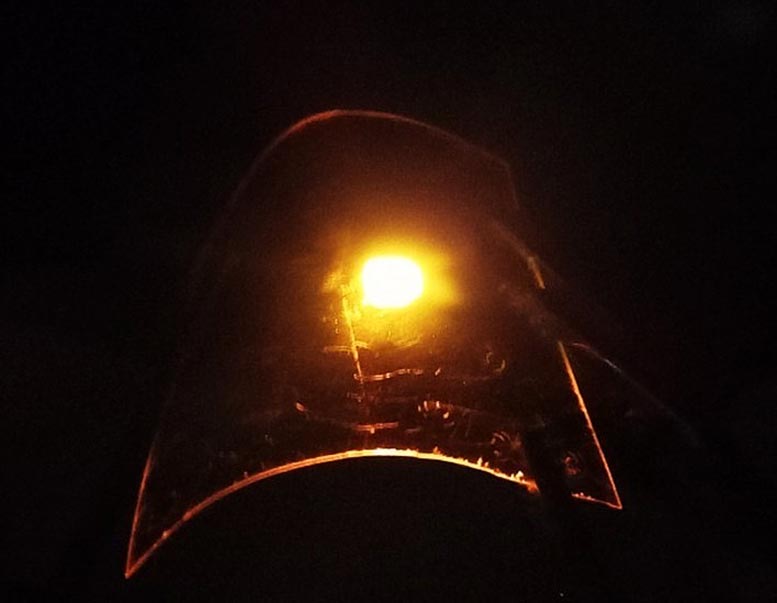
    A bendable organic LED with a natural mica backing releases a strong, candlelight-like glow. Credit: Andy Chen and Ambrose Chen

    A new flexible organic LED mimics candlelight, minimizing blue light and reducing melatonin suppression, ideal for nighttime use.

    Giving off a soft comfortable glow, candles set the ambiance for a special dinner or just a peaceful evening at home. However, some lighting alternatives, such as electronic candles, give off unwanted blue wavelength light that interferes with the body’s circadian rhythm. Now, researchers reporting in the journal ACS Applied Electronic Materials have fabricated an improved flexible organic LED that releases candlelight-like light for bendable lighting and smart displays that people can comfortably use at night.

    Previously, Jwo-Huei Jou and other researchers developed organic LEDs that emit warm-white light, similar to that produced by candles. However, the devices still emitted some blue wavelengths, which can interfere with sleep because it reduces the body’s production of melatonin.

    These devices were made of rigid materials and weren’t bendable. One option for making them flexible is to use a plastic backing, as has been done for other organic LEDs. But plastics don’t hold up well to repeated bending. Another option for the backing is mica — a natural mineral with extreme temperature tolerance that can be split into bendable, transparent sheets. So, Jou, Ying-Hao Chu, and colleagues wanted to develop an even better organic LED and apply it to a mica backing, creating a bendable candle-like light with a long lifespan.

    Creating a Bendable Candle-Like Organic LED

    The researchers deposited a clear indium tin oxide film onto a transparent mica sheet as the LED’s anode, which could bend 50,000 times without breaking. Next, the team mixed the luminescent substance N,N’-dicarbazole-1,1’-biphenyl with red and yellow phosphorescent dyes to produce a light-emitting layer. This layer was then placed between electrically conductive solutions with the anode on one side and an aluminum layer on the other side, creating a flexible organic LED.

    When a constant current was applied to the device, it produced a bright, warm light with even less blue wavelength emissions than natural candlelight. Calculations showed that exposure to the LED for 1.5 hours would suppress a person’s melatonin production by about 1.6%, whereas light from a cold-white compact fluorescent lamp would suppress melatonin production by 29%. The researchers say that the flexibility of their candlelight-like organic LED opens up the design opportunities for blue-light-free nighttime devices.

    Reference: “Flexible Candlelight Organic LED on Mica” by Tun-Hao Chen, Hao-Jen Chen, Ching-Yu Weng, Feng-Rong Chen, De-Shiang Liou, Sun-Zen Chen, Ying-Hao Chu and Jwo-Huei Jou, 9 May 2022, ACS Applied Electronic Materials.
    DOI: 10.1021/acsaelm.2c00123

    The authors acknowledge funding from the Ministry of Science and Technology (Taiwan, Republic of China).

    Never miss a breakthrough: Join the SciTechDaily newsletter.
    Follow us on Google and Google News.

    American Chemical Society LEDs Materials Science
    Share. Facebook Twitter Pinterest LinkedIn Email Reddit

    Related Articles

    Stretchy, Flexible LEDs – Made With an Inkjet Printer

    Bacteria-Sized Metallic Robots Take On Microplastics – And Win by Breaking Them Down

    Princeton Perovskite LED Breakthrough Enables Next-Generation Lighting and Displays

    3D Printing Greener Buildings Using Sustainable Building Material Made From Local Soil

    Remarkable New Fabric Efficiently Transfers Heat – Could Help Keep You Cool Even Without A/C

    New Hydrogel Can Cool Down Electronic Devices and Convert Waste Heat Into Electricity

    New Laser-Induced Graphene Technique Opens Door for Edible Electronics

    Scientists Develop a New Nanobiocomposite Material

    Researchers Reveal the Cause of LED Efficiency Droop

    Leave A Reply Cancel Reply

    • Facebook
    • Twitter
    • Pinterest
    • YouTube

    Don't Miss a Discovery

    Subscribe for the Latest in Science & Tech!

    Trending News

    JWST Finds a “Star” 100 Billion Times Brighter Than Any Star Should Be

    Scientists Find a Hidden Biological Link Across Different Forms of Autism

    Astronomers Discover a Ghostly River of Stars That Could Reveal Dark Matter

    Why Is Colorectal Cancer Rising in People Under 50? New Clues Point to the Environment

    Quantum Fluctuations Break a Crystal’s Symmetry Rules

    Why Does an Irregular Heartbeat Strike 40 Years Early in Some People?

    Scientists Reveal How ADHD Could Fuel Creative Thinking

    Scientists Find Just 3 Minutes of Sprinting Can Transform Blood Chemistry

    Follow SciTechDaily
    • Facebook
    • Twitter
    • YouTube
    • Pinterest
    • Newsletter
    • RSS
    SciTech News
    • Biology News
    • Chemistry News
    • Earth News
    • Health News
    • Physics News
    • Science News
    • Space News
    • Technology News
    Recent Posts
    • A 150-Million-Year-Old Dinosaur Flight Mystery May Finally Have an Answer
    • Giant Crocodylians Ruled South America’s Ancient Food Chain
    • 236-Million-Year-Old Fossil Reveals a Stunning Secret About the Origins of Mammal Birth
    • This Suitcase-Sized Spacecraft Could Detect a Signal From Before Stars Existed
    • Three Supermassive Black Holes Found in a Galaxy From the Dawn of the Universe
    Copyright © 1998 - 2026 SciTechDaily. All Rights Reserved.
    • Science News
    • About
    • Contact
    • Editorial Board
    • Privacy Policy
    • Terms of Use

    Type above and press Enter to search. Press Esc to cancel.