
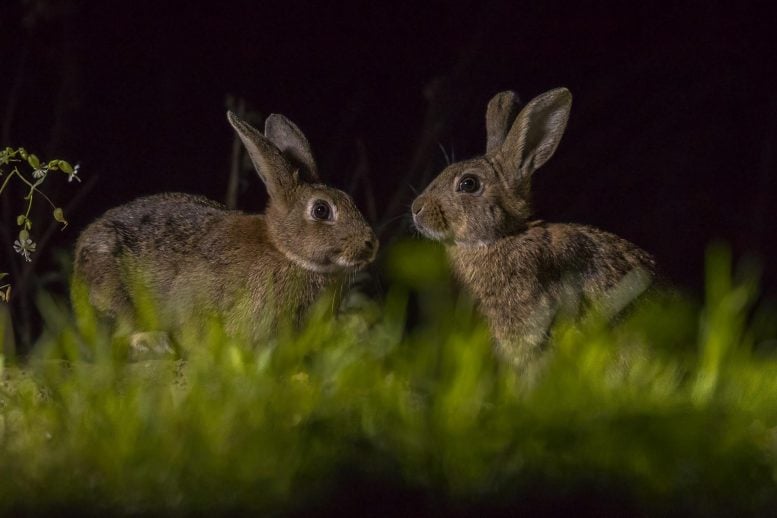
The rabbit invasion in Australia began in 1859 with one introduction of wild rabbits, whose genetic traits allowed them to spread quickly across the continent, causing ongoing ecological and economic damage.
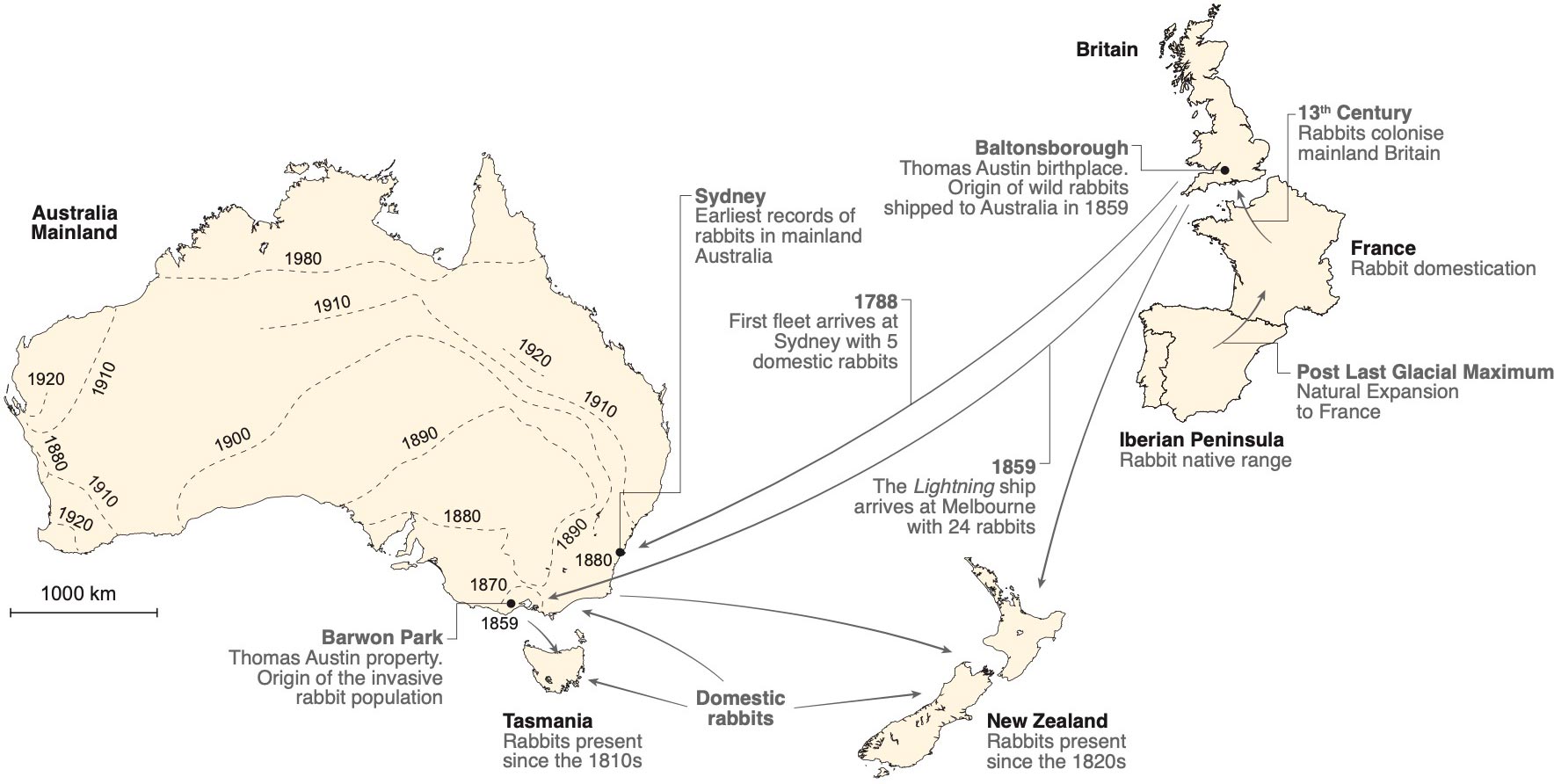
Rabbits were first introduced to mainland Australia in 1788 when five domestic animals were brought to Sydney on the First Fleet. At least 90 subsequent importations would be made before 1859, but none of these populations became invasive. However, within 50 years, at a rate of 100 km (62 miles) per year, rabbits would spread across the entire continent. This makes it the fastest colonization rate for an introduced mammal ever recorded. So what changed after 1859 and how did the invasion begin?
Historians and the Australian public have long assumed that the country’s ‘rabbit plague’ began at Barwon Park, the estate of Thomas Austin, near Geelong in Victoria. In a study published today in the Proceedings of the National Academy of Sciences, an international team of researchers led by the University of Cambridge and CIBIO Institute in Portugal finally provides genetic proof for this version of events. It also settles a debate about whether the invasion arose from a single or several independent introductions.
On October 6th, 1859, Austin’s brother, William, sent a consignment of wild rabbits – caught on the family’s land in Baltonsborough in Somerset – together with some domestic rabbits, on the ship Lightning. On Christmas Day, 24 rabbits arrived in Melbourne and were dispatched to Barwon Park. Within three years, ‘Austin rabbits’ had multiplied into thousands, according to a local newspaper report and Austin himself.
Genetic Proof of a Single Origin
To establish where Australia’s invasive rabbits originated from, the researchers studied historical records alongside new genetic data collected from 187 ‘European rabbits’ – mostly wild-caught across Australia, Tasmania, New Zealand, Britain, and France between 1865 and 2018. They wanted to determine whether the invasion arose from a single or multiple introductions; how they spread across the country; and whether there was a genetic explanation for their success compared to that of other imported rabbit populations.
Recent studies disputed the single-origin hypothesis, instead arguing that invasive rabbits arose from several independent introductions. However, they did not sample ancestral European and domestic populations, which was necessary to disentangle the source of Australia’s rabbits. Lead author, Dr. Joel Alves, who is currently a researcher at the University of Oxford and CIBIO Institute said:
“We managed to trace the ancestry of Australia’s invasive population right back to the South-West of England, where Austin’s family collected the rabbits in 1859.
“Our findings show that despite the numerous introductions across Australia, it was a single batch of English rabbits that triggered this devastating biological invasion, the effects of which are still being felt today.”
The Role of Genetics in Invasion Success
The scientists found that as the rabbits moved further away from Barwon Park, genetic diversity declined, and rare genetic variants which occur in rapidly growing populations became more frequent.
Despite the construction of rabbit-proof fences, the deliberate introduction of the myxoma virus, and other measures, rabbits remain one of the major invasive species in Australia threatening native flora and fauna. They cost the agricultural sector an estimated $200 million per year.
Previous studies have suggested that several factors contribute to biological invasions, including the number of individuals, the number of introductions, and environmental change. The new research findings suggest that the genetic composition of those animals can be just, if not more, influential.
The researchers point out that if the trigger for the invasion had been environmental change, such as the development of large pastoral areas by human settlers, then multiple local rabbit populations would likely have expanded. This possibility is undermined by the study’s genetic findings and the failure of pre-1859 rabbits to become invasive.
Instead, the team investigated the possibility that the arrival of specific genetic traits acted as the trigger for the invasion, something which would help to explain the overwhelming genetic evidence for a single introduction.
The rabbits introduced to Australia before 1859 were often described as displaying tameness, fancy coat colors, and floppy ears. These are traits associated with domestic breeds but are normally absent in wild animals. Austin’s rabbits were described as wild-caught at the time, and the new study’s genetic findings prove that at least some of these animals were indeed wild.
Senior author Professor Francis Jiggins from Cambridge’s Department of Genetics said:
“There are numerous traits that could make feral domestic rabbits poorly adapted to survive in the wild but it is possible that they lacked the genetic variation required to adapt to Australia’s arid and semi-arid climate.
“To cope with this, Australia’s rabbits have evolved changes in body shape to help control their temperature. So it is possible that Thomas Austin’s wild rabbits, and their offspring, had a genetic advantage when it came to adapting to these conditions.”
The Lasting Impact of the Rabbit Invasion
In the 20th century, Joan Palmer recalled that her grandfather William Austin had found it difficult to source the animals for Thomas “as wild rabbits were by no means common around Baltonsborough. It was only with great difficulty that he managed to get six; these were half-grown specimens taken from their nests and tamed. To make up the number he bought seven grey rabbits that the villagers had kept in hutches, either as pets or to eat”.
Alves and Jiggins found that the invasive rabbits descended from Austin’s imports contained a substantial element of domestic ancestry which they argue supports Joan Palmer’s claim that wild and domestic rabbits in the shipment bred before or during their 80-day journey, which would explain why more rabbits arrived than were sent.
Dr. Alves said: “These findings matter because biological invasions are a major threat to global biodiversity and if you want to prevent them you need to understand what makes them succeed.”
“Environmental change may have made Australia vulnerable to invasion, but it was the genetic makeup of a small batch of wild rabbits that ignited one of the most iconic biological invasions of all time.”
“This serves as a reminder that the actions of just one person, or a few people, can have a devastating environmental impact.”
Reference: “A single introduction of wild rabbits triggered the biological invasion of Australia” by Joel M. Alves, Miguel Carneiro, Jonathan P. Day, John J. Welch, Janine A. Duckworth, Tarnya E. Cox, Mike Letnic, Tanja Strive, Nuno Ferrand and Francis M. Jiggins, 22 August 2022, Proceedings of the National Academy of Sciences.
DOI: 10.1073/pnas.2122734119
Never miss a breakthrough: Join the SciTechDaily newsletter.
Follow us on Google and Google News.
2 Comments
I am pretty sure that many animal/plant species were migrating around, even long before humans!
Which animal/plant species allowed to live where is NOT up to humans to decide!
If any new species causing serious problems then the solution is restore the local balance, by finding & bringing-in best possible natural enemies!
It is definitely not, endlessly keep trying to kill new species by using poison chemicals or traps etc & keep wasting massive amounts of taxpayer money, for only temporary improvements!
Pesky wabbits!