
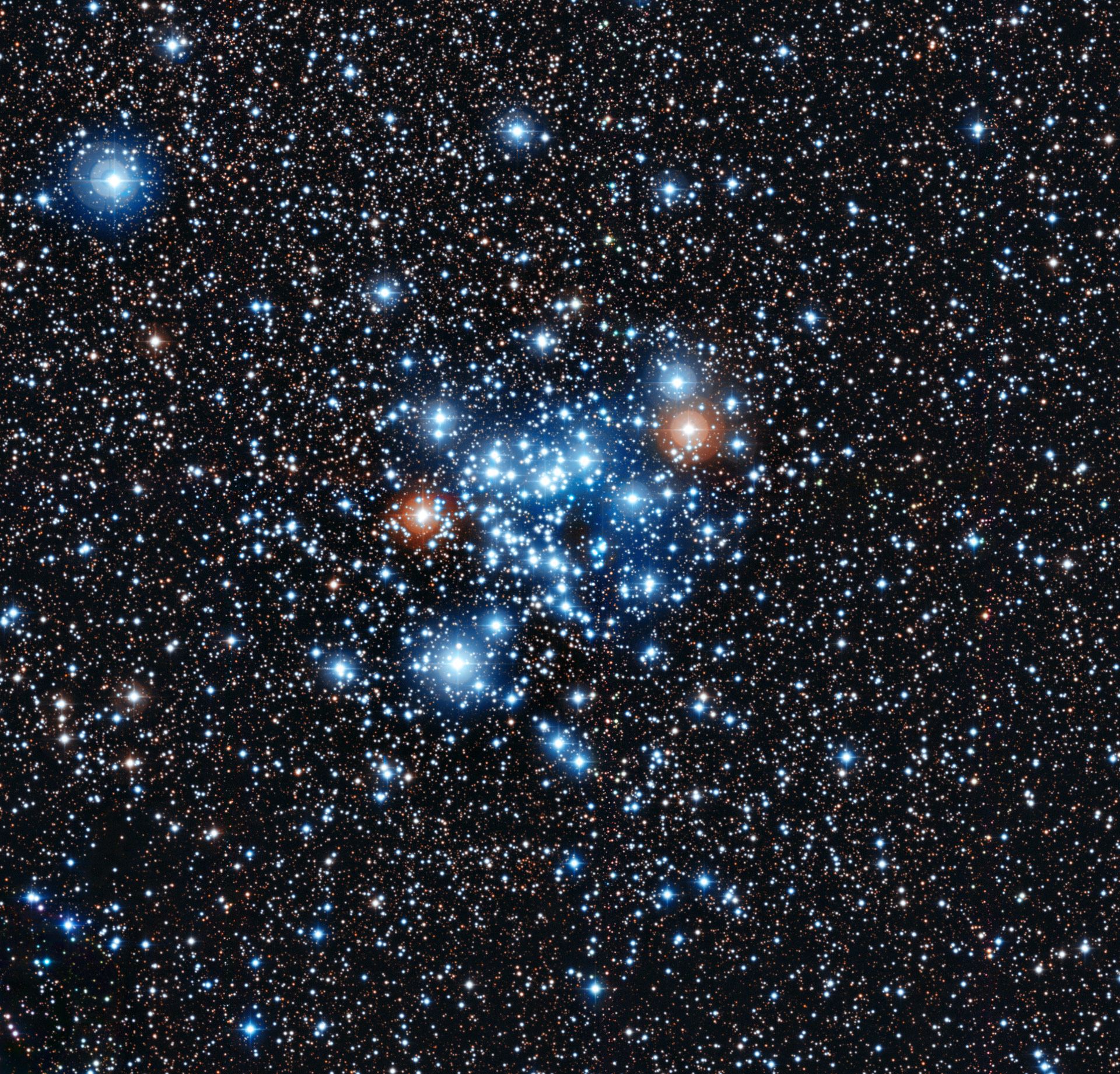
A newly published study details the discovery of a new type of variable star in the open cluster NGC 3766, which lies about 7,000 light-years from Earth in the southern constellation of Centaurus.
Astronomers using the Swiss 1.2-meter Euler telescope at ESO’s La Silla Observatory in Chile have found a new type of variable star. The discovery was based on the detection of very tiny changes in the brightness of stars in a cluster. The observations revealed previously unknown properties of these stars that defy current theories and raise questions about the origin of the variations.
The Swiss are justly famed for their craftsmanship when creating extremely precise pieces of technology. Now a Swiss team from the Geneva Observatory has achieved extraordinary precision using a comparatively small 1.2-meter telescope for an observing program stretching over many years. They have discovered a new class of variable stars by measuring minute variations in stellar brightness.
The new results are based on regular measurements of the brightness of more than three thousand stars in the open star cluster NGC 3766 [1] over a period of seven years. They reveal how 36 of the cluster’s stars followed an unexpected pattern — they had tiny regular variations in their brightness at the level of 0.1% of the stars’ normal brightness. These variations had periods between about two and 20 hours. The stars are somewhat hotter and brighter than the Sun, but otherwise apparently unremarkable. The new class of variable stars is yet to be given a name.
This level of precision in the measurements is twice as good as that achieved by comparable studies from other telescopes — and sufficient to reveal these tiny variations for the first time.
“We have reached this level of sensitivity thanks to the high quality of the observations, combined with a very careful analysis of the data,” says Nami Mowlavi, leader of the research team, “but also because we have carried out an extensive observation program that lasted for seven years. It probably wouldn’t have been possible to get so much observing time on a bigger telescope.”
This pan video gives a close-up look at a spectacular group of young stars — the open star cluster NGC 3766 in the constellation of Centaurus (The Centaur). Very careful observations of these stars by a group from the Geneva Observatory using the Swiss 1.2-meter Leonhard Euler Telescope at ESO’s La Silla Observatory in Chile have shown that 36 of the stars are members of a new and unknown class of variable star. Credit:ESO Music: movetwo
Many stars are known as variable or pulsating stars, because their apparent brightness changes over time. How the brightness of these stars changes depends in complex ways on the properties of their interiors. This phenomenon has allowed the development of a whole branch of astrophysics called asteroseismology, where astronomers can “listen” to these stellar vibrations, in order to probe the physical properties of the stars and get to know more about their inner workings.
“The very existence of this new class of variable stars is a challenge to astrophysicists,” says Sophie Saesen, another team member. “Current theoretical models predict that their light is not supposed to vary periodically at all, so our current efforts are focused on finding out more about the behavior of this strange new type of star.”
Although the cause of the variability remains unknown, there is a tantalizing clue: some of the stars seem to be fast rotators. They spin at speeds that are more than half of their critical velocity, which is the threshold where stars become unstable and throw off material into space.
“In those conditions, the fast spin will have an important impact on their internal properties, but we are not able yet to adequately model their light variations,” explains Mowlavi. “We hope our discovery will encourage specialists to address the issue in the hope of understanding the origin of these mysterious variations.”
Notes
[1] This star cluster is one of several included in this major monitoring program. NGC 3766 lies about 7,000 light-years from Earth in the southern constellation of Centaurus (The Centaur) and is estimated to be about 20 million years old.
Reference: “Stellar variability in open clusters – I. A new class of variable stars in NGC 3766” by N. Mowlavi, F. Barblan, S. Saesen and L. Eyer, 12 June 2013, Astronomy & Astrophysics.
DOI: 10.1051/0004-6361/201321065
arXiv:1304.5266
Never miss a breakthrough: Join the SciTechDaily newsletter.
Follow us on Google and Google News.