
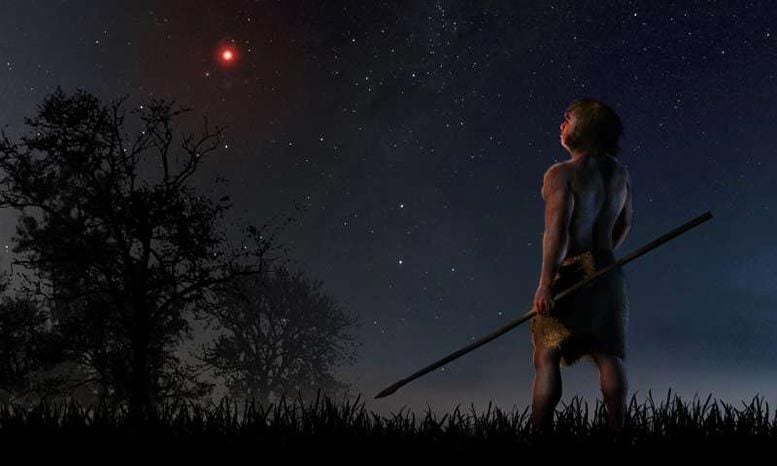
About 70,000 years ago, when the human species was already on Earth, a small reddish star approached our solar system and gravitationally disturbed comets and asteroids. Astronomers from the Complutense University of Madrid and the University of Cambridge have verified that the movement of some of these objects is still marked by that stellar encounter.
At a time when modern humans were beginning to leave Africa and the Neanderthals were living on our planet, Scholz’s star – named after the German astronomer who discovered it – approached less than a light-year from the Sun. Nowadays it is almost 20 light-years away, but 70,000 years ago it entered the Oort cloud, a reservoir of trans-Neptunian objects located at the confines of the solar system.
This discovery was made public in 2015 by a team of astronomers led by Professor Eric Mamajek of the University of Rochester (USA). The details of that stellar flyby, the closest documented so far, were presented in The Astrophysical Journal Letters.
Now two astronomers from the Complutense University of Madrid (Spain), the brothers Carlos and Raúl de la Fuente Marcos, together with the researcher Sverre J. Aarseth of the University of Cambridge (United Kingdom), have analyzed for the first time the nearly 340 objects of the solar system with hyperbolic orbits (very open V-shaped, not the typical elliptical), and in doing so they have detected that the trajectory of some of them is influenced by the passage of Scholz´s star.
“Using numerical simulations we have calculated the radiants or positions in the sky from which all these hyperbolic objects seem to come,” explains Carlos de la Fuente Marcos, who together with the other coauthors publishes the results in the MNRAS Letters journal.
“In principle,” he adds, “one would expect those positions to be evenly distributed in the sky, particularly if these objects come from the Oort cloud; however, what we find is very different: a statistically significant accumulation of radiants. The pronounced over-density appears projected in the direction of the constellation of Gemini, which fits the close encounter with Scholz´s star.”
The moment in which this star passed close to us and its position during prehistory coincide with the data of the new investigation and in those of Mamajek and his team. “It could be a coincidence, but it is unlikely that both location and time are compatible,” says De la Fuente Marcos, who points out that their simulations suggest that Scholz´s star approached even more than the 0.6 light-years pointed out in the 2015 study as the lower limit.
The close fly-by of this star 70,000 years ago did not disturb all the hyperbolic objects of the solar system, only those that were closest to it at that time. “For example, the radiant of the famous interstellar asteroid` Oumuamua is in the constellation of Lyra (the Harp), very far from Gemini, therefore it is not part of the detected over-density, “says De la Fuente Marcos. He is confident that new studies and observations will confirm the idea that a star passed close to us in a relatively recent period.
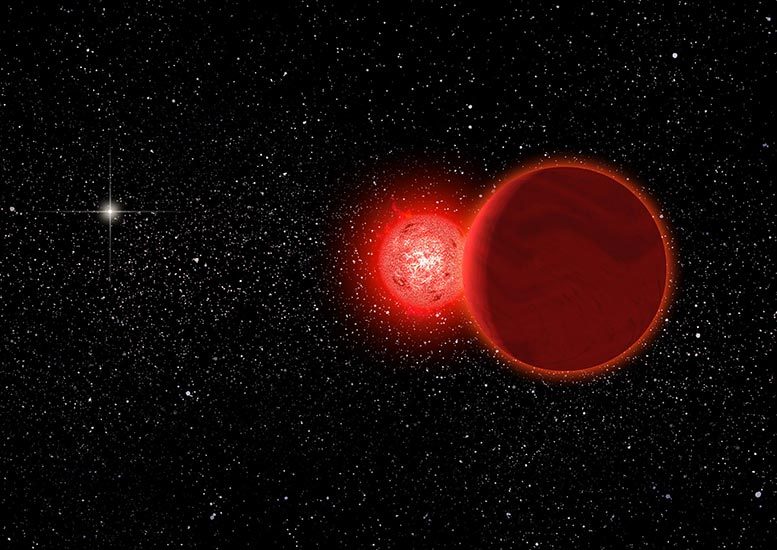
Scholz´s star is actually a binary system formed by a small red dwarf, with about 9% of the mass of the Sun, around which a much less bright and smaller brown dwarf orbits. It is likely that our ancestors saw its faint reddish light in the nights of prehistory.
References: “Where the Solar system meets the solar neighbourhood: patterns in the distribution of radiants of observed hyperbolic minor bodies” by C. de la Fuente Marcos, R. de la Fuente Marcos and S. J. Aarseth, 6 February 2018, MNRAS Letters
DOI: 10.1093/mnrasl/sly019
http://adsabs.harvard.edu/abs/2018MNRAS.476L…1D
Never miss a breakthrough: Join the SciTechDaily newsletter.
Follow us on Google and Google News.
3 Comments
Has anyone considered that black holes are simply an egress of mass, light, and energy from our expanding universe, which, once passed through those regions of great compression, are released into alternate universes, in the same expanding manner as our own universe seems to be created?
Might there be a whole series of interactive universes created by the expanding mass, light, & energy entering and emerging from the portals that we see as black holes, into which our universe may be feeding many other, alternate universes, which, in turn, feed others? Perhaps the great gravitational forces preclude that we have to develop a different wavelength of receiver to perceive these alter-universes, or that perhaps we have to better understand our own, before we can look upon others.
I enjoy scitechdaily.com newsletters greatly, and see science, not superstition, as the saving grace of our species. I hope that we may see beyond the narrow aperture of viewpoints based on the dogma of established religion, to free the inquiring nature of our species so that we may solve the social, economic,and environmental problems that we drag along with our development, limiting our ability to see real solutions for these problems we carry with us. Within the curiosity that is the trademark of the free human mind lies the answers that we need to create a sustainable world, where we see each other not as enemies, but just as a part of the same wonderful phenomenon that we all share in our brief moment in time, the wonder of life! It is within this perception that our true nature lies, and it is with an alignment of each and every inquiring mind on this planet (like the network of computers in Sagan’s SETI program) that we may find the answers we need to create a “Heaven” on Earth, rather than a slagheap!
Imagine a network of 7.5 Billion minds, working together to surmount the problems we face. I am sure that solutions to all our problems have already been imagined, again and again, and when we move beyond seeing life as a vehicle for doing nothing but procuring individual wealth, but more as a vehicle to be used for adding to the legacy of human knowledge, our species will be liberated, and united, and war will cease. It is really up to us, and as we are approaching an era of the greatest communications, planet-wide, as (perhaps) there has ever been in human history as we know it, we have the best chance ever of sharing ideas and finding new ways to move forward, without dragging the same old problems along with us.
What a time to be alive! Perhaps if every one of us would devote a small amount of time to imagine a way to make things just a little bit better, in our own communities, patterns might at the global level, to be shared throughout the network. I loved the ideas put forth in the movie “Pay It Forward”, where people looked for ways to help each other out (favors), and instead of taking payment from the person whom they helped, asked of that person to do 2 things for someone else as payment for the ‘favor’ that was done to them. Personally, I feel that “one” would be enough, but the overall effect was that society was greatly improved by the “Pay it Forward” plan, as people helped each other out, instead of trying to only compete with their fellow humans. I wonder how that would work on an international level?
Imagine!
“patterns might APPEAR at the global level” 2nd sentence paragraph 4
I would appreciate someone editing that for me! Thanks!
KS
“Pay It Forward” correction: Person receiving favor does 1 thing for 2 others.
I would appreciate someone editing that as well! Thanks again!