
Close Menu
    Facebook X (Twitter) Instagram
    SciTechDaily
    • Biology
    • Chemistry
    • Earth
    • Health
    • Physics
    • Science
    • Space
    • Technology
    Facebook X (Twitter) Pinterest YouTube RSS
    SciTechDaily
    Home»Space»Hubble Image of the Week – Lenticular Galaxy NGC 1277
    Space

    Hubble Image of the Week – Lenticular Galaxy NGC 1277

    By M. Beasley (Instituto de Astrofísica de Canarias), and P. Kehusmaa; NASA, ESAMarch 22, 2018No Comments2 Mins Read
    Facebook Twitter Pinterest Telegram LinkedIn WhatsApp Email Reddit
    Share
    Facebook Twitter LinkedIn Pinterest Telegram Email Reddit
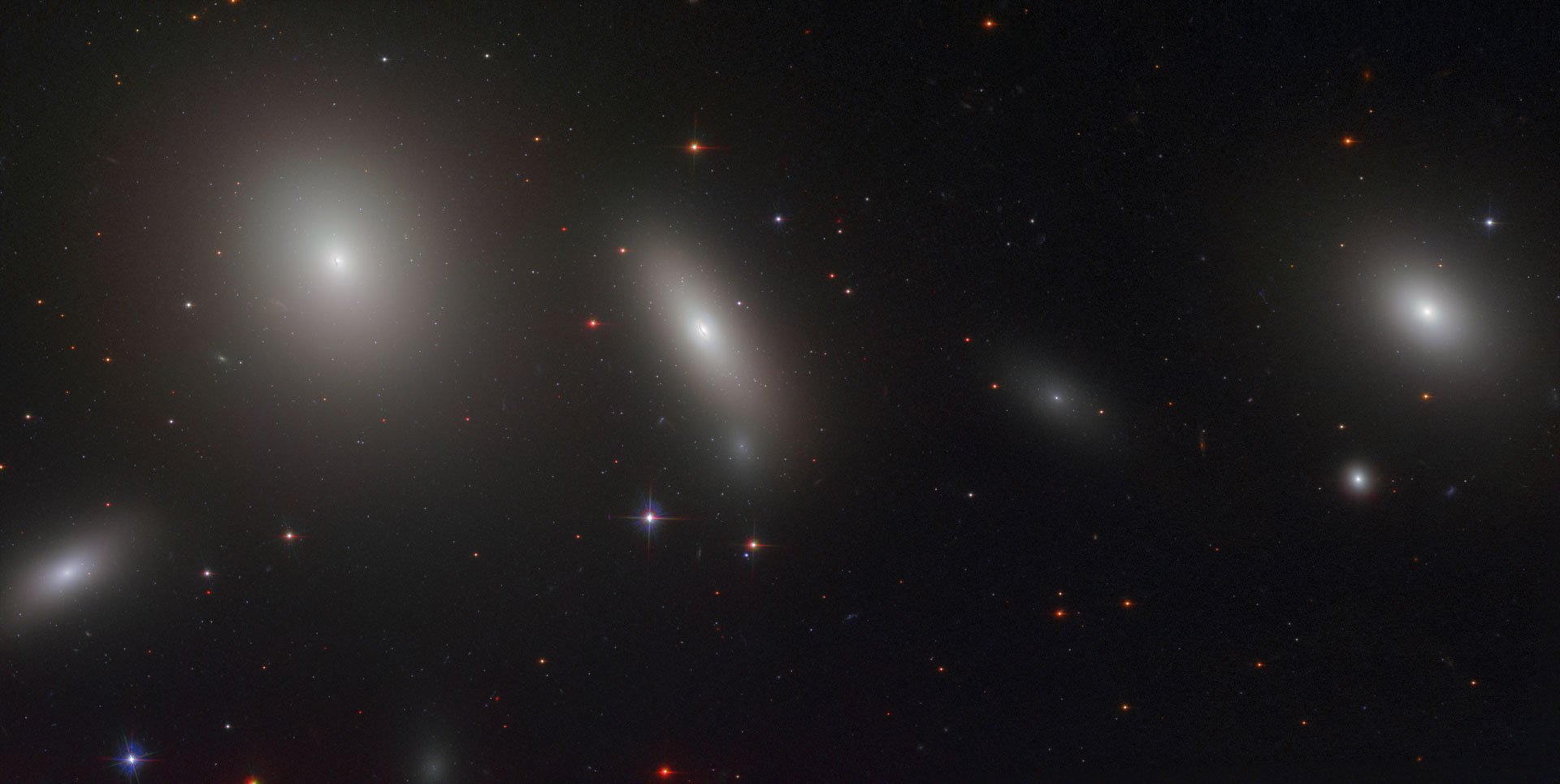
    Hubble Views Lenticular Galaxy NGC 1277
    Lenticular Galaxy NGC 1277. Credit: NASA, ESA, and M. Beasley

    This idyllic scene, packed with glowing galaxies, has something truly remarkable at its core: an untouched relic of the ancient Universe. This relic can be seen in the large galaxy at the center of the frame, a lenticular galaxy named NGC 1277. This galaxy is a member of the famous Perseus Cluster — one of the most massive objects in the known Universe, located some 220 million light-years from Earth.

    NGC 1277 has been dubbed a “relic of the early Universe” because all of its stars appear to have formed about 12 billion years ago. To put this in perspective, the Big Bang is thought to have happened 13.8 billion years ago. Teeming with billions of old, metal-rich stars, this galaxy is also home to many ancient globular clusters: spherical bundles of stars that orbit a galaxy like satellites. Uniquely, the globular clusters of NGC 1277 are mostly red and metal-rich — very different to the blue, metal-poor clusters usually seen around similarly-sized galaxies. In astronomy, a metal is any element heavier than hydrogen and helium; these heavier elements are fused together in the hot cores of massive stars and scattered throughout the Universe when these stars explode as they die. In this way, a star’s metal content is related to its age: stars that form later contain greater amounts of metal-rich material, since previous generations of stars have enriched the cosmos from which they are born.

    Massive galaxies — and their globular clusters — are thought to form in two phases: first comes an early collapse accompanied by a giant burst of star formation, which forms red, metal-rich clusters, followed by a later accumulation of material, which brings in bluer, metal-poor material. The discovery of NGC 1277’s red clusters confirms that the galaxy is a genuine antique that bypassed this second phase, raising important questions for scientists on how galaxies form and evolve: a hotly debated topic in modern astronomy.

    Reference: “Identification of the primordial globular cluster system of a massive relic galaxy” by Michael A. Beasley, Ignacio Trujillo, Ryan Leaman and Mireia Montes, 12 March 2018, Nature.
    DOI: 10.1038/nature25756

    Never miss a breakthrough: Join the SciTechDaily newsletter.
    Follow us on Google and Google News.

    Astronomy Hubble Space Telescope
    Share. Facebook Twitter Pinterest LinkedIn Email Reddit

    Related Articles

    A Morphing Spiral Galaxy Amongst Friends

    Hubble Views Magnificent Lopsided Galaxy NGC 2276

    Hubble Captures Fantastic Detail of Eponymous Spiral Galaxy NGC 691

    Spectacular Image Captured by Hubble Shows a Strangely Contorted Spiral Galaxy

    A Distant Spiral in Virgo: Extraordinary Detail Seen in a Galaxy 150 Million Light-Years Away From Earth

    Magnetic Monsters: Hubble Tracks Down Location of Mysterious Radio Signals From Intergalactic Space

    A Menagerie of Galaxies: Hubble Captures a Cluster With Galaxies of All Shapes and Sizes

    How Habitable Are Planets That Orbit Red Dwarfs – The Most Common Type of Stars in the Galaxy?

    Cosmic Silver Lining: Hubble Spots V565 Surrounded by Four Prominent Diffraction Spikes

    Leave A Reply Cancel Reply

    • Facebook
    • Twitter
    • Pinterest
    • YouTube

    Don't Miss a Discovery

    Subscribe for the Latest in Science & Tech!

    Trending News

    Scientists Warn That This Common Pet Fish Can Wreck Entire Ecosystems

    Scientists Make Breakthrough in Turning Plastic Trash Into Clean Fuel Using Sunlight

    This Popular Supplement May Interfere With Cancer Treatment, Scientists Warn

    Scientists Finally Solved One of Water’s Biggest Mysteries

    Could This New Weight-Loss Pill Disrupt the Entire Market? Here’s What You Should Know About Orforglipron

    Earth’s Crust Is Tearing Open in Africa, and It Could Form a New Ocean

    Breakthrough Bowel Cancer Trial Leaves Patients Cancer-Free for Nearly 3 Years

    Natural Compound Shows Powerful Potential Against Rheumatoid Arthritis

    Follow SciTechDaily
    • Facebook
    • Twitter
    • YouTube
    • Pinterest
    • Newsletter
    • RSS
    SciTech News
    • Biology News
    • Chemistry News
    • Earth News
    • Health News
    • Physics News
    • Science News
    • Space News
    • Technology News
    Recent Posts
    • The Most Effective Knee Arthritis Treatments Aren’t What You Expect
    • Scientists Develop Bioengineered Chewing Gum That Could Help Fight Oral Cancer
    • Popular Weight-Loss Drugs Found To Cut Heart Attack and Stroke Risk
    • After 37 Years, the World’s Longest-Running Soil Warming Experiment Uncovers a Startling Climate Secret
    • NASA Satellite Captures First-Ever High-Res View of Massive Pacific Tsunami
    Copyright © 1998 - 2026 SciTechDaily. All Rights Reserved.
    • Science News
    • About
    • Contact
    • Editorial Board
    • Privacy Policy
    • Terms of Use

    Type above and press Enter to search. Press Esc to cancel.