
Close Menu
    Facebook X (Twitter) Instagram
    SciTechDaily
    • Biology
    • Chemistry
    • Earth
    • Health
    • Physics
    • Science
    • Space
    • Technology
    Facebook X (Twitter) Pinterest YouTube RSS
    SciTechDaily
    Home»Space»Hubble Image of the Week – Lenticular Galaxy NGC 5308
    Space

    Hubble Image of the Week – Lenticular Galaxy NGC 5308

    By SciTechDailyMay 16, 2016No Comments2 Mins Read
    Facebook Twitter Pinterest Telegram LinkedIn WhatsApp Email Reddit
    Share
    Facebook Twitter LinkedIn Pinterest Telegram Email Reddit
    Hubble Views Lenticular Galaxy NGC 5308
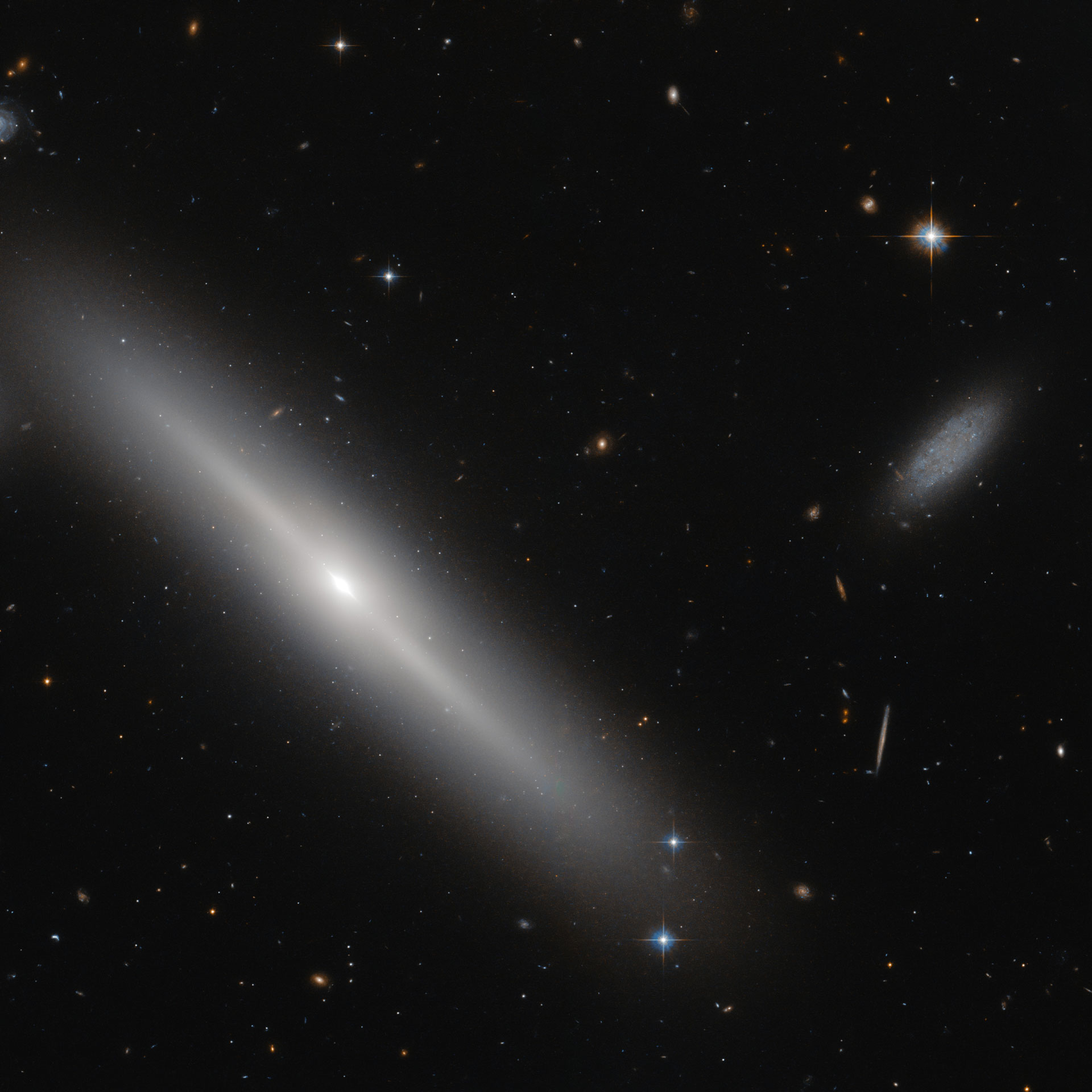
    Lenticular galaxy NGC 5308 is located roughly 100 million light-years away in the constellation of Ursa Major (The Great Bear). Credit: ESA/Hubble & NASA Acknowledgement: Judy Schmidt (Geckzilla)

    This newly released Hubble image shows lenticular galaxy NGC 5308, which is located roughly 100 million light-years away.

    This NASA/ESA Hubble Space Telescope image shows star clusters encircling a galaxy, like bees buzzing around a hive. The hive in question is the edge-on lenticular galaxy NGC 5308, located just under 100 million light-years away in the constellation of Ursa Major (The Great Bear).

    Members of a galaxy type that lies somewhere between an elliptical and a spiral galaxy, lenticular galaxies such as NGC 5308 are disc galaxies that have used up, or lost, the majority of their gas and dust. As a result, they experience very little ongoing star formation and consist mainly of old and aging stars. On 9 October 1996, one of NGC 5308’s aging stars met a dramatic demise, exploding as a spectacular Type la supernova.

    Lenticular galaxies are often orbited by gravitationally bound collections of hundreds of thousands of older stars. Called globular clusters, these dense collections of stars form a delicate halo as they orbit around the main body of NGC 5308, appearing as bright dots in the dark sky.

    The dim, irregular galaxy to the right of NGC 5308 is known, rather prosaically, as SDSS J134646.18+605911.9.


    Never miss a breakthrough: Join the SciTechDaily newsletter.
    Follow us on Google and Google News.

    Astronomy Hubble Space Telescope NASA
    Share. Facebook Twitter Pinterest LinkedIn Email Reddit

    Related Articles

    Hubble Reveals a Star Disk Three Times Hotter Than the Sun’s Surface

    A Star’s Unexpected Heatwave: FU Orionis Challenges Astrophysics Models

    NASA’s Hubble Reveals How the LMC Defied Galactic Destruction

    Legendary Star’s Smooth Disk Mystifies Astronomers, Challenges Planet Formation Theories

    Cosmic Horror Unveiled: NASA Reveals “Blood-Soaked Eyes” Staring From Deep Space [Video]

    Spanning 248 Billion Miles: Stunning Hubble Timelapse Captures a Star’s Violent Eruptions

    Jupiter’s Great Red Spot Enigma: Unexplained Oscillations Baffle Astronomers

    Unlocking Uranus: NASA’s Dual Observations Pave the Way to Discovering New Worlds

    Astronomers Baffled by Black Hole Jets Igniting Star Explosions

    Leave A Reply Cancel Reply

    • Facebook
    • Twitter
    • Pinterest
    • YouTube

    Don't Miss a Discovery

    Subscribe for the Latest in Science & Tech!

    Trending News

    Scientists May Have Discovered How To Heal Damaged Kidneys

    Interstellar Visitor 3I/ATLAS Is Bursting With an Unexpected Chemical

    Scientists Just Found All 5 Genetic “Letters” of DNA and RNA on an Asteroid

    The 4,000-Year-Old City That Defied History’s Rules on Wealth and Power

    The World’s Biggest Population Fear Has Flipped – and It Could Change Everything

    This “Fake” Pill Improved Memory and Physical Performance in Just 3 Weeks

    Scientists Say Frequent Ejaculation May Improve Sperm Quality and Fertility

    Scientists Have Found “The Heaven Sword” After Years of Looking

    Follow SciTechDaily
    • Facebook
    • Twitter
    • YouTube
    • Pinterest
    • Newsletter
    • RSS
    SciTech News
    • Biology News
    • Chemistry News
    • Earth News
    • Health News
    • Physics News
    • Science News
    • Space News
    • Technology News
    Recent Posts
    • Scientists Uncover a Previously Unknown Lineage of Ancient Marsupials
    • Critically Endangered Monkey Defies the Odds With New Baby After Surgery
    • 17-Million-Year-Old Ape Fossil in Egypt Could Change What We Know About Human Origins
    • NASA’s Orbiting Quantum Lab Pushes Deeper Into the Unknown
    • NASA’s James Webb Discovers Bizarre Salt Clouds on the Pink Planet
    Copyright © 1998 - 2026 SciTechDaily. All Rights Reserved.
    • Science News
    • About
    • Contact
    • Editorial Board
    • Privacy Policy
    • Terms of Use

    Type above and press Enter to search. Press Esc to cancel.