

Researchers precisely measured the proton’s size, resolving the proton radius puzzle and strengthening confidence in the Standard Model of particle physics.
Hydrogen is the simplest element in the universe and the first entry on the periodic table. Each hydrogen atom contains just one proton in its nucleus and one electron orbiting around it. Because of this simplicity, hydrogen has long served as an important testing ground for studying the fundamental forces and particles that shape the universe.
Yet one seemingly basic property of hydrogen has puzzled physicists for more than a decade: the exact size of its proton. Known as the proton radius puzzle, the debate centered on conflicting measurements of the proton’s radius.
Researchers at Colorado State University (CSU) now report an exceptionally precise measurement that appears to settle the issue. The results, highlighted in Physical Review Letters, strengthen confidence in the Standard Model of particle physics while providing a foundation for future research.
Precision Measurement Confirms Standard Model
Previous experiments produced conflicting answers. Measurements that used electrons suggested one proton radius, while studies using heavier particles indicated a slightly smaller value. The disagreement was comparable to measuring the same house with two reliable tools and getting different dimensions.
The inconsistency raised important questions. It suggested either that earlier experiments contained hidden sources of error or that physicists might need to revise some of the fundamental principles used to describe the universe.
The new CSU measurement places the proton’s radius at about 0.84 femtometers, compared with the previously accepted value of 0.876 femtometers. Although the difference is extremely small, it is significant for precision physics. An independent team at the Max Planck Institute reached a similar conclusion using a different technique, providing additional confidence that the long-running discrepancy has finally been resolved.
While the adjustment to the proton’s size is tiny, its implications are substantial for our understanding of matter and the laws governing the universe.
Laser Spectroscopy Reveals Proton Size
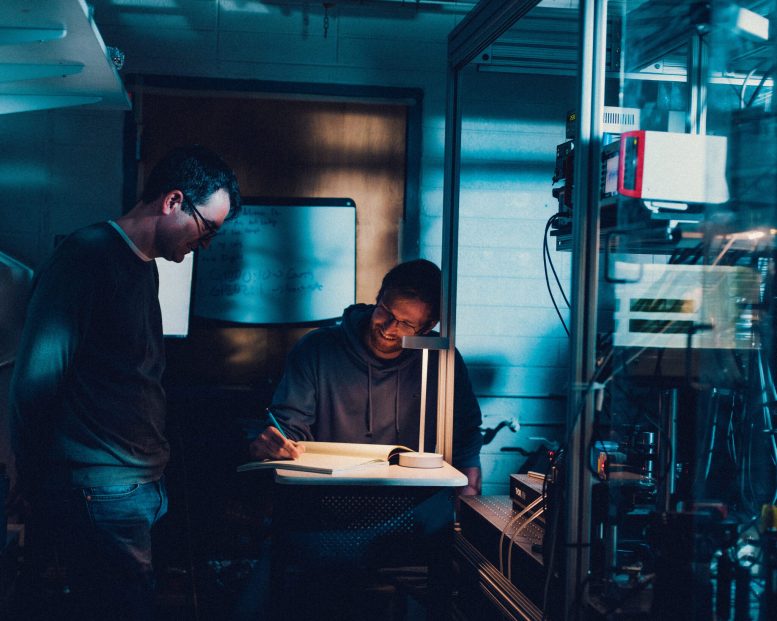
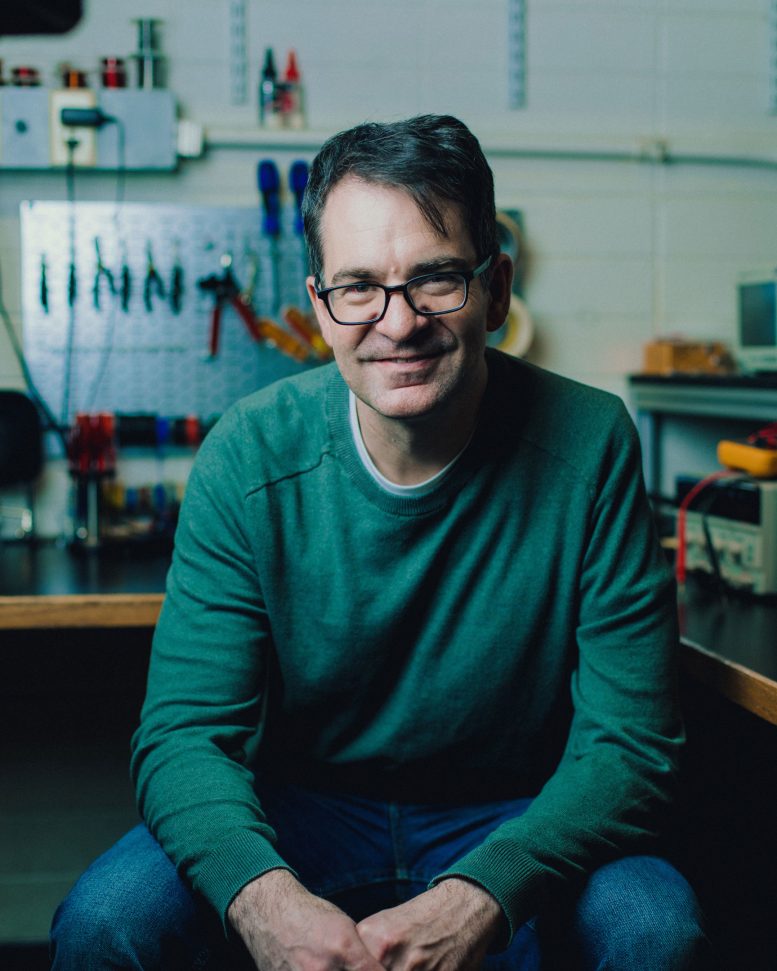
The project was led by Dylan Yost, an associate professor in CSU’s Department of Physics. According to Yost, the results align closely with predictions made by the Standard Model, which describes how particles such as electrons, muons, and protons interact. The findings also suggest that the earlier disagreement likely resulted from subtle measurement challenges or uncertainties in experimentally derived constants.
“Our test shows precise agreement with theory on the size of a proton to parts-per-trillion levels of accuracy, eliminating the possibility of a new force or particle being responsible for the discrepancy in this case. That would have significantly changed the Standard Model and is something researchers have been looking for,” he said. “That doesn’t seem to be the case in this instance, though.”
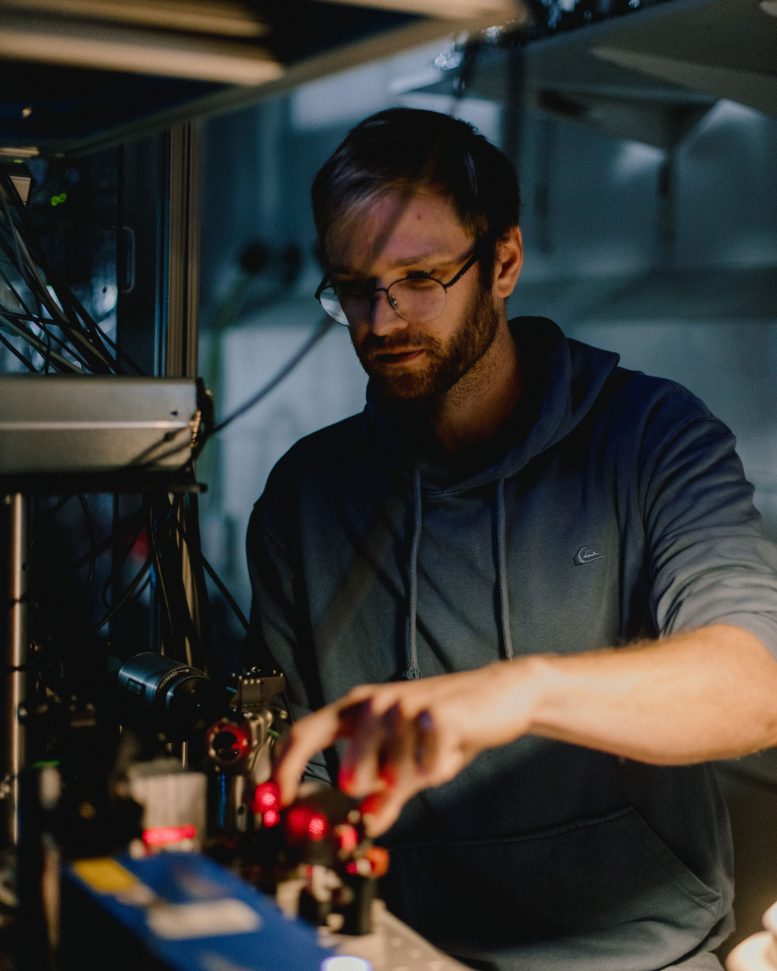
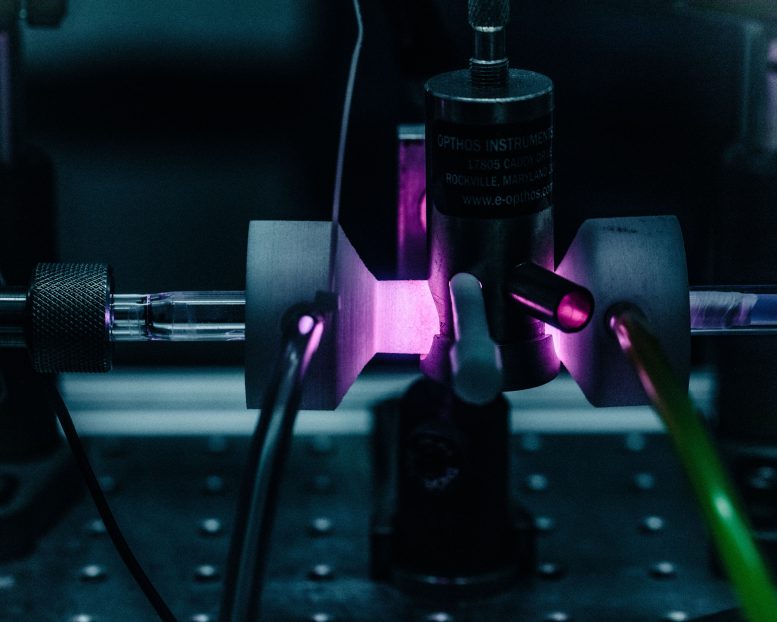
For several years, Yost’s group has been developing tabletop laser spectroscopy techniques capable of making highly precise measurements. In this experiment, the researchers created a beam of hydrogen atoms inside a vacuum chamber and used lasers to drive electrons between different energy states.
Because the proton’s size slightly influences electron behavior, the team could determine the proton’s radius by measuring how electrons responded during these laser-induced transitions. The experiment also provided a stringent test of quantum electrodynamics, the theory describing interactions between light and matter at the atomic scale.
New Laser Technique Boosts Accuracy
Ph.D. student Ryan Bullis, the paper’s lead author, said one of the biggest challenges was finding a way to examine these energy transitions with greater precision.
“These atoms move very fast and do not interact with the laser for long, which can wash out the signals that we are looking for,” he said. “We developed a new technique that uses two laser fields at the same time to increase the precision of our measurements.”
Bullis said it was especially rewarding to develop and successfully implement the new approach, which had not previously been used for this purpose, as part of his doctoral research.
Tabletop Experiments Complement Particle Colliders
Yost noted that the team’s compact experimental setup provided significant flexibility. Researchers could quickly modify equipment or shift priorities as new results emerged. He added that such experiments are particularly effective for searching for light, weakly interacting particles, whereas facilities such as the Large Hadron Collider are better suited to detecting heavier particles and stronger interactions.
Even so, Yost emphasized that both approaches play essential roles in advancing particle physics.
“The two approaches fill different needs. With our experiments, we can find and study fundamental physics without large particle accelerators. Our work is like a check-engine light coming on, telling the driver they need to investigate a potential problem,” he said. “Our work can tell you where to look or what is working, but you need both teams to continue to fully examine and probe the Standard Model in search of new physics.”
Next Steps: Studying Deuterium and Beyond
The researchers now plan to apply the same methods to more complex forms of hydrogen, including deuterium.
“We can set hydrogen aside for now because we can be satisfied that it behaves as it should. That allows us to look at other elements and interactions to be sure they are doing what we think they should be doing,” he said. “There is always a chance that future capabilities will allow us to be even more precise. But we are ready to dig back in and continue to bridge the gap between theory and experiment in the field of atomic, molecular, and optical physics.”
Reference: “Precision Spectroscopy of 2S-nS Transitions in Atomic Hydrogen: A Determination of the Proton Charge Radius” by R. G. Bullis, W. L. Tavis, M. R. Weiss, J. Orellana Cisneros, A. J. Cheeseman, U. D. Jentschura and D. C. Yost, 23 March 2026, Physical Review Letters.
DOI: 10.1103/lgl2-6cb8
Never miss a breakthrough: Join the SciTechDaily newsletter.
Follow us on Google and Google News.
1 Comment
You are ready to dig back in and continue to bridge the gap between theory and experiment in the field of atomic, molecular, and optical physics.
VERY GOOD.
Contemporary mainstream physics is mired in the quagmire of presupposed background spacetime and point particles, from which a proliferation of unfalsifiable ad hoc constructs has arisen, constituting a systemic crisis. As empirical evidence continues to accumulate, Topological Vortex Theory (TVT) will eventually sweep away the mists of the old paradigm and open a path for science that returns to reality and remains faithful to nature.
—— Excerpted from https://zhuanlan.zhihu.com/p/2053472553096816108.