
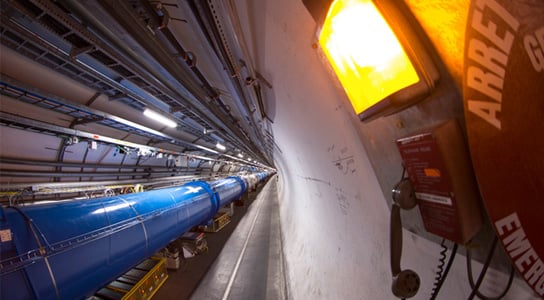
As the Large Hadron Collider has been unable to find any of the particles suggested by supersymmetry, theoretical particle physicists are trying to change their worldview, away from supersymmetry to theories that could explain the results.
So far, there have been no hints beyond the Standard Model of Particle Physics from the LHC. A recent conference in Kyoto, Japan, ruled out another broad class of supersymmetry models, finding nothing unexpected in the rates of particle decays.
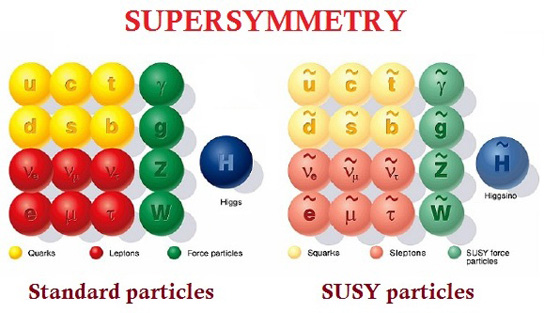
Many SUSY proponents are left to consider new theories. In the past 20 to 30 years, SUSY has been used abundantly and it’s hard to come to grips with its failure, which will have major implications in the field.
SUSY is intriguing because it predicts the existence of particles that could constitute dark matter, which permeates the outskirts of galaxies and cosmic filaments. It unifies the three fundamental forces at high energies and one of the biggest reasons for studying SUSY is that it solves the hierarchy problem.
This problem arises from the disparity between gravity and the weak nuclear force. Particles carrying the weak forces, W and Z bosons, derive their masses from the Higgs field saturating all space. It’s unclear why the energy of the Higgs field, and therefore the masses of the W and Z bosons, isn’t greater. Because other particles are intertwined with the Higgs field, their energies should spill into it during events known as quantum fluctuations. This should drive up the energy of the Higgs field, making W and Z bosons more massive and rendering the weak nuclear force as weak as gravity.
SUSY solves this problem by theorizing the existence of a superpartner for each elementary particle. Fermions may have superpartners that are bosons and existing bosons have fermion superpartners. Since particles and their superpartners are of opposite types, their energy contribution to the Higgs field has opposite signs. The pair’s contributions are canceled out, resulting in no effect on the Higgs field. One of the undiscovered superpartners could make up dark matter.
As superpartners have failed to materialize, SUSY has become less beautiful. In order to evade detection, the mainstream models state that superpartner particles would have to be much heavier than their twins, skewing the symmetry.
It was thought in the 1980s that superpartners would be only slightly heavier than the known particles, but the Tevatron, the retired particle acceleration at Fermilab, in Batavia, Illinois, found no such evidence. The LHC at CERN, Geneva, probes at increasingly higher energies without any evidence of SUSY. The remaining SUSY theories predict superpartners so heavy that they would overpower the effects of their lighter twins, if it weren’t for the fine-tuned cancellations between various superpartners. However, the introduction of fine-tuning in order to scale back the damage and to solve the hierarchy problem makes some physicists uncomfortable. This is probably one of the reasons why scientists should reexamine why SUSY was first introduced and try to come up with new models that will go beyond the Standard Model.
Never miss a breakthrough: Join the SciTechDaily newsletter.
Follow us on Google and Google News.
5 Comments
On dirait qu’on est arrivés dans une impasse. Pourquoi ne pas envisager des pistes nouvelles et inconnues? La théorie des frères Bogdanov est refusée avec brutalité, mais n’y a t-il pas des idées qu’on peut faire germer (temps imaginaire à l’instant zéro…)?
If SUSY’s beauty is ignored, other non-compatible theories will show up. We should not forget the Nobel Laurette’s explanations a few years back the reason for non-existence of anti-matter world altogether owing to the cancellations of all the matter and anti-matter particles from the decay of third generation of matter like top and bottom quarks, thereby leaving a small residue of real positive matter only in excess to construct the whole Universe. The same theory could be extended to the LHC’s non-detection of any real super particles isn’t it? Thank You.
susy and string are ether of this century and will delete by new model in physics
unification of gravity and electromagnetism,journal of physical science and application is the new physics which we are seeking for
Unified Field Theory doctor John Burton Hawke scholarship Geeomg Grammar School Mebourne Vic Australia Experiment Theory 13 yrs to compete TAKEN USA 1978 ADELAIDE UNIVERSITY 7 YRS FATHER CHEMIST,HAD OWN LABORATORY AS A CHILD RADIO ELECTRCAL STUDIES WHEN AT ADELAIDE UNIVERSTY AP 200 OF EXPERIMENTS 2OO THEORY QUANTUM PARTICES MATTER PARTICLES.LORRAINE D HAWKE