

Early metabolism may have begun as a mix of metal and enzyme catalysis before bacteria and archaea independently evolved into free-living cells.
Four billion years ago, the chemistry that eventually became life may have been unfolding around hydrothermal vents, where naturally occurring metals helped drive reactions before cells possessed the full machinery they use today. Researchers at Heinrich Heine University Düsseldorf (HHU) and collaborating institutions have reconstructed part of that transition, tracing how metabolism and enzymes changed as the ancestors of bacteria and archaea began to diverge.
The study, published in Science Advances, examined the chemical network early cells used to produce essential components of life and investigated how those reactions could have been powered. The researchers conclude that the transition to free-living bacteria and archaea may have occurred independently, even though both lineages share the same underlying genetic code.
“If we could go back 4 billion years in time and watch as the first cells emerged on Earth, what would we see? “We would see two very different kinds of cells emerging, pioneer bacteria and pioneer archaea, making their first attempts at life outside the confines of a hydrothermal vent,” says Natalia Mrnjavac, biologist at the University of Düsseldorf and lead author on the new publication in Science Advances.
Mrnjavac and colleagues compared genomes, protein structures, and chemical reactions to investigate an exceptionally early stage of microbial evolution, before free-living cells had appeared.
“These comparisons are giving us unprecedented insights into the phase of evolution when metabolism catalyzed by enzymes was arising from spontaneous reactions catalyzed by metals in the Earth’s crust,” says Düsseldorf biologist William Martin, senior author of the study.
Rather than focusing on individual genes or enzymes, the researchers examined the entire collection of reactions cells use to build amino acids, RNA bases, and vitamins from substances that were available on the early Earth (hydrogen gas, ammonia, and CO2). This network contains 420 reactions and is known as metabolism. The reactions themselves are conserved across life to a degree comparable with the genetic code.
Early metabolism did not require enzymes alone
Martin: “The surprise is that the enzymes that catalyze those reactions are not conserved across the evolutionary divide that separates bacteria and archaea. We found that the last universal ancestor of all cells, LUCA, possessed enzymes for only about half of the reactions of metabolism. The other half was catalyzed by metals in the environment where LUCA arose.”
That result suggests that early metabolism may have depended directly on the chemistry of its surroundings. Metals present naturally around hydrothermal vents could have performed functions later taken over by biological catalysts.
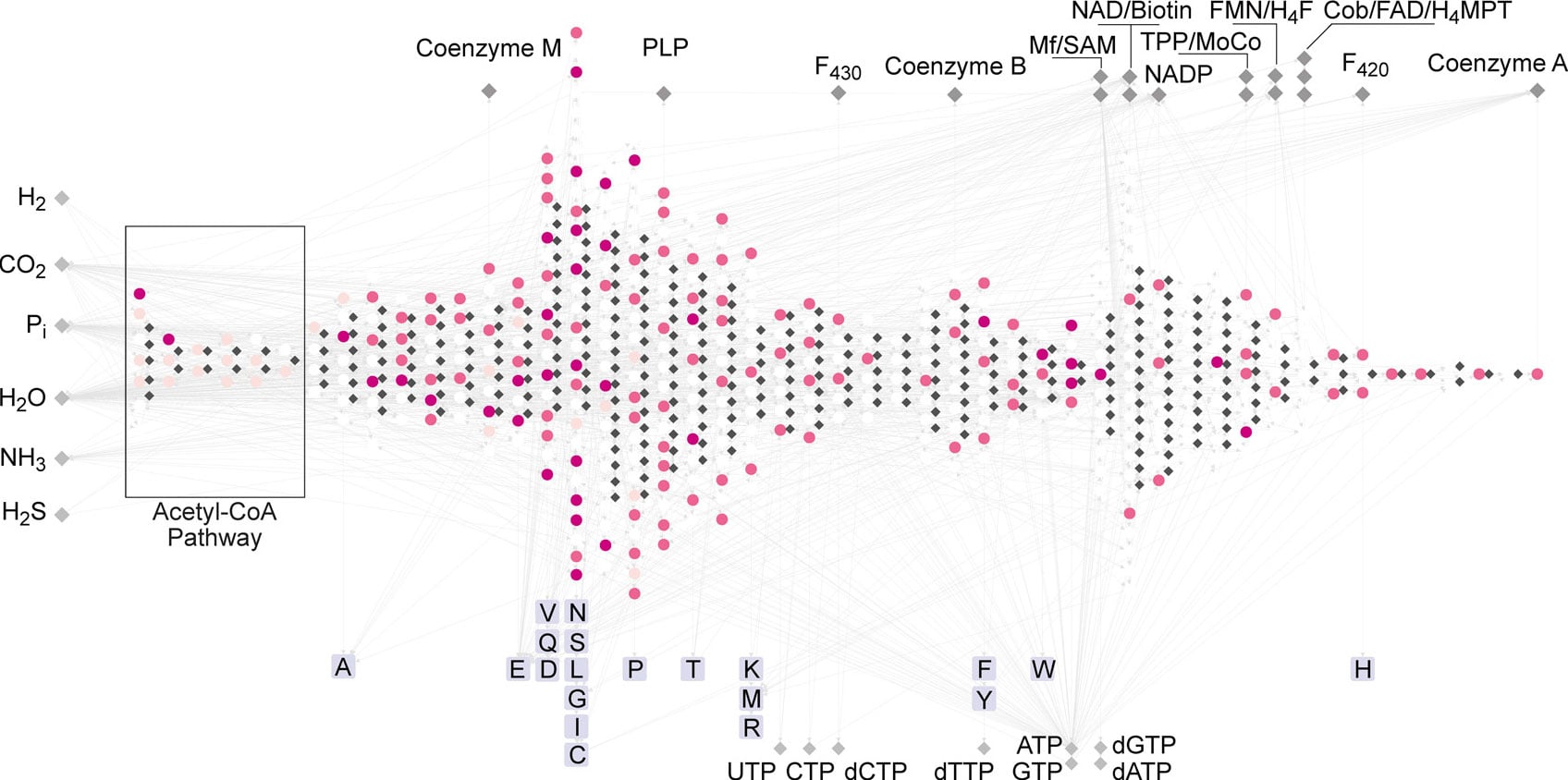
“Metals that naturally occur in hydrothermal vents can replace a surprisingly large number of enzymes in metabolism,” says Harun Tüysüz, inorganic chemist from the Max-Planck-Institut für Kohlenforschung and the IMDEA Materials Institute in Madrid, and co-author on the study.
“The closer we look, the more clearly we can see that early biochemical evolution was a hybrid of enzymatic and metal catalysts,” says Joseph Moran from the University of Ottawa, Canada, an international leader in the use of metals to catalyze metabolic reactions, replacing enzymes and cofactors.
Bacteria and archaea found separate solutions
From these comparisons, the researchers reconstructed four stages in the early development of biological catalysis. The sequence begins with reactions driven entirely by metals, followed by a combination of metals and enzymes in LUCA, and then a divergence toward the ancestors of bacteria and archaea.
As the two lineages developed, newly evolved enzymes began taking over reactions that had previously depended on inorganic catalysts supplied by the environment.
“We can see cases where the ancestors of bacteria and archaea independently evolved structurally distinct enzymes to catalyze the same essential metabolic reaction,” says Mrnjavac, “such parallel inventions could have paved the way to the independent emergence of free-living bacteria and archaea.”
Phosphite may have powered early chemistry
Another puzzle concerns energy. Modern metabolism depends heavily on ATP, but ATP is itself a complex molecule that cells manufacture with enzymes. It therefore could not simply have been available in the surroundings of the earliest metabolic systems.
“We have identified a new source of energy at metabolic origin,” says Manon Schlikker from the Düsseldorf team. One candidate involves palladium, a metal found naturally in hydrothermal vents and widely used by chemists as a catalyst.
“When we react phosphite, a form of phosphorus that naturally occurs in hydrothermal vents, with organic compounds, we get metabolic phosphorylation reactions overnight in water. Phosphite and palladium replace ATP and enzymes; it’s amazing, and it makes early evolution a lot easier to grasp,” says Schlikker.
The researchers also faced the challenge of reconstructing the possible sequence in which metabolism emerged. Because its 420 reactions form a densely interconnected network, with many compounds appearing in multiple reactions, determining an order is mathematically difficult.
Prof. Mike Steel of the University of Canterbury in New Zealand and Prof. Daniel Huson of the University of Tübingen developed a method that arranged the metabolic reactions from simpler to more complex forms, potentially reflecting the order in which they emerged during early evolution.
“The first question,” says Steel, “is whether or not a unique order exists for these reactions. Once we could prove that there is one, the algorithm to order them became tractable.”
The findings point to two origins
The broader implication concerns when the earliest cellular lineages became independently living organisms. According to the researchers’ interpretation, bacteria and archaea separately made the transition from systems dependent on their geochemical surroundings to free-living cells.
Martin: “The new data leave only one conclusion. The bacteria and archaeal lineages made the transition to the free-living state independently. Only free-living cells are alive. Let’s call it by name: we are looking at one origin of the genetic code, but two origins of life.”
Reference: “Intermediate stages in the origin of metabolism at a phosphorylating hydrothermal vent” by Natalia Mrnjavac, Nadja K. Hoffmann, Manon L. Schlikker, Maximilian Burmeister, Loraine Schwander, Carolina García García, Max Brabender, Mike Steel, Daniel H. Huson, Sabine Metzger, Quentin Dherbassy, Bernhard Schink, Mirko Basen, Joseph Moran, Harun Tüysüz, Martina Preiner and William F. Martin, 5 August 2026, Science Advances.
DOI: 10.1126/sciadv.aef3128
Never miss a breakthrough: Join the SciTechDaily newsletter.
Follow us on Google and Google News.