
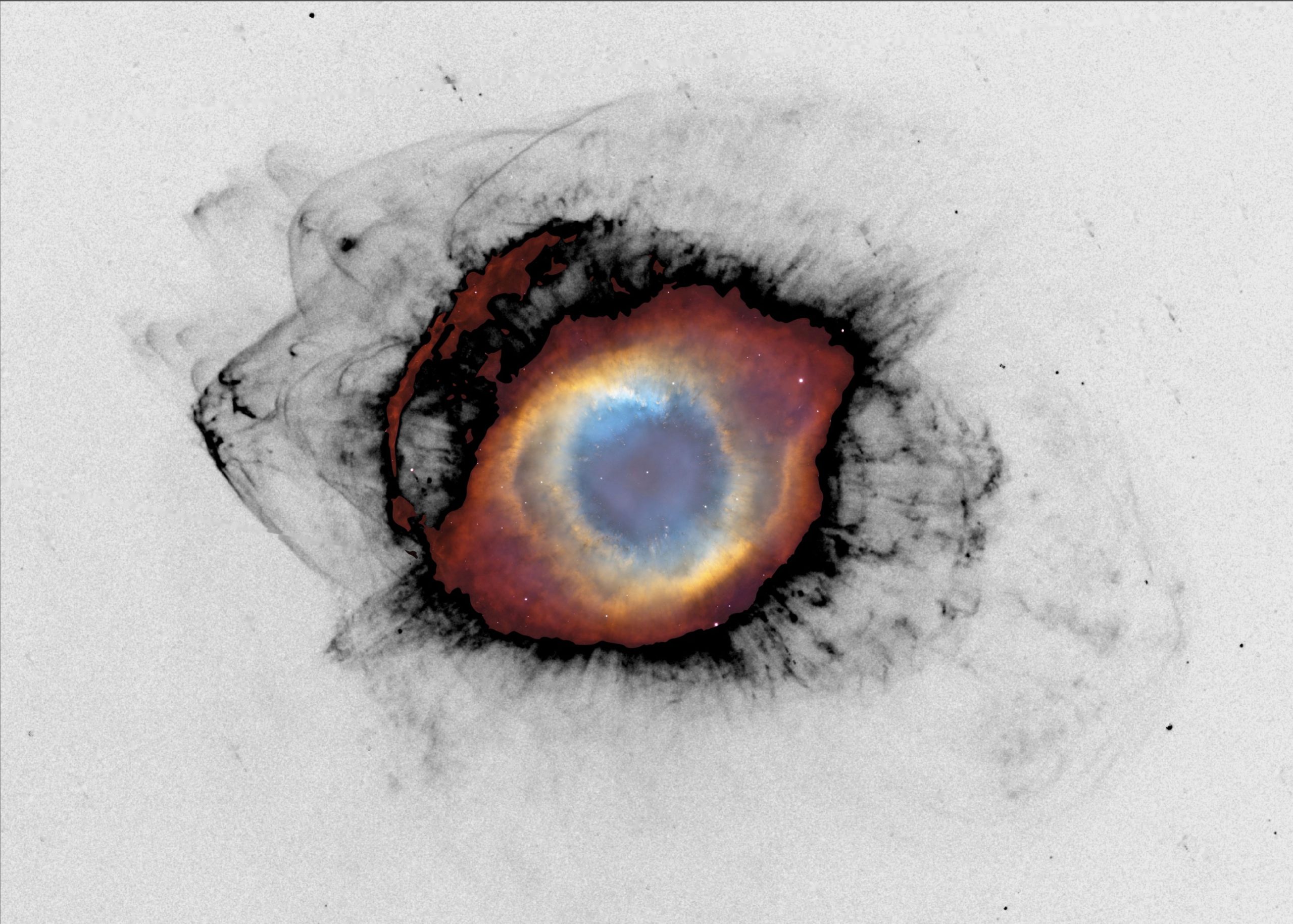
A new image of the Helix Nebula reveals how dying stars return material to the galaxy.
The Helix Nebula offers a rare look at what happens after a dying star releases its outer layers into space. New observations show fragments of that material colliding with surrounding gas, breaking apart, and beginning their return to the galaxy.
By tracing those structures, an international team that includes Northwestern University astrophysicists followed the debris as it is stripped down and mixed into interstellar space. Over time, some of that material could become incorporated into new clouds, stars, and perhaps planets.
The observations capture a stage of this recycling process that astronomers have long struggled to see directly. They also provide a preview of the distant future of our own Sun, which will eventually shed its outer layers and return some of its material to the Milky Way.
The study was published in the journal Nature.
“We are seeing material shed near the end of a star’s life being broken apart and returned to the galaxy,” said Pieter van Dokkum, the study’s lead author. “That handoff — from recognizable stellar debris to the diffuse gas between the stars — has been very difficult to observe. Far in the future, the Sun will go through a similar process, and its material will enter the same cycle.”
Van Dokkum studies galaxy formation and evolution and is co-founder of the Dragonfly Focused Research Organization (FRO), the Sol Goldman Family Professor of Astronomy and Physics at Yale University, and a visiting scholar at Northwestern’s Center for Interdisciplinary Exploration and Research in Astrophysics(CIERA).
The outer halo reveals stellar debris
Roughly 650 light-years from Earth in the constellation Aquarius, the Helix Nebula is one of the nearest and most thoroughly studied planetary nebulae. Its bright ring, often compared to a giant human eye, consists of material expelled by a star late in its life. A white dwarf, the remnant of that star, remains at the nebula’s center.
The new observations extend far beyond that familiar bright region and into the Helix’s extremely faint outer halo. On the nebula’s eastern side, the researchers identified 22 complete or partial glowing, arc-shaped shock waves known as bow shocks.
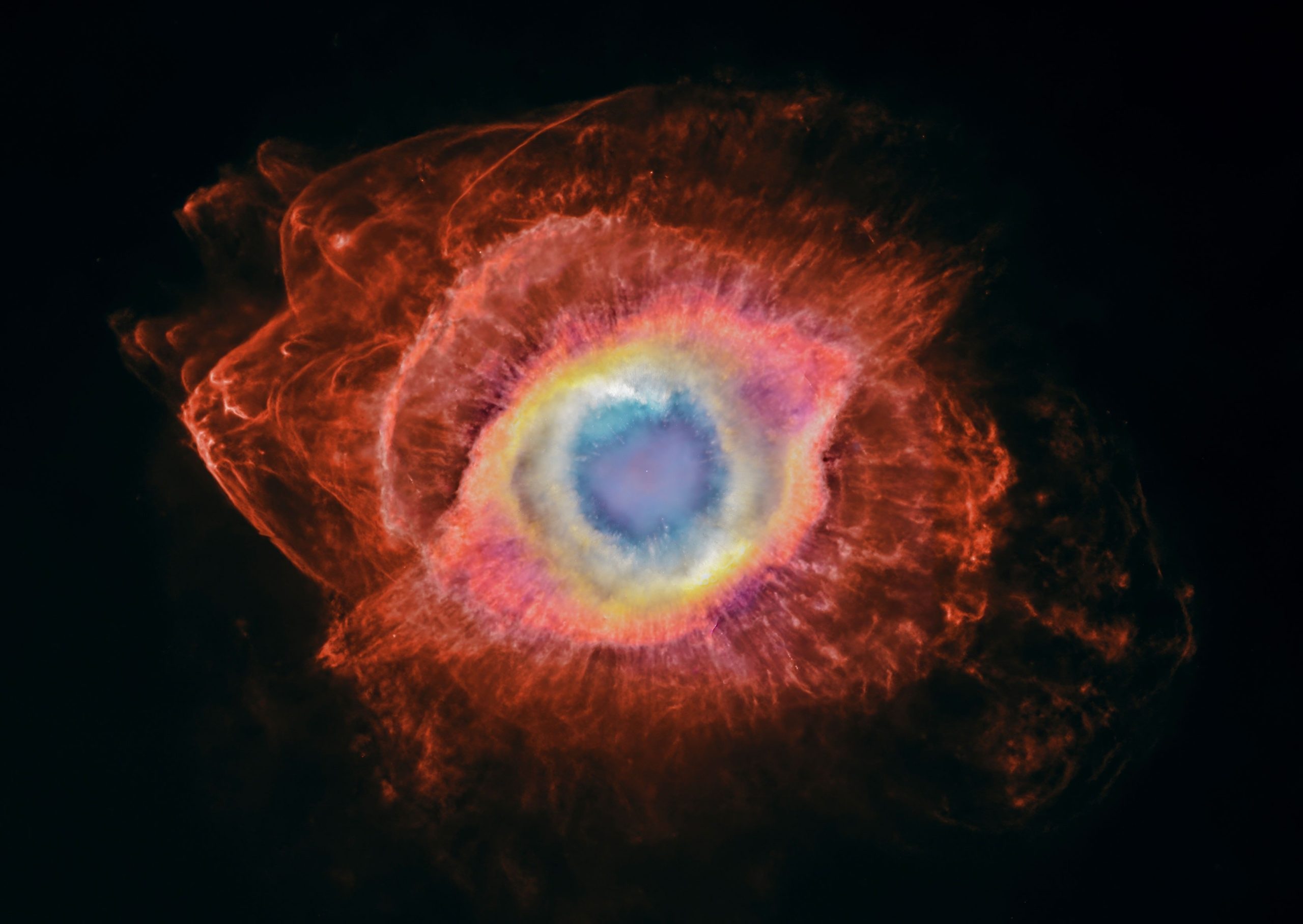
These structures resemble the waves that form ahead of a boat moving through water. In the Helix, mostly invisible clumps of stellar debris are moving rapidly through the thin gas between stars. The glowing bow shocks reveal where those fragments are colliding with the surrounding material.
“The shocks change dramatically with the distance from the central star,” said study co-author Imad Pasha, a member of Dragonfly FRO and visiting scholar at CIERA. “Those nearer the center are large, thin and sharply defined. Farther out, they become smaller, fuzzier and increasingly fragmented.”
The changing appearance of the shocks suggests that the stellar fragments are gradually eroded as they travel outward. From this progression, the researchers estimate that an individual clump remains intact for only about 10,000 years after it begins interacting with surrounding gas. Its material is then largely torn apart and dispersed into interstellar space.
A calibration target exposed hidden structure
The researchers had not originally aimed the telescope at the Helix Nebula in search of a discovery. They chose it as a calibration target because it is large, bright, and already well studied, making it useful for testing MOTHRA (Modular Optical Telephoto Hyperspectral Robotic Array), which is being built at the El Sauce Observatory in Chile.
Once finished, MOTHRA will combine 1,140 high-end telephoto lenses with specialized filters designed to detect extremely faint gas emission across broad regions of the sky. The Helix observations were collected while the instrument was still in the early stages of construction and had not yet reached full operating capability.
Even in that incomplete state, however, MOTHRA was sensitive enough to reveal structures that had previously gone unseen, offering an early indication of what the completed system may be able to detect.
“We thought we were taking a calibration image of one of the best-known nebulae in the sky,” said co-author Roberto Abraham, a member of the Dragonfly FRO and a professor of astronomy at the University of Toronto. “Instead, we found this extraordinary network of bow-shaped structures. It was immediately clear that the faint outer Helix was telling us a story that had largely been missed.”
Reference: “Numerous bow shocks in the outer Helix Nebula” by Pieter van Dokkum, Roberto Abraham, William P. Bowman, Seery Chen, Steven R. Janssens, Deborah M. Lokhorst, Imad Pasha and Carter Rhea, 12 August 2026, Nature.
DOI: 10.1038/s41586-026-10724-z
The development of MOTHRA and Dragonfly FRO have been made possible by the funding and continued strategic support of Alex Gerko, Founder and CEO of XTX Markets. Dragonfly FRO was launched in partnership with Convergent Research.
Never miss a breakthrough: Join the SciTechDaily newsletter.
Follow us on Google and Google News.