
Close Menu
    Facebook X (Twitter) Instagram
    SciTechDaily
    • Biology
    • Chemistry
    • Earth
    • Health
    • Physics
    • Science
    • Space
    • Technology
    Facebook X (Twitter) Pinterest YouTube RSS
    SciTechDaily
    Home»Space»Possible Death of Solar System Seen in White Dwarf Stars
    Space

    Possible Death of Solar System Seen in White Dwarf Stars

    By SciTechDailyMay 7, 20121 Comment2 Mins Read
    Facebook Twitter Pinterest Telegram LinkedIn WhatsApp Email Reddit
    Share
    Facebook Twitter LinkedIn Pinterest Telegram Email Reddit
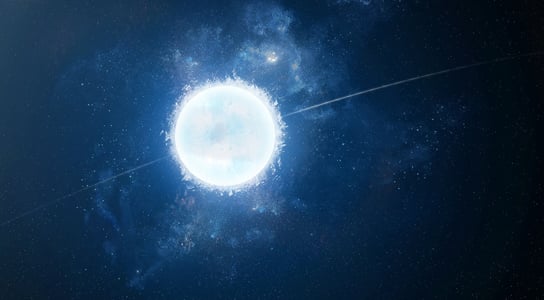
    white-dwarf
    White dwarf stars

    Astronomers using the Hubble Space Telescope have been able to probe into the chemical signatures of dusky disks encircling four distant star systems. They discovered that surprisingly the chemical composition was eerily similar to Earth. Those elements make up 93% of the Earth’s mass.

    White dwarf stars, several hundreds of light-years distant from Earth, could give an inkling of what will happen in the future to Earth. The findings were published on arXiv, and have been accepted for publication in the journal Monthly Notices of the Royal Astronomical Society.
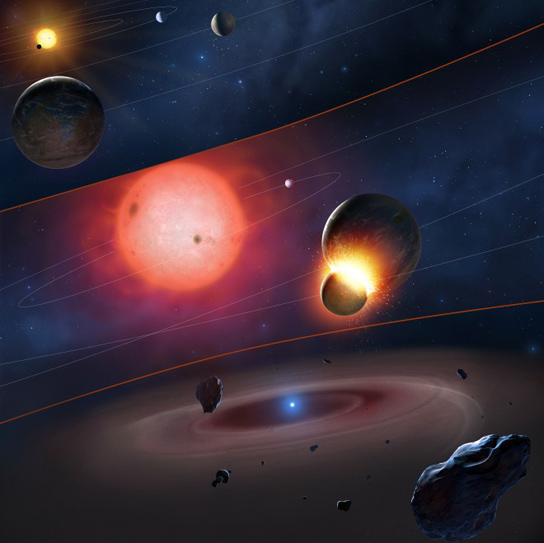
    planetary-system-death-sequence

    Sol is about 4.57 billion years old and will survive another 5 billion years or so, unless something unpredictable happens in cosmological time scales. Once it runs low on hydrogen, the fusion would push away gas that usually gathers at its core. As the gas accumulates, the rising pressure will fuse helium atoms into carbon, increasing the star’s inner core temperature.
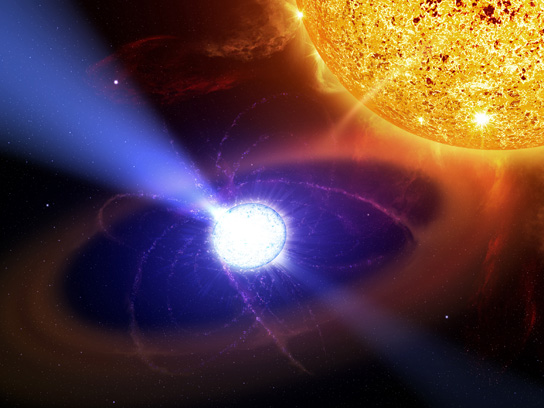
    white-dwarf-sun

    Once the final blaze pushes away the outer shell, it will become a red giant star. The surface will extend to the orbit of Earth. Sol will engulf Mercury and Venus, but it’s unclear whether the Earth will be swallowed up. Even if Earth survives, the surface will be roasted.

    Later, the sun will become a planetary nebula. As its substance drifts away, it will lose mass and this will push planets out of their orbits.

    The materials falling into the white dwarfs have allowed the team led by Boris Gänsicke, an astrophysicist at the University of Warwick, to analyze the dusty halo. The results suggest that any planets surviving the red giant phase will eventually crash into themselves, forming asteroid-like chunks.

    The cloud near PG0843+516 revealed a large amount of nickel, iron, sulfur, and other elements found in abundance in Earth’s core, implying that the accretion of such elements came from a terrestrial exoplanet.

    Reference: “The chemical diversity of exo-terrestrial planetary debris around white dwarfs” by B. T. Gänsicke, D. Koester, J. Farihi, J. Girven, S. G. Parsons and E. Breedt, 5 July 2012, Monthly Notices of the Royal Astronomical Society.
    DOI: 10.1111/j.1365-2966.2012.21201.x

    Never miss a breakthrough: Join the SciTechDaily newsletter.
    Follow us on Google and Google News.

    Astronomy Astrophysics Popular Sol Solar System White Dwarf
    Share. Facebook Twitter Pinterest LinkedIn Email Reddit

    Related Articles

    Astronomers Use Planet-Hunting Satellite To See White Dwarf “Switch On and Off” for First Time

    A Mysterious Gap Within the Solar System’s Protoplanetary Disk

    Planet Discovered That Survived Its Star’s Death: A Crystal Ball Into Our Solar System’s Future

    How Special Are We? New Clues to the Formation of Our Solar System

    A Smoldering Stellar Corpse on the Edge: Astronomers Spot a White Dwarf So Massive It Might Collapse

    “Big Surprise!” – Heavy Metal Vapors Unexpectedly Found in Comets Throughout Our Solar System – and Beyond

    Solution Proposed to Mystery of Incredibly Strong White Dwarf Magnetic Fields

    Vaporized Crusts of Earth-Like Planets Discovered in Dying Stars

    Solar System Formation in Two Steps – Explains Composition and Features of Planets, Asteroids and Meteorites

    1 Comment

    1. John Bayer on October 27, 2024 1:47 am

      Kinda late–12 years, in fact–but I have to note again that none of us can say for certain where the Earth might be when Sol leaves the Main Sequence. Intelligent beings who value our planet would presumably find various options.

      Reply
    Leave A Reply Cancel Reply

    • Facebook
    • Twitter
    • Pinterest
    • YouTube

    Don't Miss a Discovery

    Subscribe for the Latest in Science & Tech!

    Trending News

    The Universe Is Expanding Too Fast and Scientists Can’t Explain Why

    “Like Liquid Metal”: Scientists Create Strange Shape-Shifting Material

    Early Warning Signals of Esophageal Cancer May Be Hiding in Plain Sight

    Common Blood Pressure Drug Shows Surprising Power Against Deadly Antibiotic-Resistant Superbug

    Scientists Uncover Dangerous Connection Between Serotonin and Heart Valve Disease

    Scientists Discover a “Protector” Protein That Could Help Reverse Hair Loss

    Bone-Strengthening Discovery Could Reverse Osteoporosis

    Scientists Uncover Hidden Trigger Behind Stem Cell Aging

    Follow SciTechDaily
    • Facebook
    • Twitter
    • YouTube
    • Pinterest
    • Newsletter
    • RSS
    SciTech News
    • Biology News
    • Chemistry News
    • Earth News
    • Health News
    • Physics News
    • Science News
    • Space News
    • Technology News
    Recent Posts
    • Scientists Create Improved Insulin Cells That Reverse Diabetes in Mice
    • Scientists Stunned After Finding Plant Thought Extinct for 60 Years
    • A Common Diabetes Drug May Hold the Key to Stopping HIV From Coming Back
    • Ancient “Syphilis-Like” Disease in Vietnam Challenges Key Scientific Assumptions
    • Drinking Alcohol To Cope in Your 20s Could Damage Your Brain for Life
    Copyright © 1998 - 2026 SciTechDaily. All Rights Reserved.
    • Science News
    • About
    • Contact
    • Editorial Board
    • Privacy Policy
    • Terms of Use

    Type above and press Enter to search. Press Esc to cancel.