
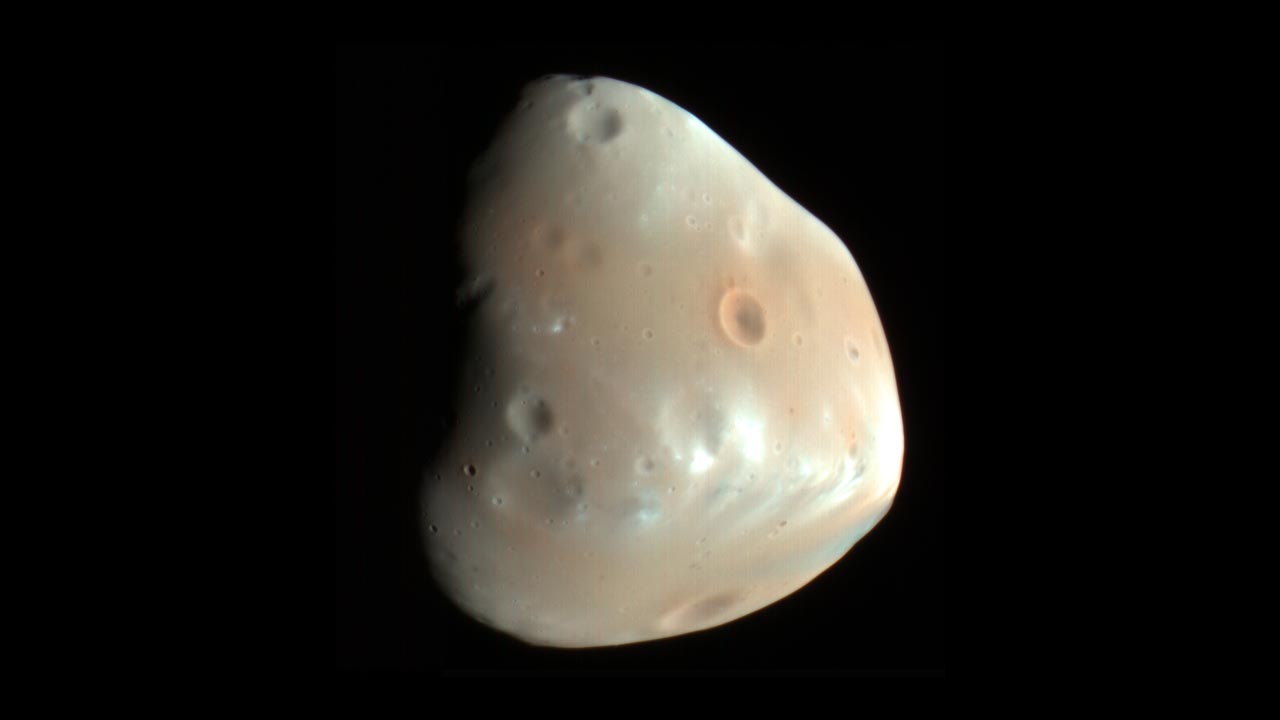
One asteroid impact may have carved Deimos, buried its surface in debris, and reshaped the entire Martian moon.
An international team led by the University of Bern has found evidence that a single asteroid collision may have dramatically reshaped Deimos, the smaller of Mars’ two moons, and produced its unusually smooth, dusty surface.
The researchers combined high-resolution computer simulations with new observations from ESA’s Hera spacecraft. Their results suggest that one impact could explain both the large depression near Deimos’s south pole and the loose blanket of debris that covers much of the moon.
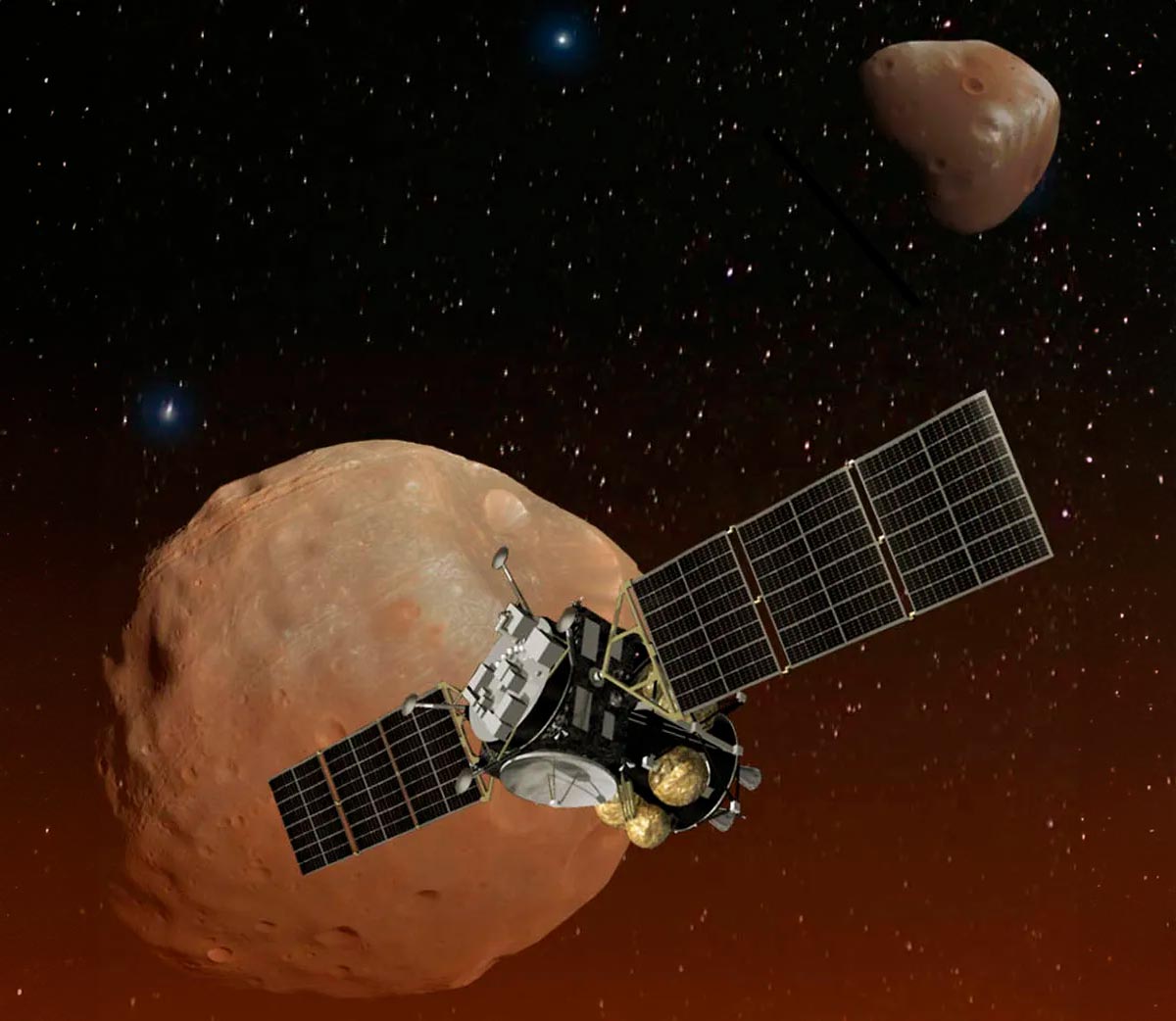
The work is also the first scientific study to use data collected during Hera’s flyby of Deimos. The findings could help guide future missions, including the Martian Moons eXploration (MMX) mission being prepared by the Japan Aerospace Exploration Agency (JAXA).
Why Deimos Looks So Different From Phobos
Deimos is the smaller and more distant of Mars’ two moons. It has a roughly oval shape and a prominent depression near its south pole.
Its surface also looks very different from that of Phobos, Mars’ other moon. Phobos is heavily marked by craters and other scars, while Deimos appears much smoother because it is covered by loose dust, broken rock, and other debris. Scientists call this material regolith.
Although spacecraft have photographed Deimos in increasing detail for decades, researchers have not known exactly how the southern depression formed or where the widespread regolith came from.
A new study led by Dr. Sabina Raducan offers a possible explanation for both mysteries. The work involved researchers from institutions including the Observatoire de la Côte d’Azur, the University of Arizona, and the University of Tokyo.
Raducan worked in the Division of Space Research and Planetary Sciences (WP) at the Physics Institute at the University of Bern until October 2025. She is now Science Program Manager at the International Space Science Institute and a Senior Fellow at the Vrije Universiteit Brussel.
Using high-resolution simulations created with the “Bern Smoothed Particle Hydrodynamics (SPH)” code, the team found that the south polar depression was most likely produced by a single asteroid impact that was powerful but not destructive enough to break Deimos apart. The same collision may also have generated the regolith now spread across the moon.
The study, published in Nature Astronomy, is the first scientific publication to incorporate data from Hera’s close flyby of Deimos. Hera is currently traveling toward the asteroid moon Dimorphos.
Recreating an Ancient Collision
To test different impact scenarios, the researchers used the Bern SPH code, a system developed at the University of Bern over roughly two decades to simulate collisions involving asteroids, comets, and planets.
The software represents colliding objects as millions of individual particles. Researchers can then adjust factors such as gravity, density, material strength, impact speed, and impact angle to see how different collisions unfold.
The University of Bern has extensive experience modeling planetary impacts. The same approach was previously used to simulate NASA’s DART spacecraft striking the asteroid Dimorphos.
“The code runs on a high-performance computing cluster here at the University of Bern and is one of the few codes capable of performing this type of simulation,” explains study leader Sabina Raducan, who is also co-chair of the Hera Impact Physics Working Group for ESA’s Hera mission.
The team ran many different scenarios, changing the size and speed of the impactor, the angle at which it struck, and assumptions about Deimos’s internal structure.
“We carried out about a hundred simulations – each one took about a week.”
Researchers then compared the results with observations collected by ESA’s Hera spacecraft.
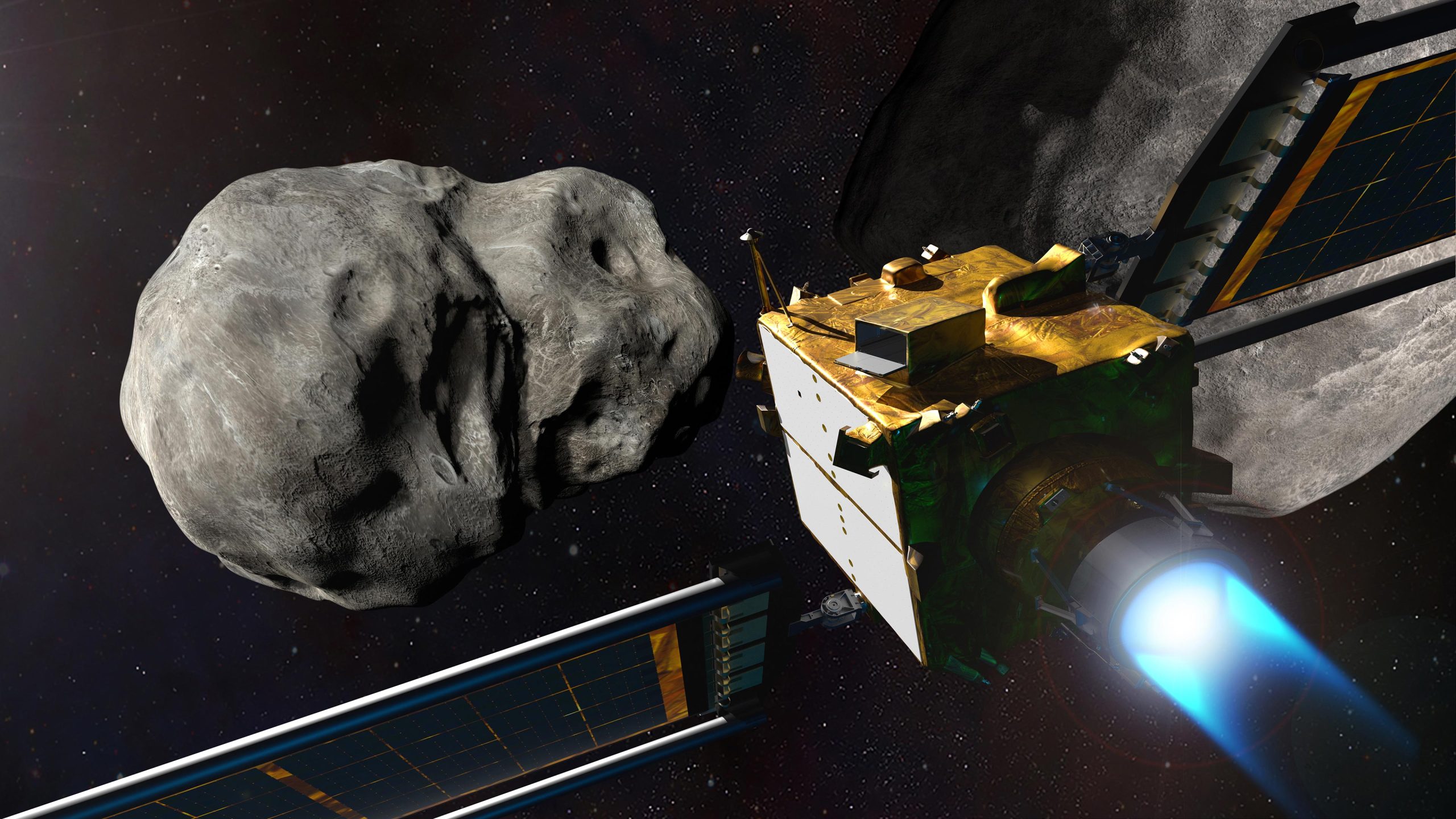
Hera’s main mission is to study the aftermath of NASA’s DART impact on Dimorphos. DART deliberately struck the small asteroid moon to test whether a spacecraft impact could alter an asteroid’s trajectory, a technique that may someday help protect Earth from a dangerous incoming object.
In March 2025, Hera flew past Mars for a gravity assist maneuver that helped redirect the spacecraft toward Dimorphos. During that encounter, Hera also observed Deimos from close range, giving scientists a rare new look at the Martian moon.
One Impact May Explain Two Major Features
The simulations pointed most strongly to one particular scenario.
According to the model, an asteroid about 320 meters across struck Deimos at a 45-degree angle. That collision could reproduce the size and shape of the depression seen near the south pole.
It could also explain the widespread regolith.
The impact would have thrown enormous amounts of material across Deimos, burying older surface features under layers of debris. In some areas, that material may be more than two hundred meters deep.
“Our simulation thus shows that a single impact was sufficient to decisively shape the current landscape of Deimos,” explains co-author Martin Jutzi from the Division of Space Research and Planetary Sciences (WP) at the University of Bern, who also serves as co-chair of the Hera Impact Physics Working Group.
“The impact was violent enough to redistribute material globally, but not so strong that it would have shattered the moon.”
The match between the simulations and the spacecraft observations also suggests that Deimos has an unusually weak outer layer and a highly porous interior.
That porous structure may have helped absorb and dampen the force of the collision, allowing the moon to survive an event strong enough to spread debris across nearly its entire surface.
“In terms of its physical properties, Deimos more closely resembles the so-called rubble-pile asteroids than our Earth’s Moon,” says Raducan.
Rubble pile asteroids are objects made largely from loosely bound fragments rather than a single solid piece of rock.
“But that doesn’t necessarily mean that Deimos is actually an asteroid. It could also have formed from material ejected during impacts on Mars.”
What Future Missions Could Test
Other explanations for Deimos’s smooth surface and southern basin are still possible, but the new study provides one scenario that could account for both features at the same time.
It also offers specific predictions that future spacecraft can test.
JAXA is preparing the Martian Moons eXploration (MMX) mission, scheduled to launch in 2026. MMX is designed to study both Martian moons in detail and return samples from Phobos to Earth.
“Our study provides important, concrete predictions for this Japanese MMX mission, such as the thickness and distribution of the regolith layer and the mechanical properties of Deimos’s material,” explains Raducan.
“This gives MMX a clearer picture of what its instruments – and ultimately the sample collection – can expect.”
Reference: “Deimos’s shape and geology explained by a subcatastrophic impact” by S. D. Raducan, H. F. Agrusa, E. Asphaug, C. M. Ernst, M. Jutzi, P. Michel, M. Popescu and S. Sugita, 18 August 2026, Nature Astronomy.
DOI: 10.1038/s41550-026-02956-w
Never miss a breakthrough: Join the SciTechDaily newsletter.
Follow us on Google and Google News.