
A giant 29-square-mile iceberg broke from Greenland’s Petermann Glacier and survived a collision with Joe Island that might have shattered a more fragile berg.
Summer is the busiest time of year for iceberg activity in Greenland’s glacier-fed fjords, and 2026 brought another dramatic example. In August, a huge iceberg separated from Petermann Glacier on Greenland’s northwest coast. The chunk of ice was roughly comparable in size to St. Thomas in the U.S. Virgin Islands and represented the largest calving event from any Arctic glacier since 2020.
Calving is a normal part of the life cycle of an outlet glacier, but scientists monitor these events closely along with many other measurements of the ice and surrounding environment for longer-term signs of instability. Petermann is one of Greenland’s largest marine-terminating glaciers, and it helps regulate the movement of ice from the interior ice sheet toward the ocean. Changes in its stability therefore have implications for sea level rise.
A Giant Ice Island Breaks Free
Adam Garbo, a doctoral student in glaciology at the University of Ottawa, first identified the summer 2026 calving event on August 4 using images from the European Space Agency’s Sentinel-1 mission. Garbo and an international group of researchers have been applying remote sensing techniques to monitor Petermann Glacier and its floating ice tongue.
According to the team, the newly formed tabular iceberg, often called an “ice island,” covered just over 76 square kilometers (29 square miles) when it separated from the glacier. It was the largest piece to calve from Petermann since the major event of 2012 (130 square kilometers). Other large calving episodes occurred in 2008 (31 square kilometers) and 2010 (just over 250 square kilometers).
Scientists had actually been preparing for an even larger break. Garbo and his colleagues were watching one of several major rifts that appeared likely to eventually cut completely across Petermann’s ice tongue.
“What surprised us was that the calving instead followed a different fracture, producing a smaller ice island than we had originally anticipated,” Garbo said.
As of late August, two major rifts were still present. Researchers expected them to eventually release additional ice islands measuring roughly 94 square kilometers and 84 square kilometers, although they could not predict when those breaks would occur.
The Iceberg Heads Toward Nares Strait
Glaciologist Mauri Pelto of Nichols College has also been tracking the iceberg with images collected by NASA USGS Landsat satellites as it moved down Petermann Fjord toward Nares Strait. During the first week after calving, the massive berg traveled an average of about 3 kilometers per day.
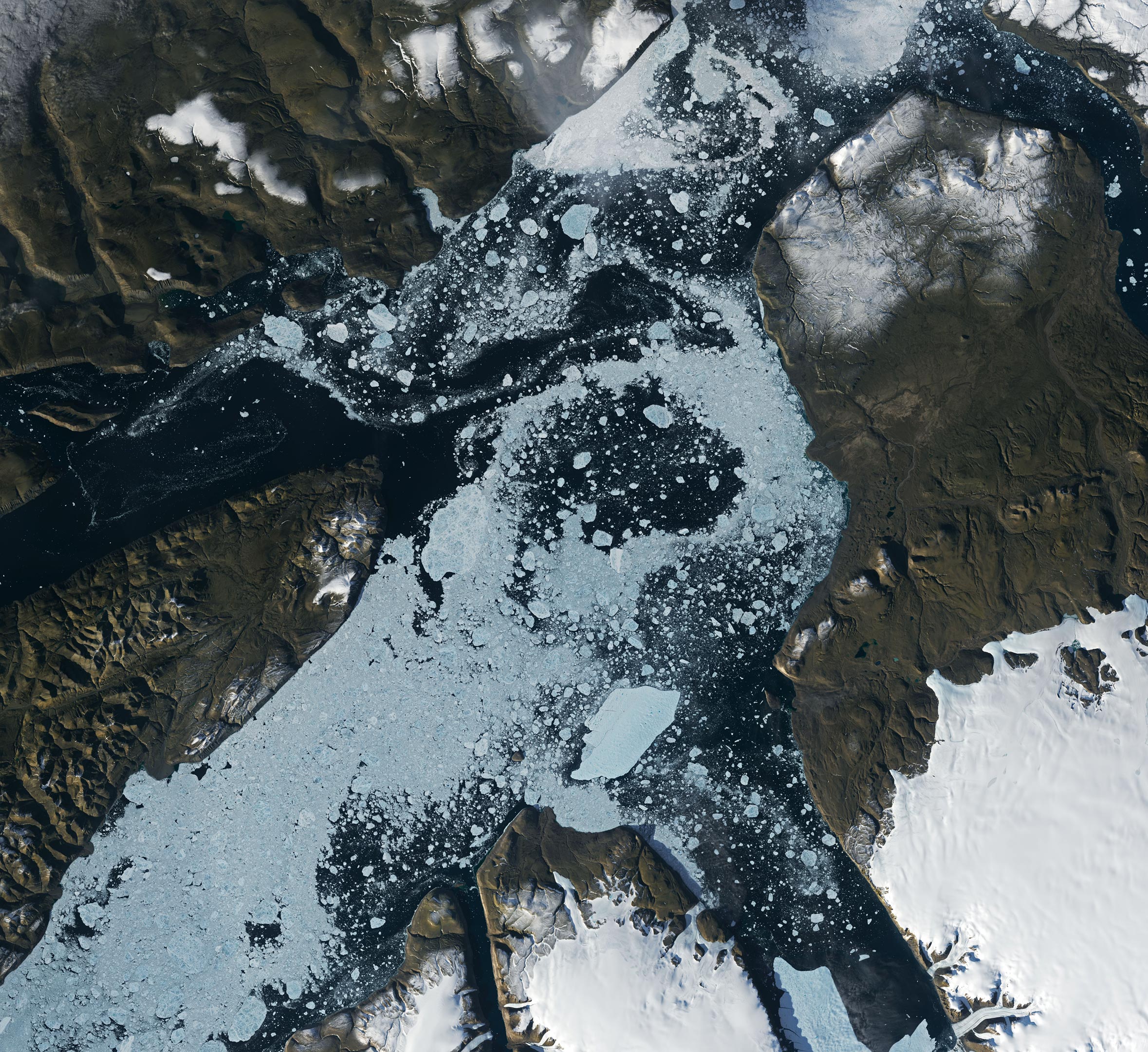
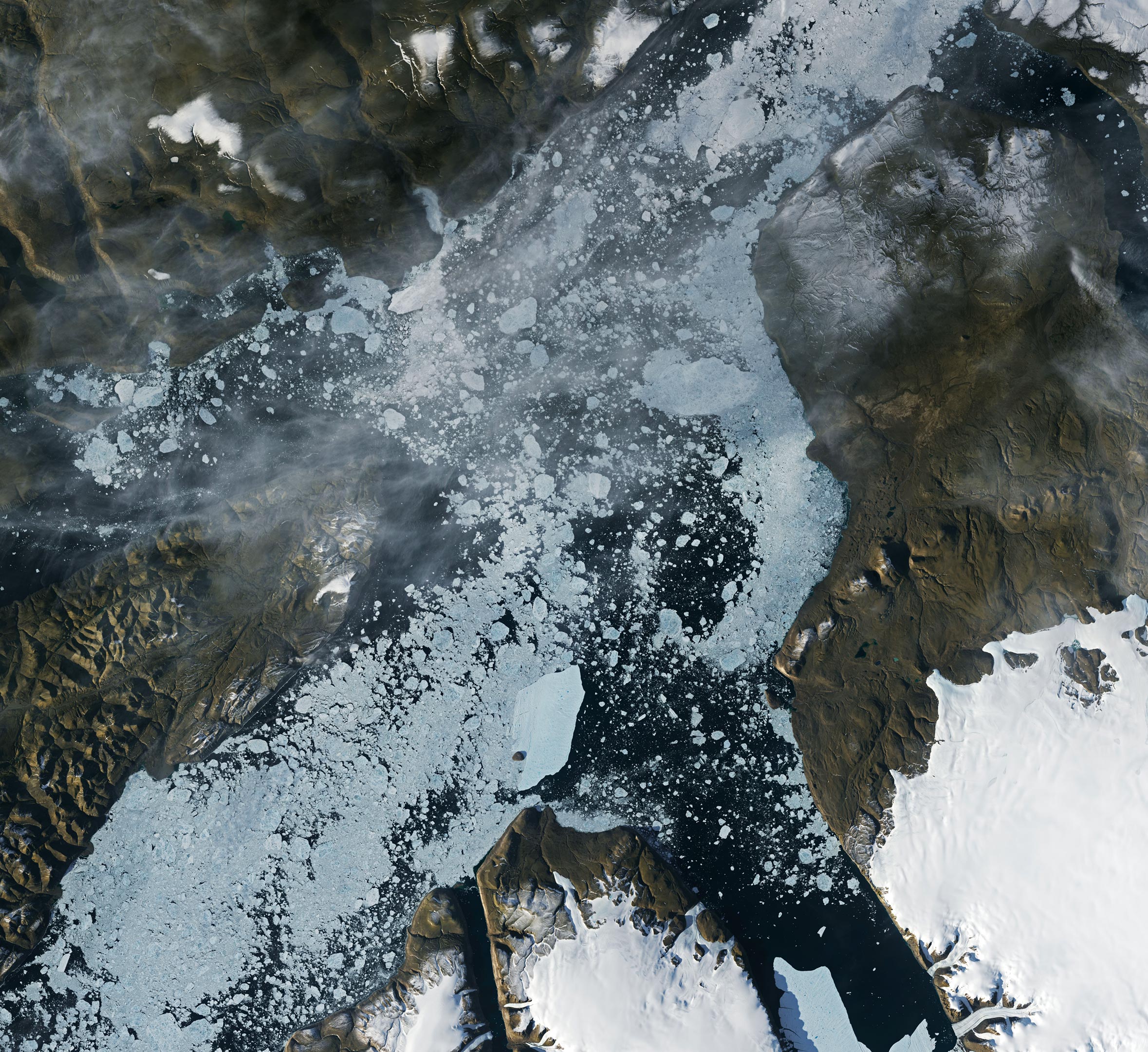
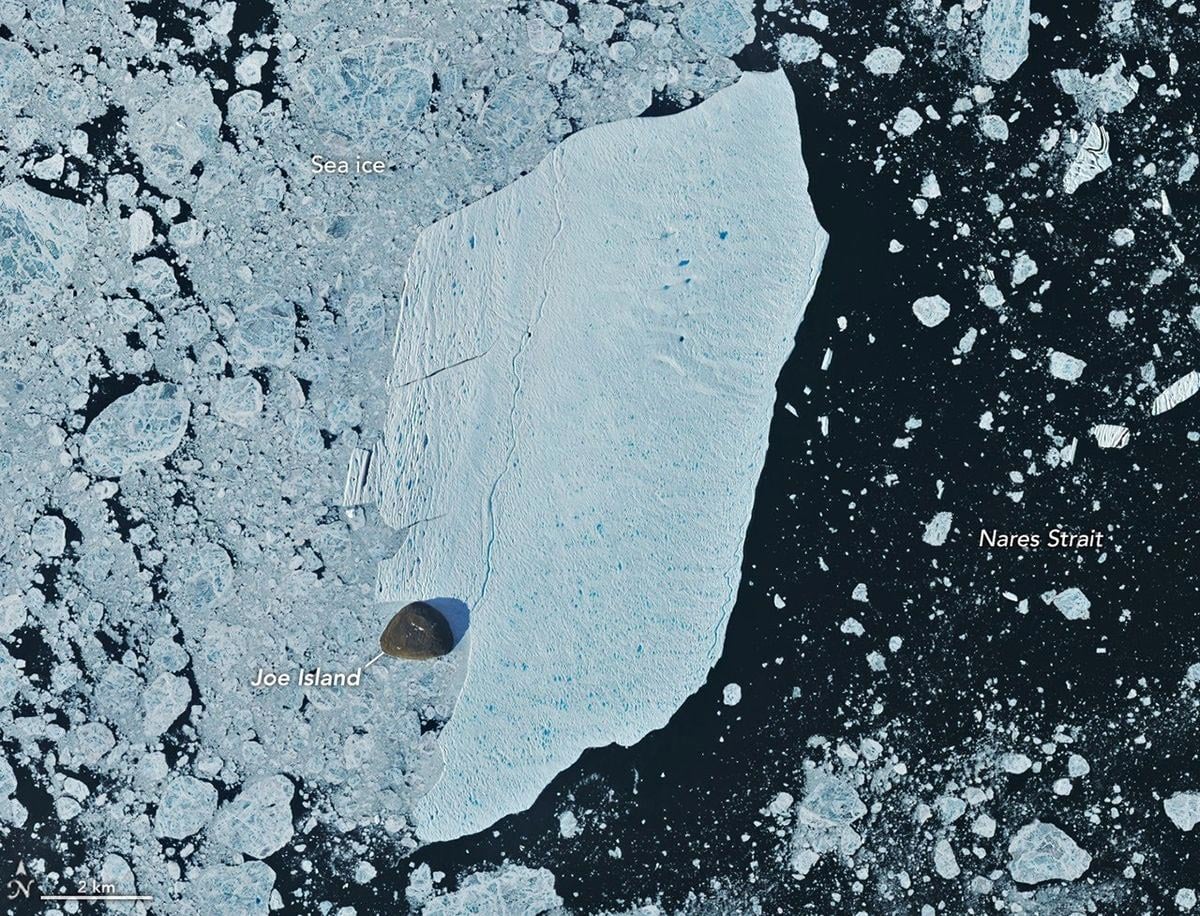
It eventually approached the point where the fjord meets Nares Strait and collided with a small rocky outcrop called Joe Island (Joe Ø). The encounter can be seen in images collected by the OLI (Operational Land Imager) aboard Landsat 9 on August 23 (top right) and August 24 (top left). A closer view from the August 24 observation is shown above.
Joe Island is positioned near the entrance to Petermann Fjord, placing it directly in the path of many ice islands leaving the glacier. Encounters with the rocky island can help trigger the breakup of these enormous pieces of ice. A collision there split the 2010 ice island into two pieces.
Pelto noted that icebergs produced by Petermann are generally thinner and more fragile than those released from Greenland glaciers such as Jakobshavn and Helheim. They are also much thinner than the enormous icebergs that break away from Antarctica.
A Collision That Failed to Break It Apart
Despite that vulnerability, the 2026 ice island came through its encounter with Joe Island largely unscathed.
“We were certainly watching closely as it interacted with Joe Island and were impressed that it survived the interaction without further fragmentation,” Garbo said.
Researchers estimated that the ice island was less than 150 meters thick when it first calved. Since then, winds and surface currents have carried it beyond the fjord. Satellite observations show the berg pivoting away from Joe Island before continuing southwest through Nares Strait.
Its survival does not mean it will remain intact indefinitely. As the ice island travels farther, tides, winds, ocean currents, and continued melting will place additional stress on the ice, eventually causing it to fracture into progressively smaller pieces.
How Far Could the Ice Travel?
Not all large icebergs behave the same way after calving. Thick bergs released from tidewater glaciers that lack floating ice shelf extensions can scrape along the seabed and sometimes become grounded inside their fjords. Ice islands like those produced by Petermann may travel farther before eventually running aground. Numerous ice islands have previously become “grounded” near the coasts of Coburg and Baffin islands.
Garbo and his colleagues noted that these giant slabs of ice, along with the fragments they produce, can travel considerable distances from where they originated. During their journeys, they may create hazards for ships and marine infrastructure. At the same time, they gradually release freshwater into the ocean as they melt.
Never miss a breakthrough: Join the SciTechDaily newsletter.
Follow us on Google and Google News.