
Close Menu
    Facebook X (Twitter) Instagram
    SciTechDaily
    • Biology
    • Chemistry
    • Earth
    • Health
    • Physics
    • Science
    • Space
    • Technology
    Facebook X (Twitter) Pinterest YouTube RSS
    SciTechDaily
    Home»Earth»Melting Point: Rapid Retreat at Petermann Glacier
    Earth

    Melting Point: Rapid Retreat at Petermann Glacier

    By NASA Earth ObservatoryMay 26, 2023No Comments3 Mins Read
    Facebook Twitter Pinterest Telegram LinkedIn WhatsApp Email Reddit
    Share
    Facebook Twitter LinkedIn Pinterest Telegram Email Reddit
    Retreat at Petermann Glacier
    Greenland’s Petermann Glacier is rapidly retreating with increased thinning and accelerated flow. Warming ocean waters are enhancing melt rates, especially at the glacier’s grounding zone, and iceberg calving events have reduced the ice tongue significantly. These changes are raising concerns over potential contributions to global sea level rise.

    Decades of retreat are visible from above, but harder-to-see changes below the waterline could also affect this iconic glacier’s future.

    Petermann Glacier is one of Greenland’s largest marine-terminating glaciers. Like most glaciers that discharge ice into the ocean, Petermann periodically sheds large icebergs. But contact with the sea also means warming waters have been melting the glacier’s ice from below, with implications for sea level rise.
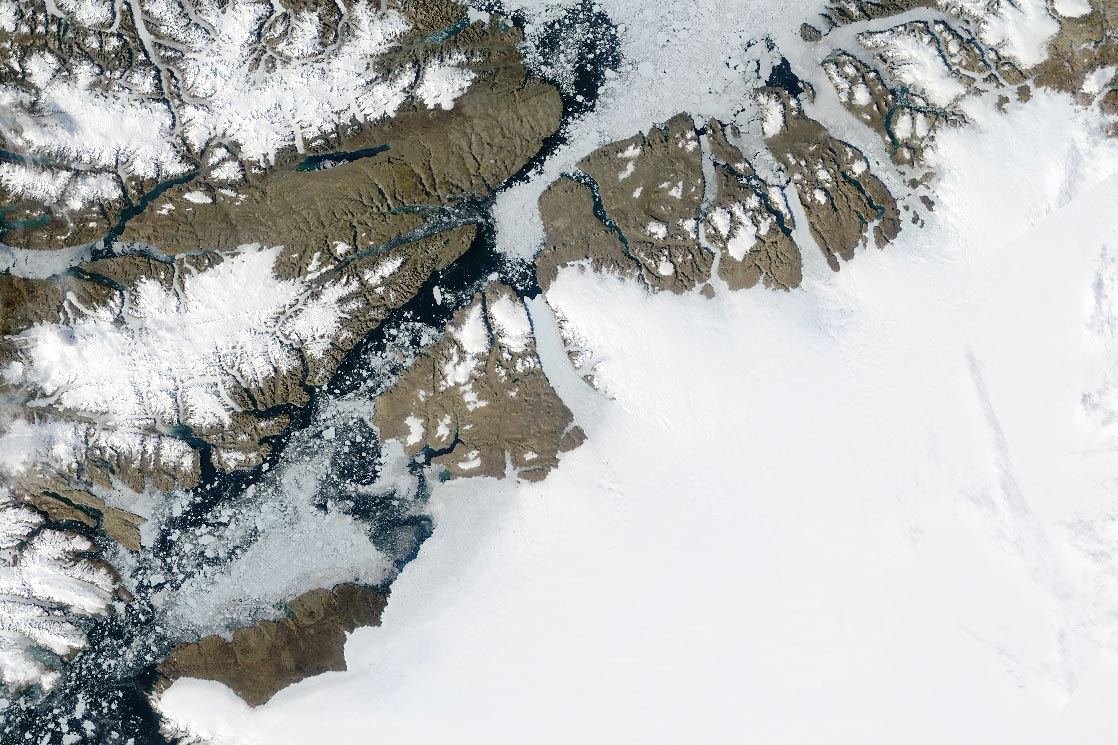
    Petermann Glacier 2002 Annotated
    Satellite image of Petermann Glacier acquired on August 16, 2002, using the Moderate Resolution Imaging Spectroradiometer (MODIS) on NASA’s Terra satellite.
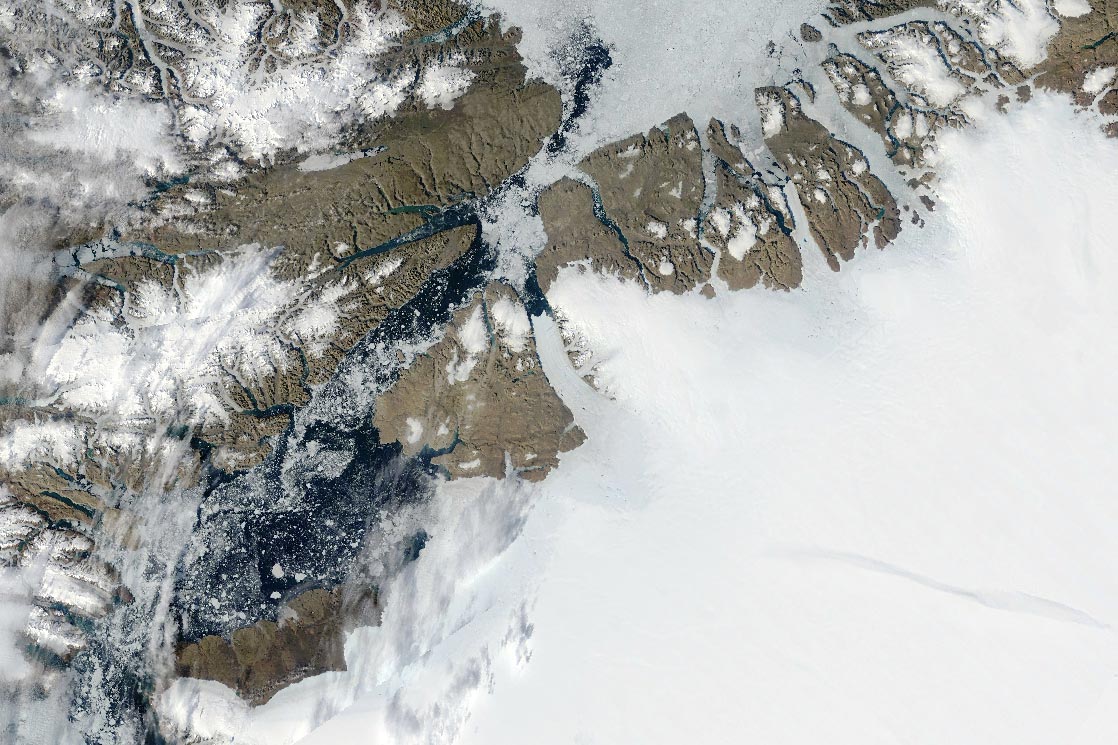
    Petermann Glacier 2022 Annotated
    Satellite image of Petermann Glacier acquired on August 16, 2022, using the Moderate Resolution Imaging Spectroradiometer (MODIS) on NASA’s Terra satellite.

    This pair of images, acquired with the Moderate Resolution Imaging Spectroradiometer (MODIS) on NASA’s Terra satellite, shows retreat of the glacier’s floating ice tongue. The upper image shows the glacier in August 2002; the lower image shows the same area two decades later, in August 2022.

    Petermann is generally thinning, retreating, and its flow is accelerating. The acceleration stretches and thins the glacier, which makes it more prone to fractures, or rifts, that can break and form an iceberg. Several large icebergs have broken from Petermann during the years spanned by these images, including a 251-square-kilometer berg in 2010, and a 32-square-kilometer berg in 2012. Rifting and periodic iceberg calving are normal parts of an outlet glacier’s life cycle, even in northwest Greenland. Still, these two events reduced the ice tongue by one-third.
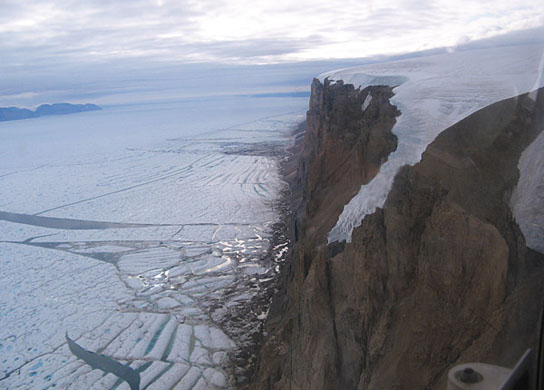
    Petermann Glacier Annotated
    Satellite image of Petermann Glacier acquired on May 14, 2023, using the Operational Land Imager (OLI) on Landsat 8.

    In 2017, a rift formed near a stream channel running lengthwise along the glacier’s surface. Since then, the “new” rift has converged with an older rift. The merged rifts are visible in this detailed image of the floating ice tongue, acquired on May 14, 2023, with the Operational Land Imager (OLI) on Landsat 8. It remains to be seen if the rift will eventually grow across the width of the glacier and release another large iceberg.

    Other signs of action are visible along Petermann’s eastern edge, where the ice of smaller glaciers flowing into the fjord has been mashed up by the more massive Petermann. As a result, a mixture of relatively small, thin icebergs lines the east side of the main glacier.

    Meanwhile, warming ocean waters are helping to melt the floating ice tongue from below. This melting might be especially significant along the grounding line—the area where the glacier loses contact with the bedrock and begins to float.

    Recent research found that the highest melt rates under Petermann’s floating ice tongue—as much as 80 meters per year—occurred within its grounding zone. Tides can help the warmer seawater reach farther into the grounding zone than previously thought, where it can melt inland ice from below. Unlike meltwater from icebergs or an ice tongue, which are already floating, meltwater from inland ice contributes to sea level rise.

    NASA Earth Observatory images by Allison Nussbaum, using MODIS data from NASA EOSDIS LANCE and GIBS/Worldview and Landsat data from the U.S. Geological Survey. Story by Kathryn Hansen with information from Christopher Shuman/UMBC/NASA.

    Never miss a breakthrough: Join the SciTechDaily newsletter.
    Follow us on Google and Google News.

    Climate Science Glaciology Greenland NASA NASA Earth Observatory Popular Sea Level
    Share. Facebook Twitter Pinterest LinkedIn Email Reddit

    Related Articles

    Study Confirms Southern Ocean Is Absorbing Carbon – Important Buffer for Greenhouse Gas Emissions

    Online Visualization Tool From NASA Provide a New Window on Rising Seas

    The Charlotte Whale: Unexpected Discovery of a Whale Skeleton Hundreds of Miles From the Sea

    What a Glacial River Reveals About the Greenland Ice Sheet and Global Sea Level Rise

    A New Artificial Island: Preparing for Rising Seas in the Maldives

    Shrinking Margins of Greenland: At Least 200 Coastal Glaciers Have Retreated Over the Past 20 Years

    Investigating California’s Rising and Sinking Coast

    New Research Shows Greenland Ice Sheet Movement is Decreasing Despite Warming

    Satellites Confirm Extensive Ice Sheet Melt in Greenland

    Leave A Reply Cancel Reply

    • Facebook
    • Twitter
    • Pinterest
    • YouTube

    Don't Miss a Discovery

    Subscribe for the Latest in Science & Tech!

    Trending News

    Scientists Discover How Coffee Impacts Memory, Mood, and Gut Health

    Why Did the Neanderthals Disappear? Scientists Reveal Humans Had a Hidden Advantage

    Physicists Propose Strange Experiment Where Time Goes Quantum

    Magnesium Magic: New Drug Melts Fat Even on a High-Fat, High-Sugar Diet

    Weight-Loss Drugs Like Ozempic May Come With an Unexpected Cost

    Mezcal “Worm” in a Bottle Mystery: DNA Testing Reveals a Surprise

    New Research Reveals That Your Morning Coffee Activates an Ancient Longevity Switch

    This Is What Makes You Irresistible to Mosquitoes

    Follow SciTechDaily
    • Facebook
    • Twitter
    • YouTube
    • Pinterest
    • Newsletter
    • RSS
    SciTech News
    • Biology News
    • Chemistry News
    • Earth News
    • Health News
    • Physics News
    • Science News
    • Space News
    • Technology News
    Recent Posts
    • Harvard Scientists Reveal Secret Structure Behind How You Smell
    • Scientists Just Discovered the Hidden Trick That Keeps Your Cells Alive
    • This Simple Movement Could Be Secretly Cleaning Your Brain
    • Male Birth Control Breakthrough: Scientists Find Way To Turn Sperm Production Off and Back On
    • A Common Vitamin Could Hold the Key to Treating Fatty Liver Disease
    Copyright © 1998 - 2026 SciTechDaily. All Rights Reserved.
    • Science News
    • About
    • Contact
    • Editorial Board
    • Privacy Policy
    • Terms of Use

    Type above and press Enter to search. Press Esc to cancel.