
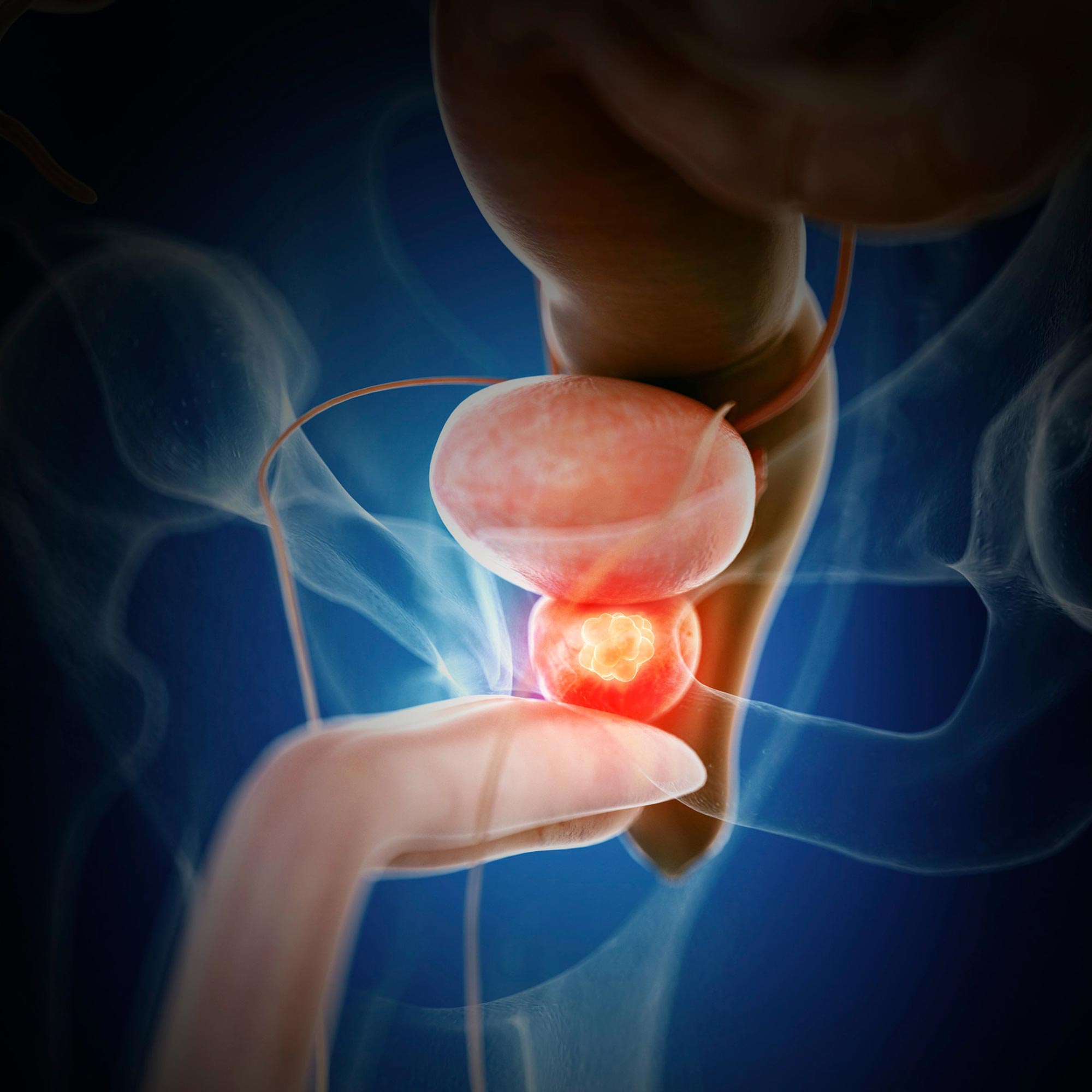
Researchers identified a promising approach to slowing treatment-resistant prostate cancer by targeting two key cancer pathways at the same time.
Prostate cancer is diagnosed in about one in eight men during their lifetime. Many survive the disease, but for some, it eventually spreads beyond the prostate and becomes metastatic.
In the United States, prostate cancer is the second-leading cause of cancer-related death among men.
Most prostate tumors retain features of glandular tissue and express genes associated with gland cells. Their growth also depends on androgens, male hormones such as testosterone.
That dependence makes androgen receptor inhibitors the main treatment for metastatic prostate cancer. The drugs often work initially, but nearly all patients eventually develop resistance.
Resistance can change tumor identity
Some resistant tumors escape treatment by activating alternative pathways that alter the cellular blueprint. As a result, the cancer cells lose glandular characteristics and begin adopting different identities.
This transformation is known as transdifferentiation.
In research published in JCI Insight, University of Michigan researchers identified two pathways that could be targeted at the same time in transdifferentiated prostate tumors.
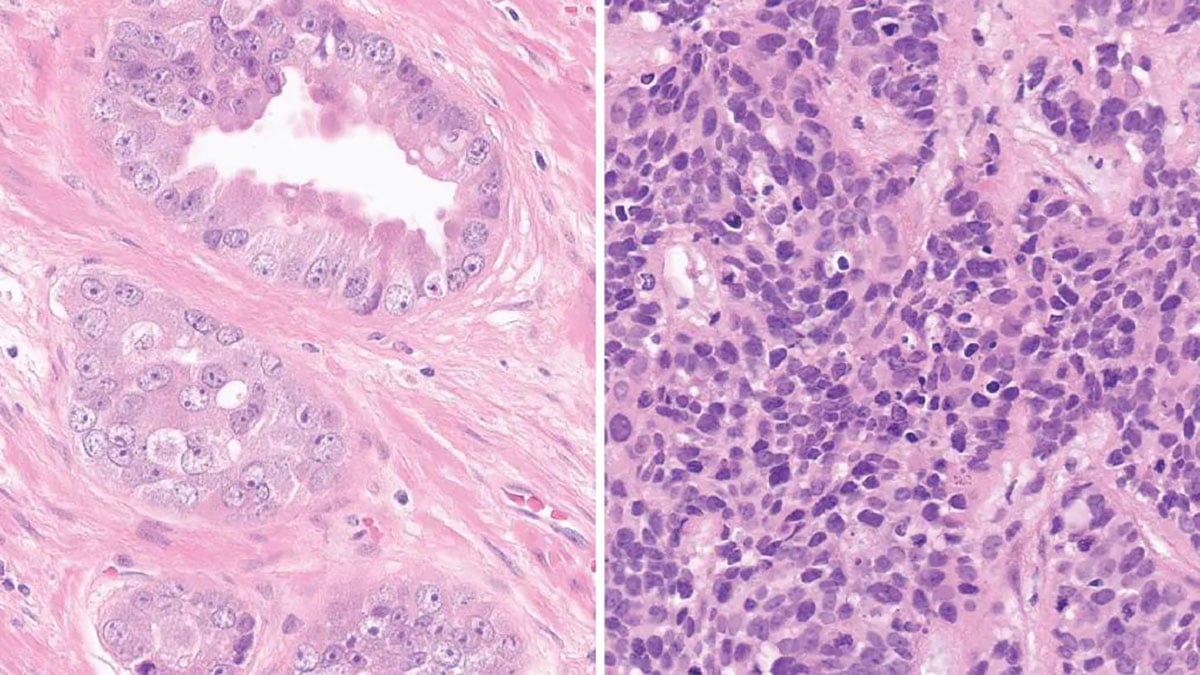
The researchers hope the strategy could eventually prove relevant to other cancers that undergo transdifferentiation, including cancers of the lungs and pancreas.
Earlier research has linked the loss of the genes TP53 and RB1 with transdifferentiation in prostate cancer.
What drives that connection, however, has remained unclear.
Two pathways emerged as treatment targets
To investigate the mechanism, the researchers examined several prostate cancer cell lines to determine which cellular pathways changed when TP53 and RB1 were missing.
“We saw that there are two sides to this transition: loss of glandular genes and activation of cell programs that cause the identity to switch into stem cells,” said Joshi Alumkal, M.D., Professor of Internal Medicine-Hematology/Oncology and member of Rogel Cancer Center.

Previous work by the researchers showed that drugs called BET bromodomain inhibitors can interfere with pathways that allow prostate cancer cells to activate alternative identity programs.
But those drugs did not permanently stop the disease from progressing.
In the current study, BET bromodomain inhibitors again slowed the growth of prostate cancer cell lines but did not kill the cancer cells.
The researchers then turned to DNA methyltransferase, or DNMT, inhibitors. These drugs can reactivate genes, including glandular genes that are often switched off as prostate cancers change identity.
DNMT inhibitors are already approved by the FDA for other conditions, including blood cancers.
Combining both inhibitors improved tumor control
When the researchers combined BET bromodomain inhibitors with DNMT inhibitors, prostate cancer cell growth was suppressed more effectively than with either drug alone.
The combination produced similar results in tumors implanted in mice.
“When we used both drugs, we reversed a significant portion of gene expression changes that occur in the tumors, which is encouraging,” said Will Storck, Ph.D., Research Lab Specialist in the Alumkal lab.
“It is also promising that we saw a significant reduction in tumor growth even at doses far lower than the recommended dose, and this drug combination was well tolerated by the mice.”
Biomarkers could guide earlier treatment
The researchers now want to determine which specific genes are responsible for the anti-tumor effects observed in the study and whether biomarkers could identify patients most likely to benefit from the drug combination.
They also want to learn whether transdifferentiation can be stopped before the cellular transformation begins.
“Preventing the emergence of transdifferentiation would be key to patient survival,” Alumkal said.
“Distinguishing between patients whose tumors will never undergo this transition versus patients whose tumors may will help us use this treatment effectively and early.”
The researchers hope to develop clinical trials to determine whether the combination works in patients with transdifferentiated prostate cancer.
They also want to investigate whether simultaneously targeting both pathways could work against other cancers that undergo transdifferentiation.
Reference: “Combined BET bromodomain and DNMT inhibition targets critical survival pathways in transdifferentiated prostate cancer” by William K. Storck, Diana Flores, Anbarasu Kumaraswamy, Zhi Duan, Shrabastee Chakraborty, Chao Zhang, Eva Rodansky, Dhruv Khokhani, Olivia A. Swaim, Karan Bedi, Raymond G. Cavalcante, Canping Chen, Faming Zhao, Ya-Mei Hu, Zheng Xia, Ryan J. Rebernick, Marcin Cieslik, Rahul Mannan, Somnath Mahapatra, Arul M. Chinnaiyan, Aaron M. Udager, Joshua A. Kuleape, Catherine R. Alumkal, Hannah N. Beck, Peter S. Nelson, Colm Morrissey, Michael C. Haffner, Leigh Ellis, Yuzhuo Wang, Joel A. Yates and Joshi J. Alumkal, 11 August 2026, JCI Insight.
DOI: 10.1172/jci.insight.207543
This work was supported by the National Cancer Institute (R01CA291986, R01CA251245, R01CA282005, R01CA252468, P30CA046392); Michigan Prostate SPORE NCI P50CA186786; University of Michigan Rogel Cancer Center NCI P30CA046592; Joint Institute for Cancer Research Award; Prostate Cancer Foundation Challenge Award; The Allen Family and Smith Family; Sheppard Family Foundation Sheppard Scholar Award; Prostate Cancer Foundation Young Investigator Award; Department of Defense Idea Award W81XWH2110539 and PC230420; National Institute of General Medical Sciences R01GM147365; A Silver Family Innovation Foundation Award; Postdoctoral fellowship of Portland Oral health Research Training program NIH T90DE030859 and National Institutes of Health (P50CA097186, P01CA298991, R01CA266452).
Never miss a breakthrough: Join the SciTechDaily newsletter.
Follow us on Google and Google News.