
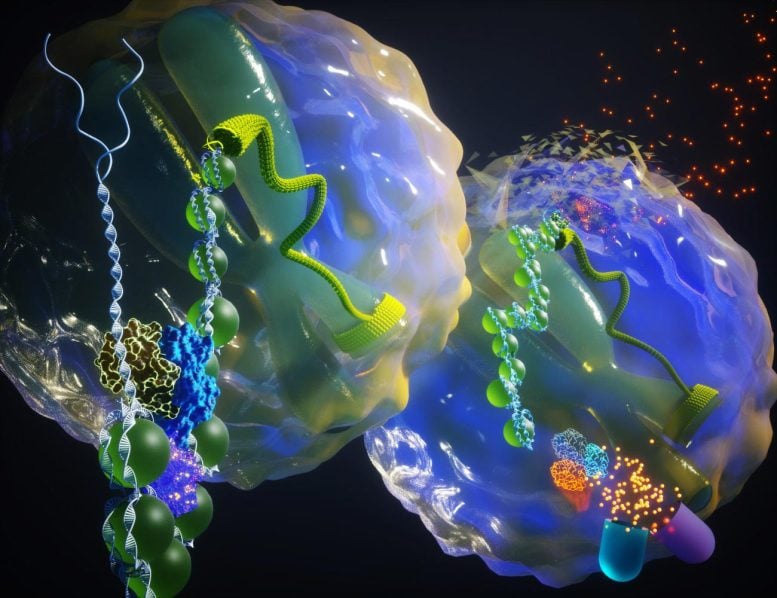
A chromatin degrader stops transcription factors from driving cancer, which may serve as a potential treatment approach for over 90% of prostate cancers.
While researchers have identified several genes that drive prostate cancer, a new study published in Nature reveals the puppet master controlling the strings.
The strings: Cancer-causing genes, or oncogenes, such as androgen receptor, FOXA1, ERG and MYC.
The puppet master: A chromatin remodeling complex called SWI/SNF, which controls the way in which DNA is arranged and compacted to fit within a cell’s nucleus. A key subunit of this complex provides energy to unwrap DNA to provide access to enhancer elements that crank up the expression of cancer-driving genes.
Cutting the Strings: Blocking Chromatin Access
In the current study, researchers at the University of Michigan Health Rogel Cancer Center demonstrated that the SWI/SNF complex facilitates access to enhancers that oncogenes can bind to and drive downstream gene expression in cancer. Degrading a subunit of this complex blocks the oncogenes, like cutting the puppet master’s strings.
The finding reveals a novel approach to treating prostate cancers fueled by different genetic drivers, which altogether represent upwards of 90% of all prostate cancers.
In human cells, DNA is tightly wrapped around histone proteins, collectively referred to as chromatin. These form a physical barrier to all DNA-based processes. Specialized protein machineries have evolved that consume energy and modulate the physical state of the DNA for its functional activation. These complexes work in close concert with DNA-binding regulatory factors called transcription factors to impart distinct cellular identity and function.
“This is the first demonstration in cancer that blocking access to chromatin can be pursued as an avenue to treat cancer. By compacting the chromatin around these enhancer elements, transcription factors are blocked from binding to the enhancer elements that drive cancer,” said study author Arul M. Chinnaiyan, M.D., Ph.D., director of the Michigan Center for Translational Pathology and S.P. Hicks Professor of Pathology and Urology at Michigan Medicine.
Targeting Oncogene Addiction
The researchers looked at several prostate cancer models that expressed different oncogenes. They found that blocking the SWI/SNF complex slowed cancer cell growth and induced cell death especially in tumors driven by FOXA1 or androgen receptor. There was no effect on benign prostate cells.
In normal development, the SWI/SNF complex is essential. “Normal cells can survive with default levels of gene transcription, but cancer cells are particularly addicted to these enhancer regions. They need access to these enhancers to jack up the expression of oncogenic targets,” Chinnaiyan said.
Components of the SWI/SNF complex are mutated in a number of cancers, but rarely in prostate cancer. Prostate cancers driven by androgen receptor or FOXA1 were more sensitive to a SWI/SNF degrader than even cancers in which subunits were mutated.
“Without having mutations, and with just oncogenic transcription factors involved, prostate cancer cells were exquisitely sensitive to this degrader, even more so than lung cancer where a component of the pathway was mutated,” Chinnaiyan said. “By disabling this SWI/SNF complex, we saw preferential activity against certain cancers and no toxicity in normal cells or normal tissues. This bodes well for clinical studies using compounds that target this pathway.”
It also suggests the possibility of using this approach for other types of cancer that are addicted to oncogenic transcription factors, including some multiple myelomas and other blood cancers.
The researchers used a SWI/SNF degrader in development by the Indian company Aurigene Discovery Technologies. These compounds are being developed for future clinical trials.
The Rogel team will continue to study the biology of this complex, help develop compounds that target this complex and evaluate what other cancer types might respond to this approach. For prostate cancer, they are exploring in the laboratory a combination therapy using the SWI/SNF degrader with an anti-androgen therapy. This approach is not yet in clinical trials.
Reference: “Targeting SWI/SNF ATPases in enhancer-addicted prostate cancer” by Lanbo Xiao, Abhijit Parolia, Yuanyuan Qiao, Pushpinder Bawa, Sanjana Eyunni, Rahul Mannan, Sandra E. Carson, Yu Chang, Xiaoju Wang, Yuping Zhang, Josh N. Vo, Steven Kregel, Stephanie A. Simko, Andrew D. Delekta, Mustapha Jaber, Heng Zheng, Ingrid J. Apel, Lisa McMurry, Fengyun Su, Rui Wang, Sylvia Zelenka-Wang, Sanjita Sasmal, Leena Khare, Subhendu Mukherjee, Chandrasekhar Abbineni, Kiran Aithal, Mital S. Bhakta, Jay Ghurye, Xuhong Cao, Nora M. Navone, Alexey I. Nesvizhskii, Rohit Mehra, Ulka Vaishampayan, Marco Blanchette, Yuzhuo Wang, Susanta Samajdar, Murali Ramachandra and Arul M. Chinnaiyan, 22 December 2021, Nature.
DOI: 10.1038/s41586-021-04246-z
Additional authors: Lanbo Xiao, Abhijit Parolia, Yuanyuan Qiao, Pushpinder Bawa, Sanjana Eyunni, Rahul Mannan, Sandra E. Carson, Yu Chang, Xiaoju Wang, Yuping Zhang, Josh N. Vo, Steven Kregel, Stephanie A. Simko, Andrew D. Delekta, Mustapha Jaber, Heng Zheng, Ingrid J. Apel, Lisa McMurry, Fengyun Su, Rui Wang, Sylvia Zelenka-Wang, Sanjita Sasmal, Leena Khare, Subhendu Mukherjee, Chandrasekhar Abbineni, Kiran Aithal, Mital S. Bhakta, Jay Ghurye, Xuhong Cao, Nora M. Navone, Alexey I. Nesvizhskii, Rohit Mehra, Ulka Vaishampayan, Marco Blanchette, Yuzhuo Wang, Susanta Samajdar, Murali Ramachandra
Funding: Prostate Cancer Foundation Challenge Award, National Cancer Institute grants P50-CA186786, R35-CA231996, U01-CA214170, P30-CA046592, Department of Defense Prostate Cancer Research Program W81XWH-21-1-0500. Chinnaiyan is a Howard Hughes Medical Institute Investigator, an A. Alfred Taubman Scholar and an American Cancer Society Professor
Disclosure: S. Sasmal., L.K., S.M., C.A., S. Samajdar, K.A. and M.R. are affiliated with Aurigene Discovery Technologies. J.G., M.S.B. and M.B. are affiliated with Dovetail Genomics. A.M.C. is a co-founder and serves on the scientific advisory boards of LynxDx, Oncopia and Esanik. A.M.C. serves on the scientific advisory board of Tempus and Ascentage.
Never miss a breakthrough: Join the SciTechDaily newsletter.
Follow us on Google and Google News.