
Video shows animation of MRI-guided transurethral ultrasound ablation (TULSA) procedure. TULSA works by delivering precise doses of sound waves to diseased prostate tissue while sparing the healthy nerve tissue surrounding the prostate.
- Transurethral ultrasound ablation effectively treats prostate cancer with minimal side effects.
- Clinically significant cancer was eliminated in 80% of the study participants.
- The noninvasive technique can also treat benign enlargement of the prostate.
A novel MRI-guided procedure that uses therapeutic ultrasound effectively treats prostate cancer with minimal side effects, according to a new study presented today at the annual meeting of the Radiological Society of North America (RSNA). Researchers said the incision-free technique could also be used to treat benign enlargement of the prostate gland.
“Unlike with other ultrasound systems on the market, you can monitor the ultrasound ablation process in real time and get immediate MRI feedback of the thermal dose and efficacy.” — Steven S. Raman, M.D.
Prostate cancer is the second-leading cause of cancer death in men after lung cancer. Treating disease in the small gland that surrounds the urethra just outside the bladder is challenging. Surgery and radiation are not always effective and can result in incontinence, impotence and bowel dysfunction. Other currently available techniques lack sophisticated imaging guidance and temperature monitoring.
In recent years, a minimally invasive method called MRI-guided transurethral ultrasound ablation (TULSA) has emerged as a promising treatment option. TULSA works by delivering precise doses of sound waves to diseased prostate tissue while sparing the healthy nerve tissue surrounding the prostate.
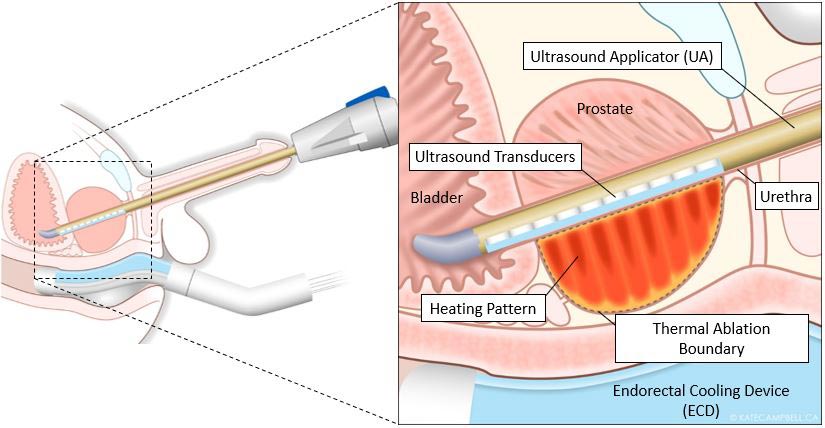
TULSA relies on a rod-shaped device that is inserted into the urethra. The novel device has 10 ultrasound-generating elements that can cover the entire prostate gland. One or more of the elements are used to send out sound waves that heat and destroy the target prostate tissue. The elements are controlled automatically by a software algorithm that can adjust the shape, direction and strength of the therapeutic ultrasound beam. The entire procedure takes place in an MRI scanner so that doctors can closely monitor treatment and assess the degree and location of heating.
Video shows TULSA medical team beginning the treatment process on a patient.
“Unlike with other ultrasound systems on the market, you can monitor the ultrasound ablation process in real time and get immediate MRI feedback of the thermal dose and efficacy,” said study co-author Steven S. Raman, M.D., professor of radiology and urology, and director of Prostate MR Imaging and Interventions and Prostate MR Imaging Research at the University of California at Los Angeles (UCLA). “It’s an outpatient procedure with minimal recovery time.”
In the new multicenter study, researchers reported on the 12-month outcomes from the TULSA-PRO® ablation clinical trial (TACT). The trial enrolled 115 men, median age 65, with localized low or intermediate risk, gland-confined prostate cancer. Clinicians delivered TULSA treatment to the entire gland. Treatment time averaged 51 minutes.
Video shows real-time MRI thermometry and feedback control.
Prostate volume in the study group decreased on average from 39 cubic centimeters pre-treatment to 3.8 cubic centimeters a year after treatment. Overall, clinically significant cancer was eliminated in 80% of the study participants. Seventy-two out of 111 men, or 65%, had no evidence of any cancer at biopsy after one year. Blood levels of prostate-specific antigen (PSA), a marker of prostate cancer, fell by a median of 95%. There were low rates of severe toxicity and no bowel complications.
“We saw very good results in the patients, with a dramatic reduction of over 90 percent in prostate volume and low rates of impotence with almost no incontinence,” Dr. Raman said.
Approved for clinical use in Europe, TULSA has just received FDA 510(k) clearance for prostate tissue ablation in the United States. Assuming follow-up studies support the preliminary results, the technique could develop into an important tool for treating both prostate cancer and benign prostatic hyperplasia, or enlargement of the prostate.
“There are two very unique things about this system,” Dr. Raman said. “First, you can control with much more finesse where you’re going to treat, preserving continence and sexual function. Second, you can do this for both diffuse and localized prostate cancer and benign diseases, including benign hyperplasia.”
TULSA also has the benefit of allowing further treatment if needed, Dr. Raman said. If it fails, then the procedure can be repeated, and more aggressive invasive approaches like surgery and radiation therapy can still be used. Alternatively, TULSA may enable noninvasive treatment for localized radiation failure.
The study also supports the use of MRI for post-treatment monitoring of patients who undergo TULSA. MRI at one year after treatment had a negative predictive value of 93 to 96% for detecting residual cancer, meaning it was very accurate for ruling out disease recurrence in patients.
Co-authors are Aytekin Oto, M.D., Katarzyna J. Macura, M.D., Ph.D., Sandeep S. Arora, M.B.B.S., Temel Tirkes, M.D., Jurgen J. Futterer, M.D., Ph.D., Daniel N. Costa, M.D., David Bonekamp, M.D., Ph.D., Masoom A. Haider, M.D., Derek W. Cool, M.D., Ph.D., Carlos Nicolau, M.D., Thorsten Persigehl, M.D., Kiran R. Nandalur, M.D., Robert Staruch, Mathieu Burtnyk, Dipl.Phys., Marc Serrallach, M.D., Gregory Zagaja, M.D., Gencay Hatiboglu, M.D., James D. Relle, M.D., Allan Pantuck, M.D., Yair Lotan, M.D., Axel Heidenreich, M.D., Michiel Sedelaar, M.D., Ph.D., Joseph Chin, M.D., Michael Koch, M.D., Christian Pavlovich, M.D., David Penson, M.D., Laurence Klotz, M.D., and Scott Eggener, M.D.
Never miss a breakthrough: Join the SciTechDaily newsletter.
Follow us on Google and Google News.
7 Comments
Looks good. Any other places using? East coast? Florida?
Can this treatment be given in Benign Prostatic Hypertrophy
I have Benign Prostatic Hyperplasia (BPH, a non-cancerous enlarged prostate).
The article suggests that the uretheral wall is not punctured, unlike TURP or even Rezum) and this could turn something for people like me that previously was either an in-patient procedure or an out-patient procedure requiring a long recovery wearing a catheter into a quick out-patient one with minimal recovery time needed.
Still taking way to long to get a real enlarged prostate solution and still not sure why the procedures being used in China are being ignored in North America.
Can you elaborate about the procedures being used in China or provide a web link?
For someone without insurance, this should be a far cheaper option too.
thank you