

Just 20 minutes of easy walking appeared to jolt the gut into action, nearly doubling the intensity of bowel sounds within minutes.
Constipation is one of the most common digestive complaints, affecting people of all ages. Beyond bloating, straining, and infrequent bowel movements, persistent symptoms can cause stress, interfere with work and daily routines, and substantially reduce quality of life.
If it continues untreated, constipation can contribute to hemorrhoids, cardiovascular strain during bowel movements, and other colorectal problems. Yet many people do not seek help until the condition becomes difficult to ignore.
Why Walking May Help Constipation
Movement is routinely recommended as a simple way to support regular bowel function. People who are more active tend to report fewer digestive problems, while prolonged inactivity is associated with slower intestinal movement. The biological explanation, however, remains incomplete.
Most studies have examined exercise habits over weeks, months, or years. Far less is known about the gut’s response during the first few minutes after physical activity, even though that immediate reaction could help explain why a short walk sometimes provides relief.
Researchers at Fujita Health University investigated this rapid response in healthy adults. In their study, published in Scientific Reports, they used bowel sounds (BS) as a noninvasive window into intestinal activity.
Listening to the Intestines
Bowel sounds form as contractions move gas and liquid through the digestive tract. Although these noises do not reveal every aspect of digestion, their frequency, duration, and intensity can provide useful clues about changes in gut motility.
The study included 21 healthy young adults. While each participant rested lying down, researchers used an electronic stethoscope and signal processing software to collect a one-minute baseline recording. Participants then walked on a treadmill for 20 minutes at a comfortable, self-selected pace.
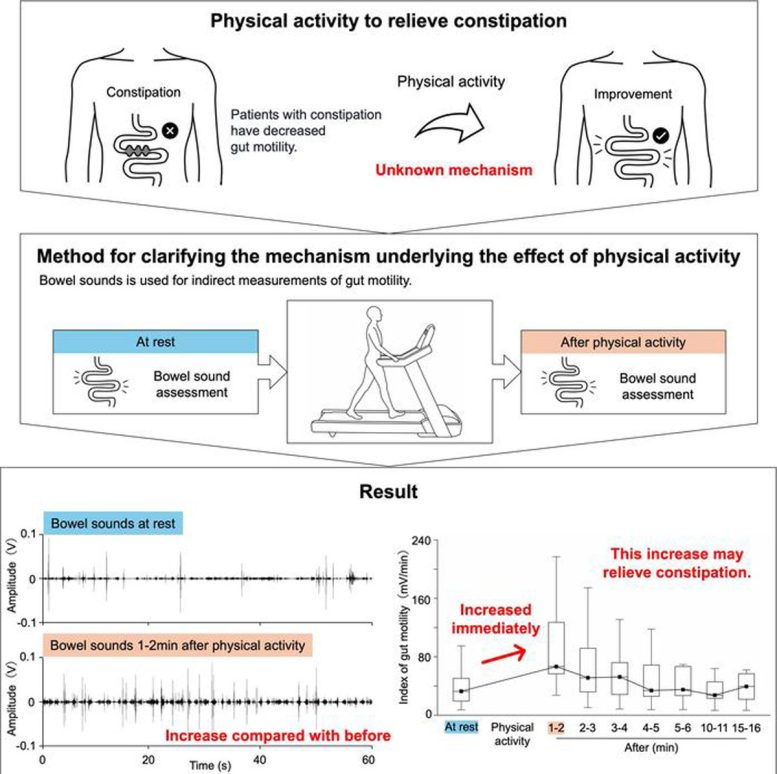
Afterward, they returned to the lying position while the team made several more recordings over 15 minutes. The researchers assessed three indicators: the Sound Index (SI), which represents total sound amplitude; the percentage of recording time containing bowel sounds; and the number of separate sound events per minute.
A Rapid but Brief Gut Response
All three measures increased significantly within one to two minutes after the walk. Sound amplitude nearly doubled, bowel noises occupied more of the recording period, and the number of individual events per minute also rose.
The effect faded within two to three minutes, suggesting that the immediate response was short-lived. Even so, the speed of the change provides evidence that light physical activity can rapidly stimulate measurable intestinal activity rather than influencing digestion only through long-term fitness.
Professor Yohei Otaka, the study’s senior author, said, “Walking can serve as an effective, immediate tool for stimulating bowel function. The findings also point to potential underlying mechanisms, such as changes in autonomic nervous system activity or reflexes triggered by the body’s natural oscillations during movement.”
Promising Clues, but Important Limits
The researchers also highlighted bowel sound analysis as a potentially useful tool for future gastrointestinal research. Because it does not require instruments to be placed inside the body, the technique could make it easier to monitor short-term changes repeatedly and in real time.
However, the experiment was small and involved healthy young adults rather than people experiencing constipation. It measured bowel sounds as an indicator of motility, not whether participants passed stool more easily or experienced lasting symptom relief. Further research will be needed to determine whether the same response occurs in older adults and people with digestive disorders.
Reference: “Immediate effect of physical activity on gut motility in healthy adults” by Kento Katagiri, Soichiro Koyama, Kotaro Takeda, Kouji Yamada, Koki Tan, Hikaru Kondo, Yohei Otaka and Shigeo Tanabe, 29 September 2025, Scientific Reports.
DOI: 10.1038/s41598-025-18860-8
Never miss a breakthrough: Join the SciTechDaily newsletter.
Follow us on Google and Google News.