
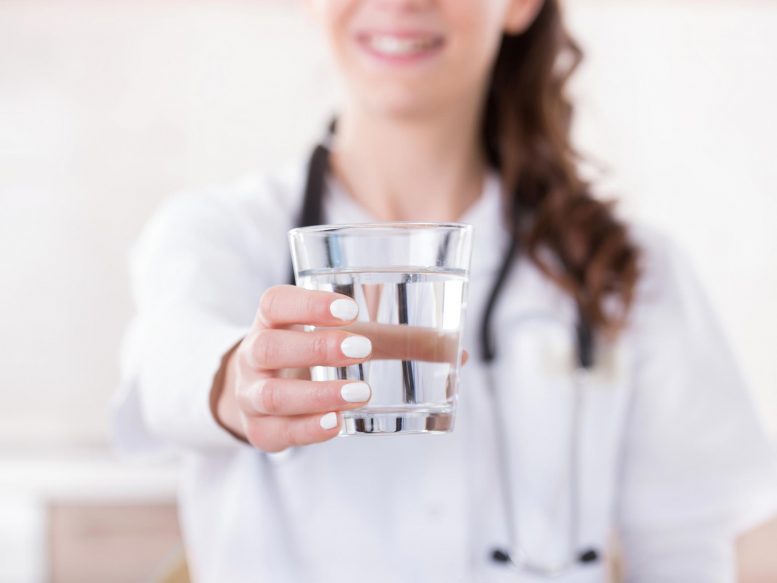
Do I have to drink eight glasses of water per day?
Everyone knows humans need water and we can’t survive without it. We’ve all heard we should be aiming for eight glasses, or two liters of water per day.
This target seems pretty steep when you think about how much water that actually is, and don’t we also get some water from the food we eat?
We asked five medical and sports science experts if we really need to drink eight glasses of water per day.
All five experts said no

Here are their detailed responses:
Karen Dwyer – Nephrologist
You only need to drink to thirst. The best gauge of your hydration level is the color of your urine. You should aim for light yellow in color; if very dark then you’re dehydrated and need more water; if clear (like water) then you don’t need so much water. Excessive water intake can be dangerous, particularly in those with heart conditions. The kidney has a remarkable ability to concentrate water so if you are “getting dry” the kidney will concentrate the urine and send a message to the brain to drink more.
Vincent Ho – Gastroenterologist
No, it’s not necessary to drink eight glasses of water a day. It appears the origin of the recommendation to drink eight glasses of water a day may have come from a publication by the National Academy of Sciences Food and Nutrition Board in 1945 stating “A suitable allowance of water for adults is 2.5 liters daily in most instances.” The recommendation also stated that “most of this quantity is contained in prepared foods,” a fact which is often overlooked. We do get a lot of our water intake from the foods we consume. Cauliflower and eggplant for example are 92% water. A one-size-fits-all approach is unlikely to be helpful. Healthy adults may not need to drink an additional eight glasses of water a day. On the other hand, persons with certain diseases or living in very hot climates may require larger intakes of fluid.
Michael Tam- GP
Eight glasses, which is just less than two liters of water, is very roughly the basal water required by a fasting, well adult per day, who is doing nothing at all (for example, staying in hospital), with no special losses (such as vomiting or diarrhea). In day-to-day life, we usually have additional losses (exercise, or sweating during a hot day), and we receive water from other sources. There are the obvious ones from our diet such as beverages, and juicy and moist foods, such as fruit and vegetables. Less obvious is water from the metabolism of food. The conversion of fats, carbohydrates, and proteins to energy in our bodies all produce water. Rather than focusing on the number of glasses, simply drink fluids when thirsty. Aiming for more water (especially in place of sweetened drinks) is often a good idea to improve health.
Jon Bartlett – Sport Scientist
A person’s daily water requirements are highly individual and dependent upon a number of internal and external factors. While eight glasses of water per day is recommended as a base requirement to meet daily physiological needs, the actual volume of water required in a day is dependent on one’s day-to-day activities, health, and the climate in which they reside. Research shows even just a mild level of dehydration can negatively affect both mental and physical performance. This is further accentuated for individuals who are highly active and who live in hot environments. A simple and easy reminder to ensure you are drinking enough is to drink to thirst, and for days when activity levels are higher than normal or in hotter environments to increase the regularity of drinking and the total volume.
Toby Mundel – Exercise Scientist
Many factors will determine how much water (via all foods and fluid, not just water!) your body needs. These include body size and composition (weight, muscle, and fat), how much you sweat (physically active, hot or humid environment, too much clothing) or urinate (taking certain medication, being at high altitude), your health (having fever, vomiting or disease) or status (pregnant, breast-feeding), and diet (high-water content foods, carbohydrates). For most healthy adults rarely feeling thirsty and having light yellow (or colorless) urine usually confirms adequate water intake. Other helpful tips include drinking a glass of low-calorie fluid before and with every meal (to distinguish hunger from thirst), and drinking low-calorie fluid before, during and after physical activity (especially if you sweat). Although rare, drinking too much fluid can also have negative health consequences so more is not necessarily better.
Written by Alexandra Hansen, Deputy Editor and Chief of Staff, The Conversation.
Interviewed:
- Jon Bartlett – Sport Science Research Fellow, Victoria University
- Karen Dwyer – Deputy Head, School of Medicine, Deakin University
- Michael Tam – Specialist General Practitioner, and Conjoint Senior Lecturer, UNSW
- Toby Mündel – Associate Professor, School of Sport, Exercise and Nutrition, Massey University
- Vincent Ho – Senior Lecturer and clinical academic gastroenterologist, Western Sydney University
This article was first published in The Conversation.
Never miss a breakthrough: Join the SciTechDaily newsletter.
Follow us on Google and Google News.