
Changes in Bird Behavior Persist Long After the Fireworks Are Gone
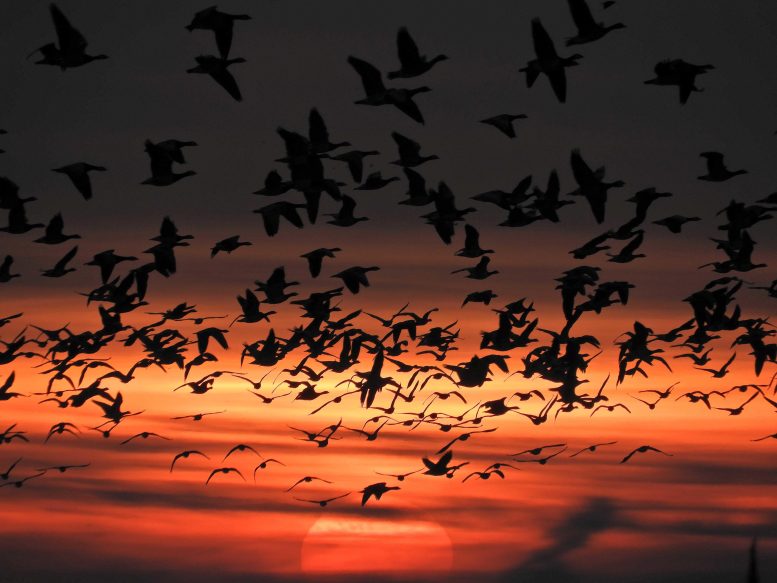
Researchers from the Max Planck Institute of Animal Behavior in Konstanz, Germany, and the Netherlands Institute of Ecology used GPS tracking to study the migration patterns of Arctic geese in Germany, Denmark, and the Netherlands during the New Year period. By analyzing the movement data of 347 geese, they were able to observe the impact of fireworks on the birds’ behavior. On New Year’s Eve, the geese were found to abruptly leave their roosting sites and fly to areas further away from human settlements.
The geese that were affected by the fireworks rested for two hours less and flew longer distances, sometimes up to 500 kilometers non-stop. These behaviors continued for all studied days after the celebrations, as the geese spent more time foraging and never returned to their original roosting sites.
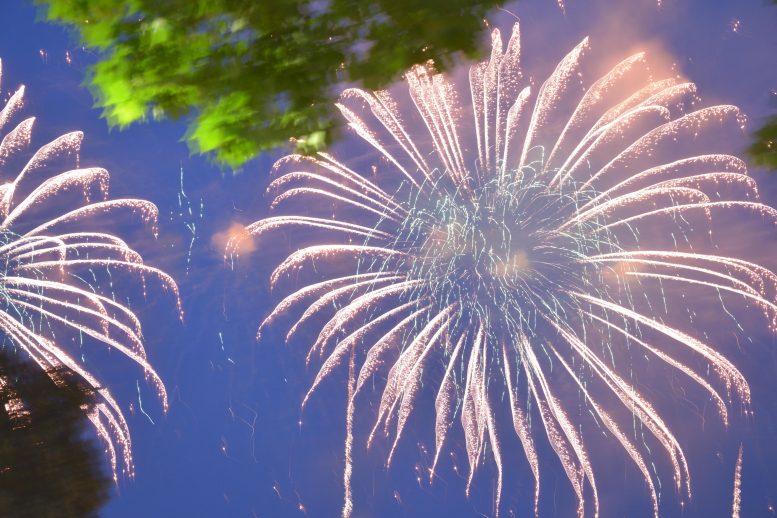
Every year, fireworks are set off around the world to welcome the new year. This nighttime spectacle of light, color, and sound is enjoyable for humans, but less so for animals. As anyone with a pet knows, the combination of loud bangs, bright lights, and smoke can provoke fear and disorientation in animals. In western European countries, the New Year’s Eve disturbance is exacerbated by the availability of recreational fireworks, which the public is allowed to purchase and set off for a certain number of hours before and after midnight. These greatly increase the scale of the disturbance, going beyond a few centralized public displays to include explosions scattered far and wide.
During the last decade, studies in Europe have begun to uncover the negative impacts of fireworks on wild birds. A study from 2011 used weather radar to show that thousands of birds in the Netherlands erupted into the air at midnight on New Year’s Eve when fireworks began. But research has yet to create a clear picture of if fireworks change important behaviors, such as eating and sleeping, and whether or not birds are able to bounce back after the immediate disturbance.
Geese With GPS Trackers
Using GPS trackers, a team of scientists has quantified, for the first time, the effects of widespread New Year’s fireworks on the behavior of individual birds. GPS tracks were collected for 347 individuals in the twelve days before and twelve days after New Year’s Eve for eight consecutive years, with each individual tracked for on average two years.
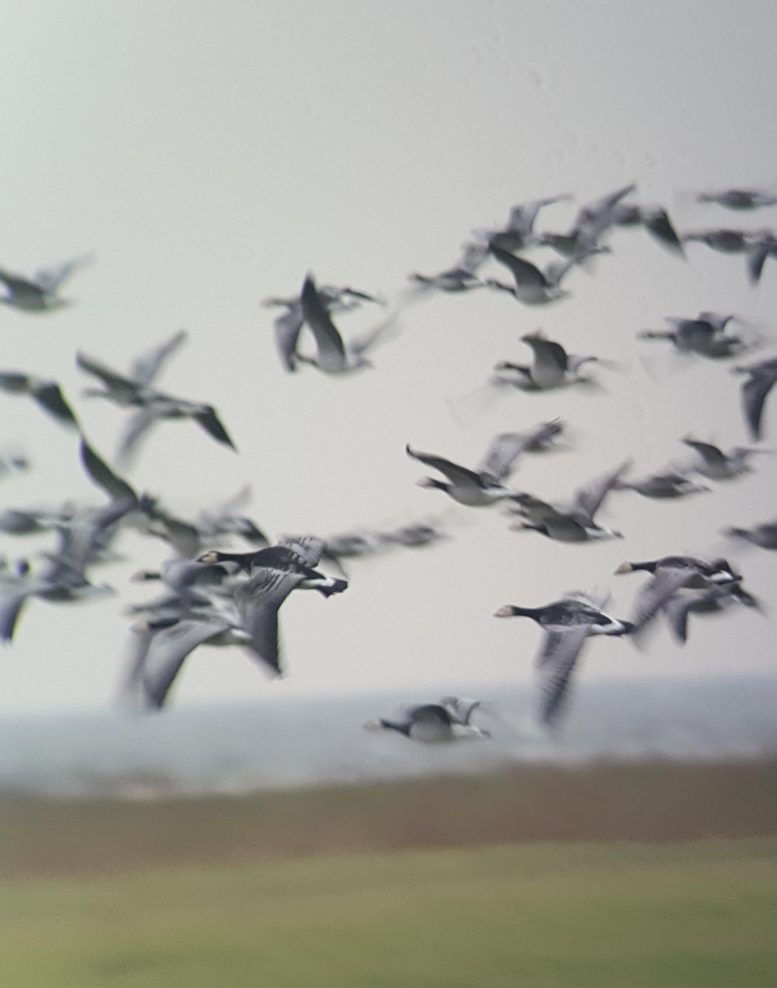
The four species studied were greater white-fronted, barnacle, pink-footed, and bean geese. Are all Arctic migratory species, which spend their winters resting and feeding in Northern Germany, Denmark, and the Netherlands. But the study’s findings reveal significant changes to the wintering behavior of all species in response to fireworks. Normally, geese returned to the same water body for several nights, resting on the surface and moving very little, thus saving essential energy. But during the night of New Year’s Eve, when fireworks were being lit, geese left their sleeping sites more often, and flew on average 5 to 16 kilometers further and 40 to 150 meters higher than on previous nights.
“It is shocking to see just how much further birds are flying on nights with fireworks compared to other nights,” says Andrea Kölzsch, a research scientist at the Max Planck Institute of Animal Behavior and the first author of the study. “Some individuals flew hundreds of kilometers over a single night, covering distances that they normally would only fly during migration.”
Escaping Particulate Matter
In parallel, the team measured particulate matter in the air near sleeping sites, finding that it increased by up to 650 percent on New Year’s Eve in all sites studied. “We find that birds are leaving their sleeping sites and choosing places further from people and with lower particulate matter, which strongly suggests that they are trying to escape from the fireworks,” says Kölzsch.
In the final year of the study, the team was offered a unique opportunity to control for the effect of fireworks. The pandemic lockdown of 2020/2021 led to a widespread firework ban and greatly reduced levels of disturbance. Despite this, the effects of increased flight activity, distance, and altitude were still present on New Year’s Eve in two of the four goose species. “This suggests that even small amounts of fireworks will change the behaviors of geese in ways that might reduce their chances of survival, at least in severe winters,” says Nolet. “In order to provide a safe space for the birds, recreational fireworks should be banned from areas near national parks, bird sanctuaries, and other important bird resting places.”
Beyond the immediate response to fireworks, birds also foraged ten percent more and moved less in the twelve days after New Year’s Eve. “The birds are likely compensating for the extra energy they expended during the night of the fireworks,” says Bart Nolet, senior researcher at the Netherlands Institute of Ecology and final author of the study.
Reference: “Wild goose chase: Geese flee high and far, and with aftereffects from New Year’s fireworks” by Andrea Kölzsch, Thomas K. Lameris, Gerhard J. D. M. Müskens, Kees H. T. Schreven, Nelleke H. Buitendijk, Helmut Kruckenberg, Sander Moonen, Thomas Heinicke, Lei Cao, Jesper Madsen, Martin Wikelski and Bart A. Nolet, 24 November 2022, Conservation Letters.
DOI: 10.1111/conl.12927
Never miss a breakthrough: Join the SciTechDaily newsletter.
Follow us on Google and Google News.
4 Comments
Typical of the “science” rules crowd… You aren’t Karen’s today, but on Christmas day : welcome to Debbie downer!
Christ is born!
Will follow up studies look at the effect of emergency service vehicles, peak traffic periods and military training areas. All should then be compared to thunderstorms, earthquakes and volcanic eruptions to increase our understanding of their comparative impact.
What is the effect of windmills on the bird population?
The comments are always more entertaining than the articles for some reason. Haha guys!