

Obesity may leave behind a cellular memory that pushes the body to regain lost weight.
Researchers at the Harrington Discovery Institute at University Hospitals and Case Western Reserve University have uncovered a mechanism that could help explain two stubborn features of obesity: why lost weight so often returns and why heightened susceptibility can pass from mother to child. Their findings suggest that obesity leaves a molecular memory in fat cells that continues to intensify hunger even after body weight falls.
The study, published in Cell Reports, centers on asprosin, a hormone released by fat tissue that signals the brain to stimulate appetite. In mice, obesity altered the activity of fat cells in a way that kept asprosin elevated (“obesity memory”) after weight loss. Evidence from publicly available human datasets also supported the proposed mechanism, although researchers must still confirm directly that it operates the same way in people.
When The Hunger Signal Stays On
“Imagine having an appetite-stimulating signal stuck in the ‘on’ position day after day, despite losing weight,” explained Atul Chopra, MD, PhD, senior author of the study, investigator and associate director of the Harrington Rare Disease Program at Harrington Discovery Institute at UH, and associate professor of medicine, genetics and genomics at Case Western Reserve University School of Medicine. “Our findings suggest one reason weight regain can be so difficult to prevent after treatment ends. This same signal can also cross the placenta from mother to baby. The result is a child born with a programmed susceptibility to obesity. This may also explain why obesity became such an epidemic, and why the cycle has continued for generations.”
The researchers began by asking what causes asprosin production to rise during obesity. Their experiments pointed to TGF-β1, an inflammatory signaling molecule. Brief exposure to TGF-β1 created a lasting epigenetic change, meaning it altered how genes behaved without changing the underlying DNA sequence.
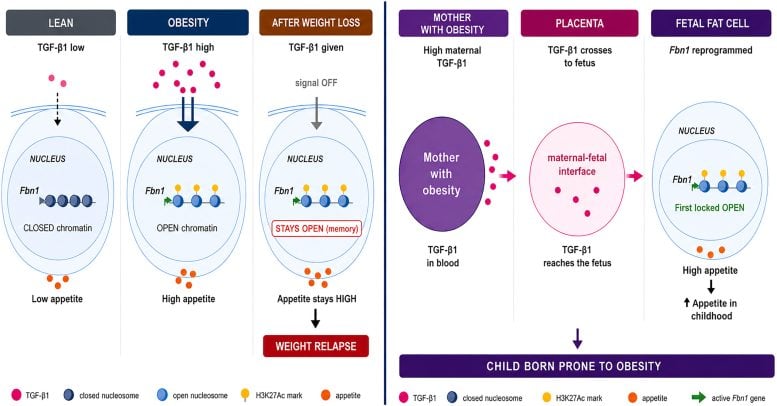
That change remained for weeks after TGF-β1 levels returned to normal. Even when mice shed all their excess weight, their fat cells continued producing more asprosin, which sustained a stronger appetite signal.
“It was like flipping a light switch that stays on even after you remove your finger,” said Dr. Chopra. “Even after mice lost all the excess weight and TGF-β1 returned to normal, this switch in their fat cells remained flipped, keeping asprosin and appetite elevated. This gives us a molecular explanation for why GLP-1 drugs, which suppress appetite while you take them, cannot fix the underlying biological memory that drives hunger back up once treatment ends. This same signal crosses the placenta and programs a baby’s fat cells before birth.”
Why Weight Can Return After Treatment
GLP-1 medications help people lose weight partly by reducing hunger and increasing feelings of fullness. However, they control appetite while treatment continues rather than erasing the cellular changes that may keep the body primed for renewed hunger. If the asprosin mechanism also functions in humans, it could help explain why weight commonly returns after these medications are discontinued.
The finding reinforces the view that obesity relapse is not simply a failure of discipline. According to Chopra, fat tissue can retain biological changes that continue influencing appetite long after a person has lost weight.
“We need to treat obesity as a condition that leaves lasting biological scars, not just a temporary state of excess weight,” he said.
Pharmaceutical companies are searching for treatments that can protect weight loss after medication ends. The newly identified pathway presents a possible complementary target. Instead of only suppressing appetite during active treatment, a future therapy might weaken the persistent signal that promotes rebound weight gain.
Blocking Obesity Memory In Mice
To test the pathway directly, the team interfered with it at several points, from the gene responsible for producing asprosin to the brain receptor that responds to the hormone. Blocking the pathway in mice prevented both weight regain after dieting and the transmission of increased obesity susceptibility from mothers to their offspring.
“These patterns have been observed for decades, but nobody knew the exact molecular mechanism that makes obesity so persistent or how it transmits across generations,” added Dr. Chopra. “We wanted to find the biological basis for that persistence.”
The researchers also tested whether the central result could be reproduced independently. A separate laboratory led by Seth J. Field, MD, PhD, confirmed that the cellular change persisted. Field is director of physician-scientist programs and chief scientific officer at the Harrington Discovery Institute at UH and a professor at Case Western Reserve School of Medicine. Analyses of existing mouse and human datasets provided additional evidence consistent with the findings.
The Next Test Is In People
The work offers a potential explanation for weight regain, but most of the experimental evidence comes from mice. Researchers now need to establish whether human fat cells retain the same epigenetic memory after weight loss and determine how strongly asprosin influences long-term weight outcomes in people.
The team also plans to investigate whether therapies can safely block asprosin or reset the epigenetic changes that keep its production elevated. Such treatments could potentially be paired with GLP-1 medications or used after them to help preserve weight loss.
“Given the need for durable obesity treatments, we are interested in whether asprosin-blocking therapies could be used alongside or after GLP-1 treatment to prevent rebound,” concluded Dr. Chopra.
Reference: “Adipose TGFβ-asprosin memory promotes obesity relapse and offspring obesity susceptibility” by Brian C. Kim, Hiba Obeid, Yi Fan Chen, Christopher Kim, Adam Lieberman, Bijoya Basu, Elizabeth S. Silva, Jingzhi Meng, Kyle Starost, Natalia Aladyshkina, Ila Mishra, Seth Field and Atul R. Chopra, 11 August 2026, Cell Reports.
DOI: 10.1016/j.celrep.2026.117809
Never miss a breakthrough: Join the SciTechDaily newsletter.
Follow us on Google and Google News.