

The fluid surrounding the brain may hold another clue to Alzheimer’s, with elevated levels of an enzyme called meprin-β raising the possibility of a new disease indicator.
One of the defining features of Alzheimer’s disease is the buildup of beta-amyloid, a protein fragment produced when enzymes cut a larger protein called amyloid precursor protein into pieces. Scientists studying this process have focused much of their attention on an enzyme called BACE1. Another enzyme, meprin-β, can also make one of the cuts involved, and new research is examining how it might be connected to the disease.
Researchers in Spain found higher levels of active meprin-β in brain tissue and cerebrospinal fluid, the fluid surrounding the brain and spinal cord, from people with Alzheimer’s. Experiments with human neurons also showed that exposure to beta-amyloid increased levels of the enzyme, suggesting a connection between the accumulating fragments and changes in meprin-β.
The work was led by Javier Sáez Valero, head of the Altered Molecular Mechanism in Alzheimer’s Disease and Dementia laboratory at the Institute for Neurosciences. The institute is a joint center of Miguel Hernández University of Elche and the Spanish National Research Council. The findings were published in Alzheimer’s Research & Therapy.
Active meprin-β increases in advanced Alzheimer’s
To understand what changes in patients’ brains, the team distinguished between two forms of meprin-β. Its immature form is inactive, while its mature form can carry out its work as an enzyme. Measuring them separately allowed the researchers to determine which form was elevated and at what stages of Alzheimer’s.
They examined samples from the frontal cortex of people with Alzheimer’s and compared them with samples from people without the disease. The Alzheimer’s samples were classified by Braak stage, a scale that describes the progression of disease-related changes in the brain.
The increase in active meprin-β appeared in the more advanced Braak stages, while no such increase was observed in the early stages. At intermediate and advanced stages, the researchers also found higher levels of messenger RNA from MEP1B, the gene that contains instructions for making meprin-β. Messenger RNA carries those instructions for protein production.
BACE1 and meprin-β can both act as β-secretases, enzymes that perform one of the cuts involved in generating beta-amyloid from amyloid precursor protein, also known as APP.
“Until now, much of the attention has focused on BACE1 as a relevant β-secretase in Alzheimer’s disease. Our work shows that there is another protein, meprin-β, whose active form is increased in the brain and cerebrospinal fluid of people with this disease”, explains Sáez Valero, the study’s principal investigator.
Beta-amyloid raises meprin-β in human neurons
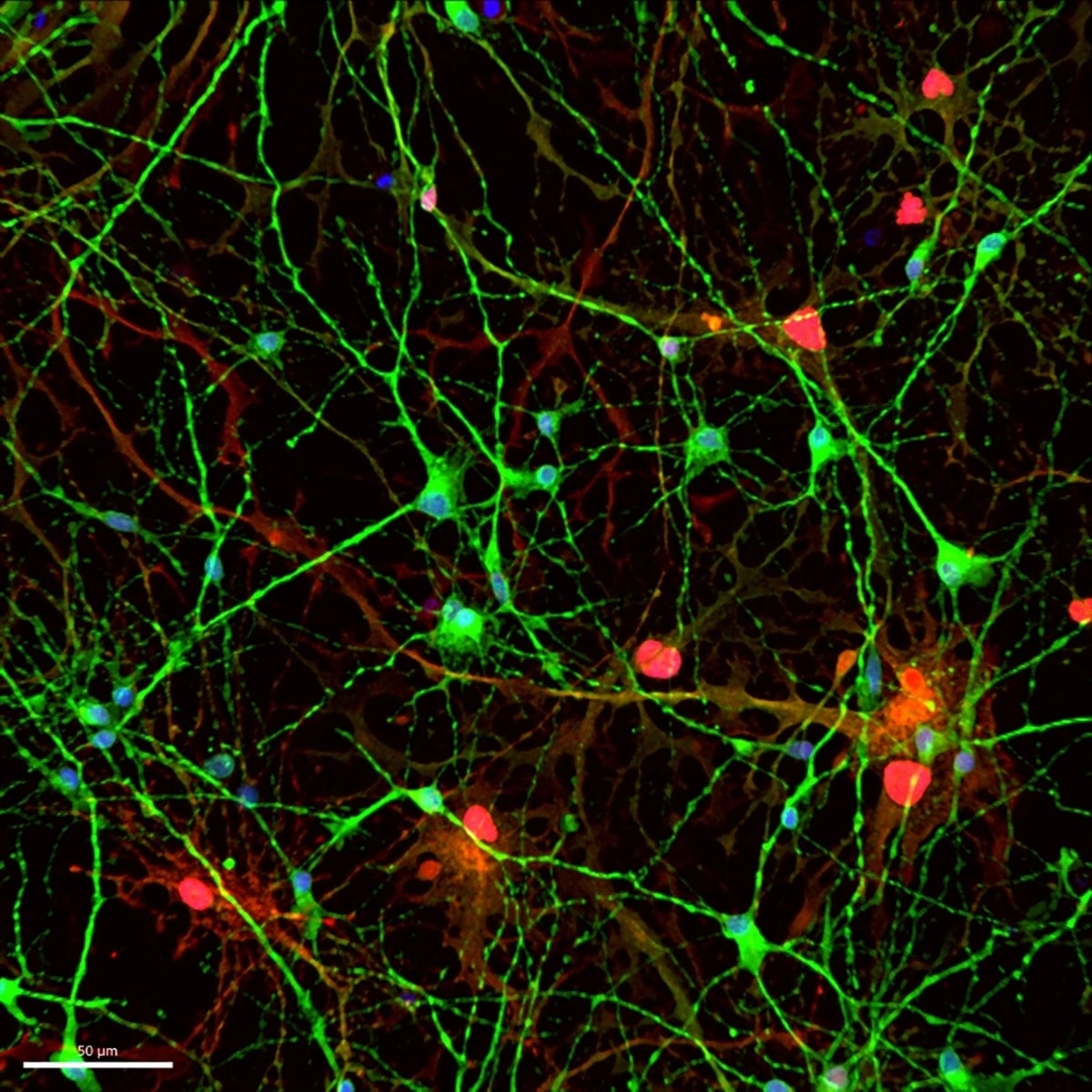
The patient samples established an association, while experiments allowed the team to investigate whether beta-amyloid could influence meprin-β levels. For these experiments, the researchers used human neurons grown from induced pluripotent stem cells, or iPSCs. These are cells reprogrammed into a state that allows them to develop into different cell types, including neurons.
Exposing the neurons to Aβ42, a form of beta-amyloid, produced a significant increase in meprin-β.

“When we expose human neurons to beta-amyloid, we also observe an increase in meprin-β. This provides an experimental link between one of the hallmarks of Alzheimer’s disease and the alteration we have found in patient samples,” explains Sergio Escamilla, the study’s first author.
A related finding came from genetically modified rats that develop disease-related changes associated with beta-amyloid accumulation. Their cerebrospinal fluid also contained increased levels of active meprin-β. Together, the experiments support a possible relationship between beta-amyloid and the enzyme, which the authors suggest could be involved in disease-related APP processing.
Could meprin-β be an Alzheimer’s indicator?
The finding in human cerebrospinal fluid also raises the possibility of using meprin-β as an indicator of Alzheimer’s. This fluid can be collected through a lumbar puncture and analyzed for molecules associated with processes occurring in the nervous system.
“Finding increased levels of the active form of meprin-β in cerebrospinal fluid raises new questions about its relationship with the changes that occur during the disease and its potential use as an indicator,” explains Sáez Valero.
Further studies are needed to determine whether measuring meprin-β could serve that purpose.
Reference: “Meprin-β levels are increased in the brain and the cerebrospinal fluid of Alzheimer’s disease patients” by Sergio Escamilla, Carlos Avilés-Granados, Carmen Márquez-Marco, Maximilian Keller, Irene Sánchez-Domínguez, Inmaculada Cuchillo-Ibáñez, Fernando Aguado, Henrik Zetterberg, Claus U. Pietrzik and Javier Sáez-Valero, 28 May 2026, Alzheimer’s Research & Therapy.
DOI: 10.1186/s13195-026-02092-7
This work was made possible thanks to funding from the Fondo de Investigaciones Sanitarias (FIS), the European Regional Development Fund (ERDF “Investing in your future”) of the European Union, the CIBERNED network of the Carlos III Health Institute, the CIAICO programme of the Direcció General de Ciència i Investigació of the Generalitat Valenciana, the Ministry of Science, Innovation and Universities, the State Research Agency and the Severo Ochoa Programme for Centres of Excellence.
Never miss a breakthrough: Join the SciTechDaily newsletter.
Follow us on Google and Google News.