
By simulating a billion years of Earth’s history, researchers have identified a possible window for life’s earliest chemistry around 4.33 billion years ago.
During its first few hundred million years, Earth was a hostile target. Asteroids, comets, and leftover planetesimals, smaller bodies remaining from planet formation, relentlessly battered the planet, generating intense heat that could sterilize the shallow crust and destroy chemical precursors to life.
For biological systems to take root, their delicate molecules required prolonged periods to form, remain intact, and interact. Researchers are particularly interested in finding when this stability emerged for the RNA World, a proposed early stage in biological history before DNA assumed its modern genetic role. Because RNA can hold genetic information and perform some of the chemical work needed for replication, scientists consider it a leading candidate for an early biological system.
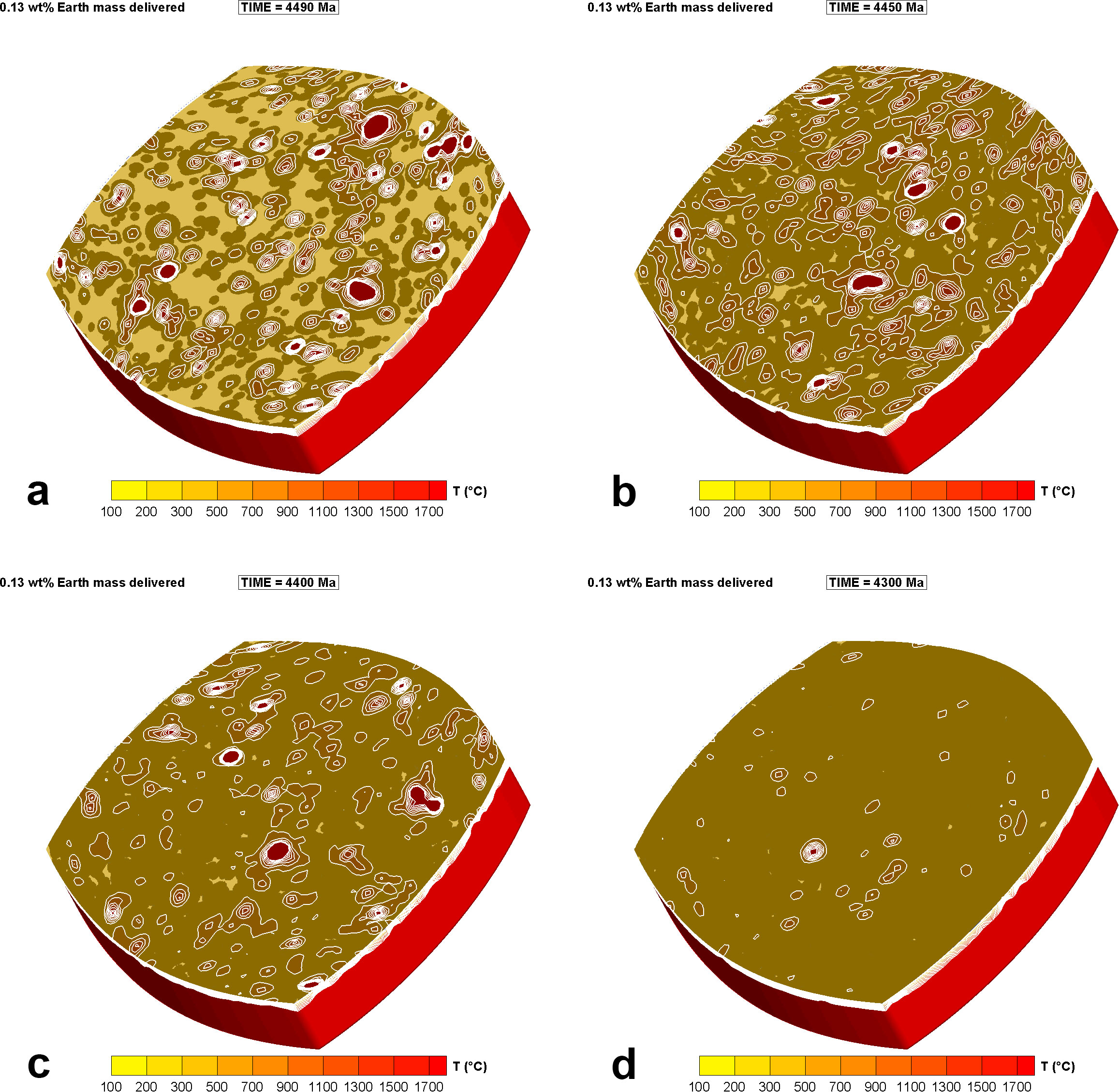
A three-dimensional computer model published in Nature Communications traces how the planet eventually settled down enough to support these fragile molecules. By simulating how impacts heated the crust between 4.5 and 3.5 billion years ago, researchers found that frequent global sterilization events continued until about 4.4 billion years ago.
Impact heat could fuel early chemistry
The same impacts that threatened fragile molecules could also create environments where the chemistry preceding life might develop. Water flowing through hot, fractured rock can establish a hydrothermal system, bringing together water, heat, and sources of chemical energy. Scientists have long considered these environments possible settings for the reactions that preceded life.
The researchers examined both sides of that relationship, comparing simulated crustal temperatures with the limits at which RNA and other molecules important to life remain stable while also tracking the hydrothermal environments’ impacts.
“We used a different approach than previous studies, which were based on geochemical modeling, biomolecular analyses, and models of early atmospheric chemistry,” said Oleg Abramov, a senior scientist at the Planetary Science Institute who co-led the study.
The team tested different estimates of how much material struck Earth during the modeled period. Evidence used to constrain the bombardment included highly siderophile elements, which readily associate with iron.
“We constructed an impact bombardment model constrained by observables such as the lunar cratering record and highly siderophile elements in the upper mantle. We examined both detrimental effects of impacts, such as temperature-induced degradation of key biomolecules, and effects conducive to life, such as generation of hydrothermal systems. These criteria point to the Earth becoming suitable for an early stage of life between 4.4 and 4.3 billion years ago, with optimal conditions at approximately 4.33 billion years ago.”
Where RNA could survive the bombardment
That estimate concerns conditions suitable for the chemistry associated with life’s origins, rather than establishing when life actually began. Around 4.3 billion years ago, the simulations showed especially abundant interconnected groups of hydrothermal systems generated by impacts. This activity overlapped with the emergence of more enduring environments in the shallow crust, where molecules could survive as the bombardment declined.
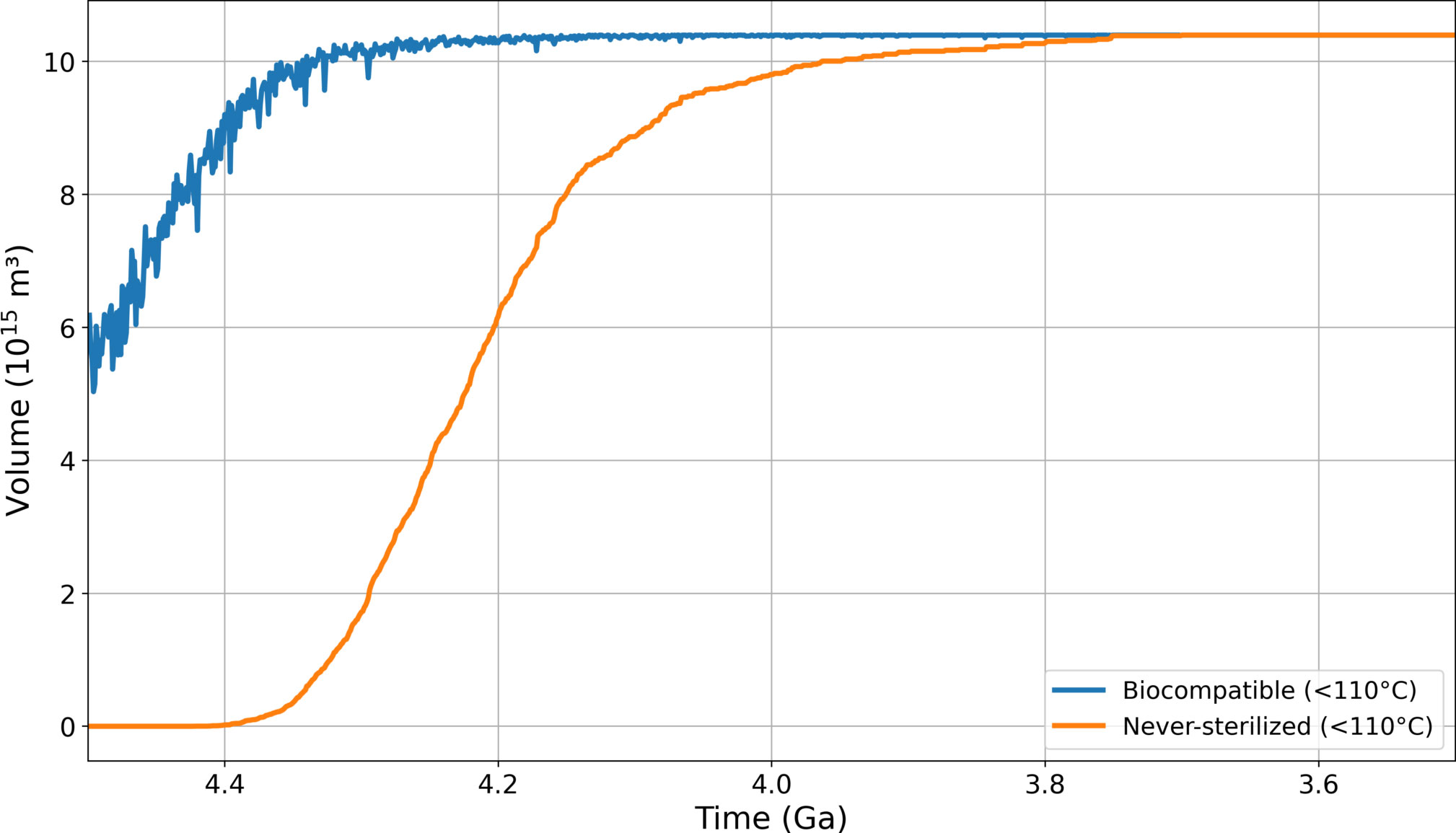
“Prebiotic chemistry needs continuously stable temperatures, not just a brief cool interval between impacts,” Abramov said. “Before about 4.4 billion years ago, a region that had cooled enough for prebiotic chemistry could still be heated again by a later impact, so the clock kept resetting. Once never-sterilized volumes appear, parts of the shallow crust stay below the temperature threshold from that time forward.”
These “never-sterilized” regions expanded as impacts became less frequent. By 4.25 billion years ago, they accounted for more than half of the modeled crustal volume.
Reference: “A Hadean timeline for the emergence of the RNA World” by Oleg Abramov, Anna Medvegy, Barbara Kremer and Stephen J. Mojzsis, 22 September 2026, Nature Communications.
DOI: 10.1038/s41467-026-76978-3
This work was supported by the ERC Horizon Europe funding program in support of the Synergy Grant – GEOASTRONOMY, grant agreement number 101166936 (to S.J.M., O.A.), funding from the Research Center for Astronomy and Earth Sciences (CSFK), an MTA Center of Excellence, in Budapest, Hungary (to A.M., O.A. and S.J.M.) and the Institute of Paleobiology, Polish Academy of Sciences (to B.K.). The idea for this paper was an outcome of the Biogeodynamics COST Action CA23150 “EUROBiG,” supported by the European Cooperation in Science and Technology.
Never miss a breakthrough: Join the SciTechDaily newsletter.
Follow us on Google and Google News.