
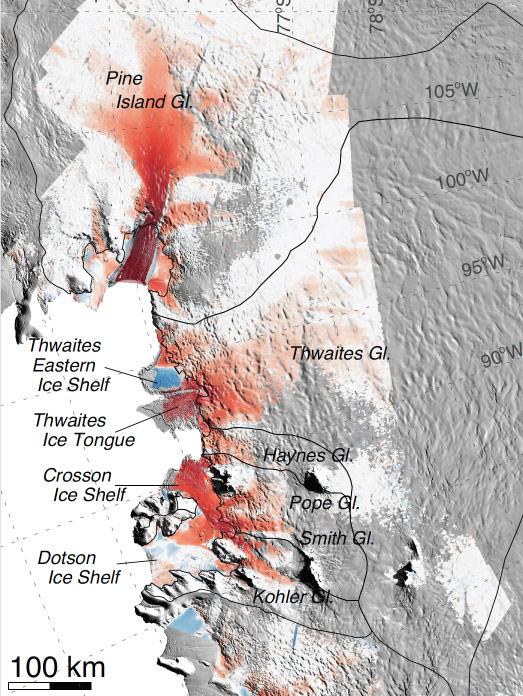
A new study led by NASA researchers presents multiple lines of evidence – incorporating 40 years of observations – that rapidly melting section of the West Antarctic Ice Sheet appears to be in an irreversible state of decline. A new ScienceCast video lays out the evidence for irreversible decline of the West Antarctic glaciers.
Over the years, as temperatures around the world have ratcheted upward, climate change researchers have kept a wary eye on one place perhaps more than any other: The West Antarctic Ice Sheet, and particularly the fastest melting part of it, the glaciers that flow into the Amundsen Sea.
In that region, six glaciers hang in a precarious balance, partially supported by land, and partially floating in waters just offshore. There’s enough water frozen in the ice sheet that feeds these icy giants to raise global sea levels by 4 feet (1.2 meters) —if they were to melt. That’s troubling because the glaciers are melting. Moreover, a new study finds that their decline appears to be unstoppable.
ScienceCasts: No Turning Back – West Antarctic Glaciers in Irreversible Decline – A new study led by NASA researchers shows that half-a-dozen key glaciers in the West Antarctic Ice Sheet are in irreversible decline. The melting of these sprawling icy giants will affect global sea levels in the centuries ahead.
“We’ve passed the point of no return,” says Eric Rignot, a glaciologist working jointly at NASA’s Jet Propulsion Laboratory and the University of California, Irvine. Rignot and colleagues have used 19 years of satellite radar data to map the fast-melting glaciers. In their paper, which has been accepted for publication in Geophysical Research Letters, they conclude that “this sector of West Antarctica is undergoing a marine ice sheet instability that will significantly contribute to sea level rise” in the centuries ahead.
A key concept in the Rignot study is the “grounding line”—the dividing line between land and water underneath a glacier. Because virtually all melting occurs where the glaciers’ undersides touch the ocean, pinpointing the grounding line is crucial for estimating melt rates.
The problem is, grounding lines are buried under thousands of feet of glacial ice. “It’s challenging for a human observer to figure out where they are,” Rignot explains. “There’s nothing obvious that sticks out on the surface to say, ‘This is where the glacier goes afloat.’”
To find the hidden grounding lines, they examined radar images of the glaciers made by the European Space Agency’s Earth Remote Sensing satellites from 1992 to 2011. Glaciers flex in response to tides. By analyzing the flexing motions, they were able to trace the grounding lines.
This led to a key discovery. In all the glaciers they studied, grounding lines were rapidly retreating away from the sea.
Animation – Loss of West Antarctic Glaciers Appears Unstoppable
“In this sector, we are seeing retreat rates that we don’t see anywhere else on Earth,'” Rignot says. Smith Glacier’s line moved the fastest, retreating 22 miles upstream. The other lines retreated from 6 to 19 miles (10 to 31 kilometers).
As the glaciers melt and lose weight, they float off the land where they used to sit. Water gets underneath the glacier and pushes the grounding line inland. This, in turn, reduces friction between the glacier and its bed. The glacier speeds up, stretches out, and thins, which drives the grounding line to retreat farther inland.
This is a “positive feedback loop” that leads to out-of-control melting.
The only natural factor that can slow or stop this process is a “pinning point” in the bedrock — a bump or projection that snags the glacier from underneath and keeps it from sliding toward the sea. To investigate this possibility, the researchers made a novel map of the bed beneath the glaciers using radar and other data from satellites and NASA’s airborne IceBridge mission. The map revealed that the glaciers had already floated off many of their small pinning points.
In short, there seems to be no turning back.
“At current melt rates,” concludes Rignot, “these glaciers will be ‘history’ within a few hundred years.”
Reference: “Sustained increase in ice discharge from the Amundsen Sea Embayment, West Antarctica, from 1973 to 2013” by J. Mouginot, E. Rignot and B. Scheuchl, 12 February 2014, Geophysical Research Letters.
DOI: 10.1002/2013GL059069
PDF
Never miss a breakthrough: Join the SciTechDaily newsletter.
Follow us on Google and Google News.
1 Comment
The scary thing is that the maximal sea level rise is about 260 ft or about 80 meters and it only depends on supported ice sliding into the ocean not necessarily melting.