
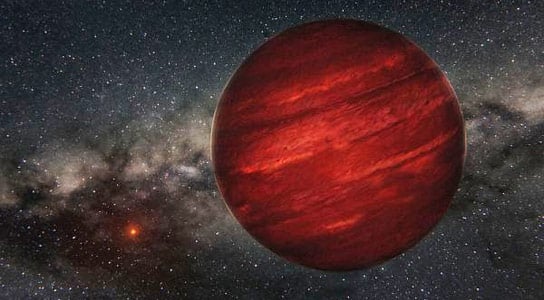
Researchers at the University of Montreal have discovered a gas giant exoplanet, called GU Psc b, that is around 2,000 times the Earth-Sun distance from its star, a record among exoplanets.
A gas giant has been added to the short list of exoplanets discovered through direct imaging. It is located around GU Psc, a star three times less massive than the Sun and located in the constellation Pisces. The international research team, led by Marie-Ève Naud, a PhD student at Université de Montréal’s Department of Physics, was able to find this planet by combining observations from the Observatoire Mont-Mégantic (OMM), the Canada-France-Hawaii Telescope (CFHT), the W.M. Keck Observatory, and the Gemini North and South Observatories.
A distant planet that can be studied in detail
GU Psc b is around 2,000 times the Earth-Sun distance from its star, a record among exoplanets. Given this distance, it takes approximately 80,000 Earth years for GU Psc b to make a complete orbit around its star! The researchers also took advantage of the large distance between the planet and its star to obtain images. By comparing images obtained in different wavelengths (colors) from the OMM and CFHT, they were able to correctly detect the planet.
“Planets are much brighter when viewed in infrared rather than visible light, because their surface temperature is lower compared to other stars,” Naud said. “This allowed us to identify GU Psc b.”
Knowing where to look
The researchers were looking around GU Psc because the star had just been identified as a member of the young star group AB Doradus. Young stars (only 100 million years old) are prime targets for planetary detection through imaging because the planets around them are still cooling and are therefore brighter. This does not mean that planets similar to GU Psc b exist in large numbers, as noted by by Étiene Artigau, co-supervisor of Naud’s thesis and astrophysicist at Université de Montréal. “We observed more than 90 stars and found only one planet, so this is truly an astronomical oddity!”
Observing a planet does not directly allow its mass to be determined. Instead, researchers use theoretical models of planetary evolution to determine its characteristics. The light spectrum of GU Psc b obtained from the Gemini North Observatory in Hawaii was compared to such models to show that it has a temperature of around 800°C. Knowing the age of GU Psc due to its location in AB Doradus, the team was able to determine its mass, which is 9-13 times that of Jupiter.
In the coming years, the astrophysicists hope to detect planets that are similar to GU Psc but much closer to their stars, thanks, among other things, to new instruments such as the GPI (Gemini Planet Imager) recently installed on Gemini South in Chile. The proximity of these planets to their stars will make them much more difficult to observe. GU Psc b is therefore a model for better understanding these objects.
“GU Psc b is a true gift of nature. The large distance that separates it from its star allows it to be studied in depth with a variety of instruments, which will provide a better understanding of giant exoplanets in general,” said René Doyon, co-supervisor of Naud’s thesis and OMM Director.
The team has started a project to observe several hundred stars and detect planets lighter than GU Psc b with similar orbits. The discovery of GU Psc, a rare object indeed, raises awareness of the significant distance that can exist between planets and their stars, opening the possibility of searching for planets with powerful infrared cameras using much smaller telescopes such as the one at the Observatoire du Mont-Mégantic. The researchers also hope to learn more about the abundance of such objects in the next few years, in particular, using GPI instruments, the CFHT’s SPIRou, and the James Webb Space Telescope’s FGS/NIRISS.
Reference: “Discovery of a wide planetary-mass companion to the young M3 star GU Psc” by Marie-Eve Naud, Étienne Artigau, Lison Malo, Loïc Albert, René Doyon, David Lafrenière, Jonathan Gagné, Didier Saumon, Caroline V. Morley, France Allard, Derek Homeier, Charles A. Beichman, Christopher R. Gelino and Anne Boucher, 28 April 2014, The Astrophysical Journal.
DOI: 10.1088/0004-637X/787/1/5
arXiv: 1405.2932
Never miss a breakthrough: Join the SciTechDaily newsletter.
Follow us on Google and Google News.
2 Comments
Forget miles or au’s etc. what does the math work out to as far as light days/ weeks etc. distance from its star? and are we sure this isn’t a brown dwarf binary companion?
My estimation is about 11 light days .