
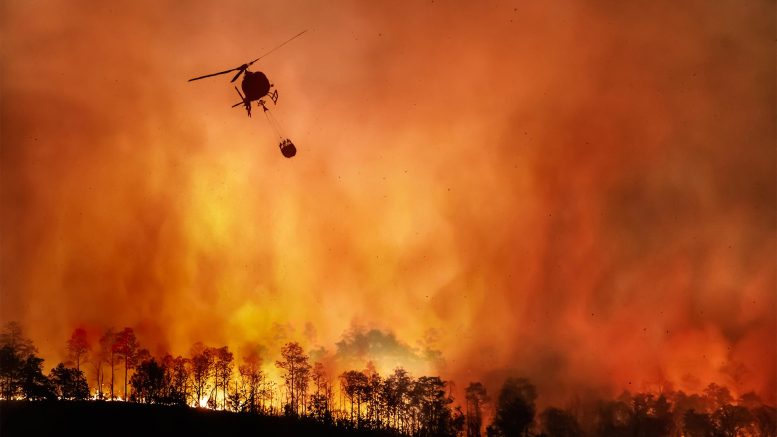
Human-ignited fires drive most PM2.5-related premature deaths in the U.S.
Over 80% of premature deaths caused by small smoke particles in the United States result directly from human-ignited fires. This is the outcome of a study published today (January 16, 2023) in IOP Publishing’s journal Environmental Research Letters.
The new study, led by researchers at the Massachusetts Institute of Technology, analyses the impact of smoke particles on air quality in the United States. Their research shows that human-ignited fires account for more than 67% of small smoke particles called PM2.5 in the United States. These particles are known to degrade air quality, causing respiratory illnesses and premature death.
The level of fire activity in the US is on the rise. The research team estimate that smoke from human-ignited fires was responsible for 20,000 premature deaths in 2018 alone, a year with a high frequency of fire events — a substantial portion of which were associated with human ignitions such as agricultural and human-lit fires. This is 270% more than there were in 2003, when there was a low frequency of fire events. The research highlights that during high fire activity years, there are much higher concentrations of smoke PM2.5 in the air.
PM2.5 in Air Pollution and Health Risks
Dr. Therese Carter, lead author of the study, said: “Fires not only threaten human lives, infrastructure, and ecosystems, but they are also a major cause for concern in terms of air quality. High levels of smoke exposure can negatively impact human health resulting in conditions such as respiratory infections, lung cancer, heart disease, and even premature births. Our results show that a large and significant portion of harmful smoke particles result directly from human-lit fires.”
The team used the Global Fire Emissions Database to quantify agricultural fire emissions, then classify these fires into two categories: human vs. natural ignition. Applying a chemical transport model, they simulate the concentration of smoke particles across the United States, concluding that a significant portion of PM2.5 in the US results from human-ignited fires and thus has the potential to be managed.
Policy Recommendations to Reduce Human-Ignited Fires
To limit the devastating effects of pollution from small smoke particles, the team recommends an ignition-focused approach. State agencies can implement management plans to restrict the ignition of agricultural fires to periods when weather conditions would minimize health impacts. However, human-ignited wildfires are much harder to manage due to their sporadic and unplanned nature.
Carter concludes, “Now we know that humans can play a pivotal role in reducing PM2.5 concentrations, we should be putting policies, regulations, and management plans in place to reduce human-ignited fires. Efforts to minimize human-ignited fires should be focused on certain regions and ignition types in order to be more successful. Identifying and acknowledging the sources of these particles is the first step in a cleaner, healthier future.”
Reference: “Large mitigation potential of smoke PM2.5 in the US from human-ignited fires” by Therese S Carter, Colette L Heald and Noelle E Selin, 16 January 2023, Environmental Research Letters.
DOI: 10.1088/1748-9326/aca91f
Never miss a breakthrough: Join the SciTechDaily newsletter.
Follow us on Google and Google News.