
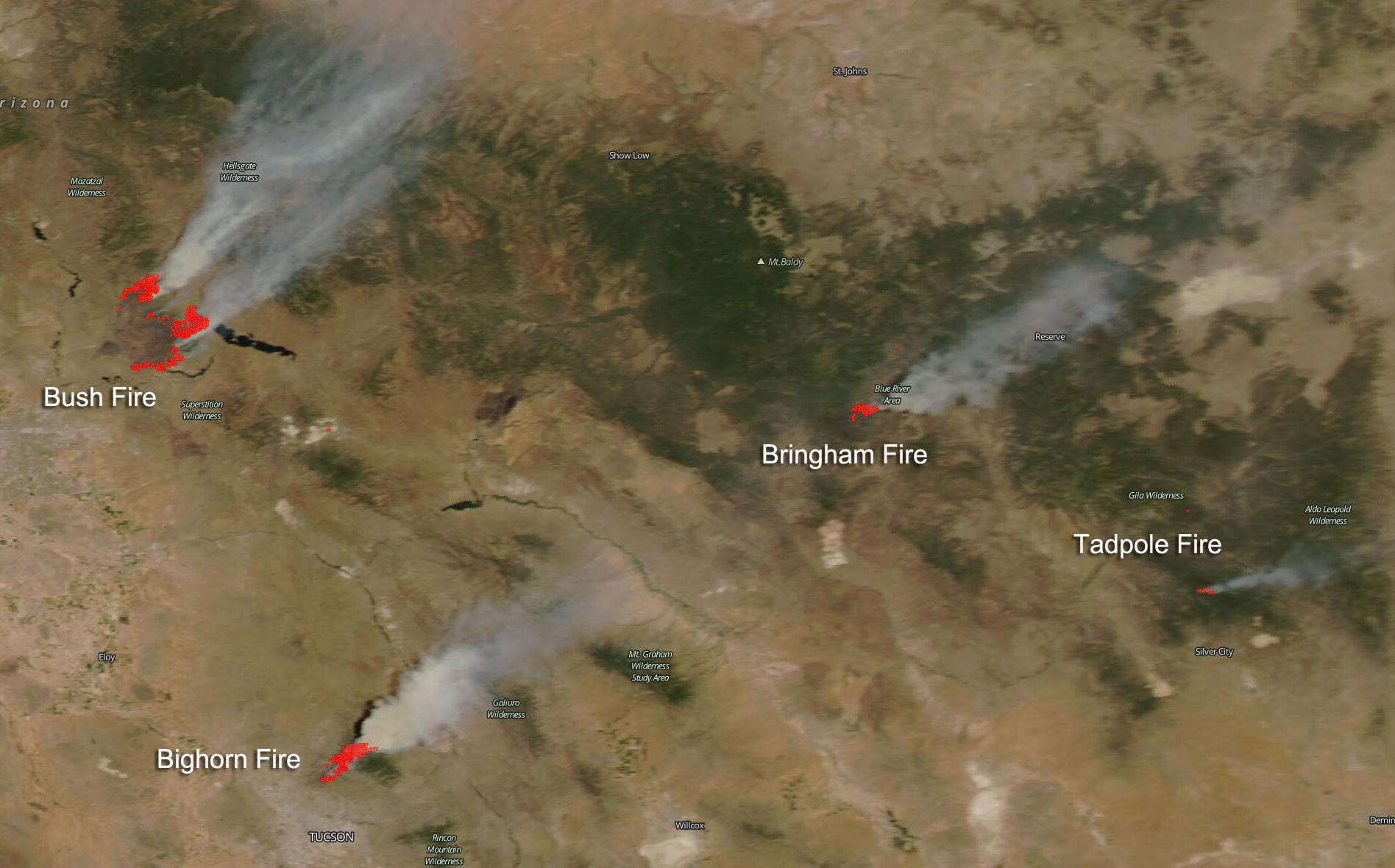
It is still relatively early in the wildfire season out West but already wildfires are crossing the state of Arizona and heading into New Mexico. Four large wildfires were captured by the Aqua satellite on June 17, 2020, in this image. Three of them are in Arizona and one is inside the state line of New Mexico.
The Bush Fire is by far the largest of the four at 114,941 and is only 5 percent contained. This fire began on Saturday, June 13, 2020, and it has been determined that this fire was human-caused. The Bush Fire is located in the Tonto National Forest, about 8 miles (13 kilometers) northeast of Mesa, Arizona along Hwy 87. Due to the growth of the fire and its movement near communities, Emergency Management Services in Gila and Maricopa counties are evacuating Apache Lake, Sunflower, Punkin Center, and Tonto Basin. Weather concerns regarding fire growth include hot, dry conditions, coupled with increased winds which will continue to push the fire to the north, northeast, and southeast. There is also an abundance of fuel for the fire with invasive grasses in the desert ecosystem, native grasses, and low fuel moisture in the live plants.
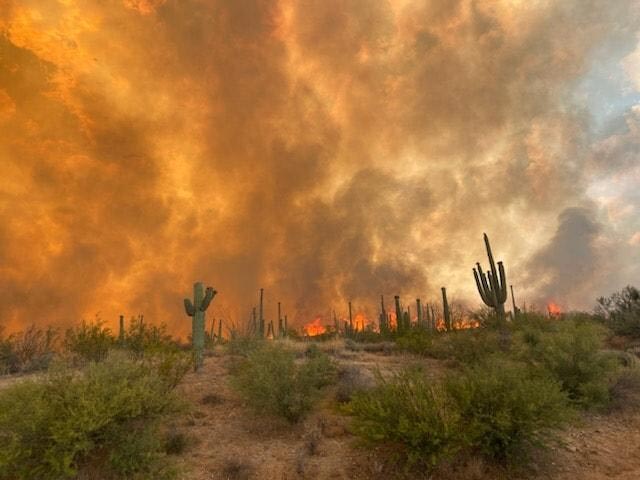
The second fire, located to the south of the Bush Fire, is the Bighorn Fire. This fire began on June 05, 2020, with a lightning strike in the Catalina Mountains of the Coronado National Forest. This fire has consumed 23,892 acres (97 square kilometers) and is 40 percent contained. Dry, windy conditions have pushed the fire closer to communities and is now forcing evacuations. Weather concerns include, “Maximum temperatures from the upper 70s (upper 20s Celsius) in the upper elevations to 102 degrees Fahrenheit (39 degrees Celsius) on the valley floor and minimum relative humidity values were between 5 and 8 percent on the valley floor and 9 to 14 percent in the upper elevations.” Earlier red flag warnings were in effect due to 20-foot (6-meter) winds southwest at 15 to 25 mph (24 to 40 kph), with a maximum gust to around 30 mph (48 kph) on the valley floor and 45 mph (72 kph) at Mt. Lemmon Ski Valley. The project incident activity is that: “This fire will likely continue around Cathedral Rock and work its way down Ventana, Esperero, and Romero Canyon.”

The third fire in this image located in the middle of the satellite photo is the Bringham fire which began on June 06, 2020, also with a lightning strike. This fire has burned 15,398 acres and is 5 percent contained. The Bringham fire is located 22 miles north of Morenci, Arizona, is currently burning on the Clifton Ranger District of the Apache-Sitgreaves National Forests. Forecasters are expecting thunderstorms in the fire area with gusty and erratic winds. The weather continues hot and dry, increasing into next week. Red Flag conditions are also expected. The Bringham Fire is burning in steep inaccessible terrain. Only indirect fire attack is possible.

The last and smallest fire in the NASA Aqua satellite image is the Tadpole fire which is located 12 miles (19 kilometers) north of Silver City, New Mexico near the Gila National Forest. It also began during the thunderstorms on June 6, 2020, with a lightning strike. It is currently (as of today) 6,800 acres (28 square kilometers) and is 30 percent contained. Overall, the fire’s spread is still slow, however, the major weather concern with this fire is that moisture that had been in the area has pushed out and the area is trending back to typical mid-June heat and dryness which would most likely cause the fire to expand.
NASA’s satellite instruments are often the first to detect wildfires burning in remote regions, and the locations of new fires are sent directly to land managers worldwide within hours of the satellite overpass. Together, NASA instruments detect actively burning fires, track the transport of smoke from fires, provide information for fire management, and map the extent of changes to ecosystems, based on the extent and severity of burn scars. NASA has a fleet of Earth-observing instruments, many of which contribute to our understanding of fire in the Earth system. Satellites in orbit around the poles provide observations of the entire planet several times per day, whereas satellites in a geostationary orbit provide coarse-resolution imagery of fires, smoke and clouds every five to 15 minutes.
NASA’s Earth Observing System Data and Information System (EOSDIS) Worldview application provides the capability to interactively browse over 700 global, full-resolution satellite imagery layers and then download the underlying data. Many of the available imagery layers are updated within three hours of observation, essentially showing the entire Earth as it looks “right now.” Actively burning fires, detected by thermal bands, are shown as red points.
Never miss a breakthrough: Join the SciTechDaily newsletter.
Follow us on Google and Google News.
2 Comments
What is a “20-foot wind?”
That means 20 feet above the surface. “A 20-foot wind is the sustained wind speed averaged over a 10-minute period at a height of 20 feet above the surface.”