
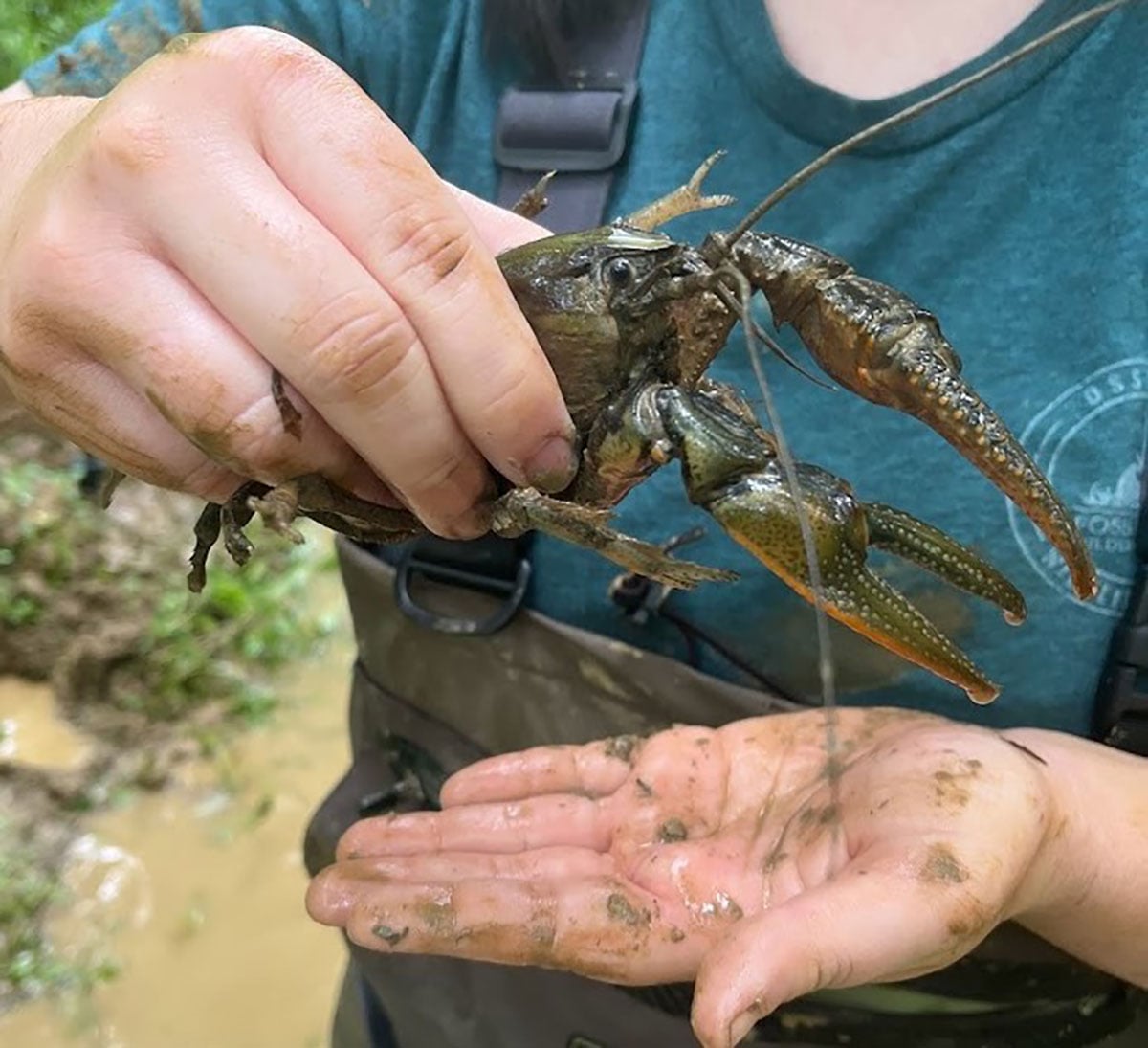
The search for North America’s biggest crayfish has turned a friendly rivalry into a scientific question about what limits their growth.
A Tennessee bottlebrush crayfish in a West Virginia university collection has taken the top spot in a new ranking of North America’s largest known crayfish. Its carapace, the hard shell covering its head and midsection, measures 86.6 millimeters, or about 3.4 inches, without counting the tail, claws, or antennae.
The specimen, housed at West Liberty University, led a list of 20 large individuals representing 18 species. The rankings, published in Ecology, grew out of a friendly disagreement that sent researchers searching through museum collections around the country.
Museum specimens settle a crayfish rivalry
Caitlin Bloomer had pulled a huge crayfish known as a Crawzilla crawdad from the muck during a biological survey in Kentucky. A teaching assistant professor in the Department of Natural Resources and Environmental Sciences in the College of Agricultural, Consumer, and Environmental Sciences at the University of Illinois Urbana-Champaign, she brought the animal back to campus.
“I thought, ‘There’s no doubt I have caught the biggest crayfish anyone’s ever seen!’ I brought it back to campus to show my colleague, naturally bragging about having caught the biggest-ever crayfish. But, as all biologists and sport fisherman do, he took one look and said, ‘No way, I’ve caught bigger,’” Bloomer said.
To settle the question, Bloomer enlisted biologists and museum curators to find the largest specimens in their collections. The researchers used calipers, tools for taking precise measurements, to compare the animals and determine their places in the rankings.
Six of the top 20 came from the Illinois Natural History Survey, part of the university’s Prairie Research Institute. Another four belonged to the Smithsonian Institution’s National Museum of Natural History.
“I knew we had some massive crayfish in the West Liberty University Astacology Collection, but it was a surprise to learn we had the two largest specimens known from North America! Our record-holder, a Tennessee bottlebrush crayfish collected by Dr. Zac Loughman and West Liberty students back in 2011, shows just how amazing and diverse crayfish can be,” said Zackary Graham, an assistant professor of biology at West Liberty University. “Its carapace alone is about the length of a credit card, and with the tail and claws, it stretches nearly the width of a sheet of notebook paper. Both of these giants are now proudly displayed in my office, and I show them to just about everyone who walks in.”
“Mine was not the biggest, but it did make the top 20, so I’m super proud of it,” Bloomer said. “And it was also the only burrowing crayfish to make the list, so I’ll take the win.”
What keeps North American crayfish smaller?
Comparing specimens across collections provided some of the first estimates of maximum size for North American crayfish. Those measurements also allowed the researchers to investigate whether the largest animals shared environmental conditions that might help explain their growth.
“They all seemed to max out around that 80-millimeter mark, but we weren’t sure why, especially given that there are absolutely massive crayfish in other parts of the world,” Bloomer said. “We started looking at things like latitude, oxygen availability, and habitat type as possible correlates to explain why certain species and individuals were larger than others, but we weren’t seeing any patterns.”
Without a clear environmental explanation, the researchers suspect that the limits may come from the animals’ own bodies. The makeup of their exoskeletons, or outer coverings, and aspects of their muscles could constrain how large they become. Those possibilities remain to be tested.
“This was a case where we saw something unusual in the field, and it sparked a future research direction,” Bloomer said. “We think that it could really be worthwhile to look at the physiology of crayfish to see if something there is influencing their body size.”
Bloomer said the team could address this basic question only by drawing on museum collections, underscoring the scientific value of these public resources. Even for animals familiar to generations of creek explorers, those collections can help fill gaps in what researchers know.
“Anyone that goes to a stream as a kid knows what crayfish are — they’re almost a universal onboarding for people to care about aquatic life. I still go out with people who are in their 50s or 60s, who recall catching crawfish in the creek when they were seven,” Bloomer said. “It’s just amazing how much we still have to learn about them.”
Reference: “North American crayfish: A quest for the biggest catch” by Caitlin C. Bloomer, Susan B. Adams, Zanethia C. Barnett, Zackary A. Graham, Emmy M. Delekta, David M. Hayes, Zachary J. Loughman, Hugh MacIntosh, M. Worth Pugh, Karen Reed, Nathaniel F. Shoobs, Christopher A. Taylor and Eric R. Larson, 4 September 2026, Ecology.
DOI: 10.1002/ecy.70471
Never miss a breakthrough: Join the SciTechDaily newsletter.
Follow us on Google and Google News.