
Close Menu
    Facebook X (Twitter) Instagram
    SciTechDaily
    • Biology
    • Chemistry
    • Earth
    • Health
    • Physics
    • Science
    • Space
    • Technology
    Facebook X (Twitter) Pinterest YouTube RSS
    SciTechDaily
    Home»Biology»European Catfish Learn to Catch Pigeons
    Biology

    European Catfish Learn to Catch Pigeons

    By SciTechDailyDecember 7, 20122 Comments2 Mins Read
    Facebook Twitter Pinterest Telegram LinkedIn WhatsApp Email Reddit
    Share
    Facebook Twitter LinkedIn Pinterest Telegram Email Reddit
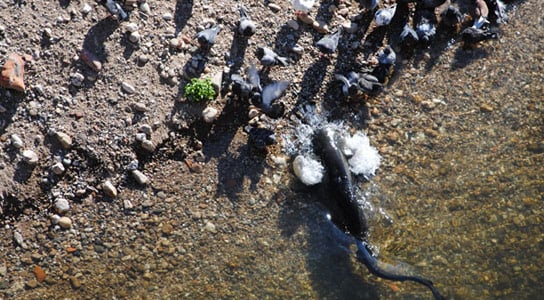
    predatory-catfish-pigeons
    Cucherousset, Bouletreau, Azemar, Compin, Guillaume & Santoul. 2012. ‘‘Freshwater Killer Whales’’: Beaching Behavior of an Alien Fish to Hunt Land Birds. Credit: PLOS ONE, DOI: 10.1371/journal.pone.0050840

    A group of European catfish in Southwestern France has learned to catch pigeons, as they get close to the River Tarn. European catfish (Silurus glanis) can grow up to 1 to 1.5 meters (3.3 to 4.9 feet) long and are the largest freshwater fish in Europe.

    The scientists published their findings in the journal PLOS ONE. S. glanis accomplishes this feat by lunging out of the water, grabbing a pigeon, and then wriggling back into the water to swallow their prey. This process leaves the fish stranded on land for a few seconds.
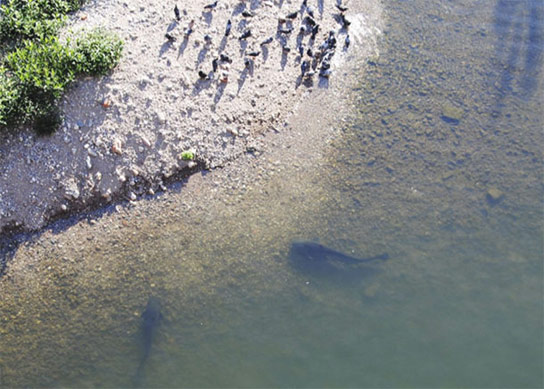
    predatory-catfish-pigeons-in-wait
    Cucherousset, Bouletreau, Azemar, Compin, Guillaume & Santoul. 2012. ‘‘Freshwater Killer Whales’’: Beaching Behavior of an Alien Fish to Hunt Land Birds. Credit: PLOS ONE, DOI: 10.1371/journal.pone.0050840

    Bottlenose dolphins have been observed using a similar technique in South Carolina, as have Argentinian killer whales, which actually swim onto beaches to snag resting sea lions. Researchers were alerted to this behavior by local fishermen. Over the summer of 2011, they filmed 54 attacks, of which 28% were successful.

    The erect barbels on S. glanis‘ upper jaws, combined with the fact that only moving pigeons were attacked, indicate that the fish are sensing the vibrations of the birds as they approach the water.

    For now, scientists don’t know what prompted this predatory behavior on the part of S. glanis and whether they gain any benefit from it. S. glanis was introduced to Tarn in 1983 and the breed is flourishing. It’s possible that the catfish have eaten too many of the local fish and have been forced to seek additional prey.

    Reference: ““Freshwater Killer Whales”: Beaching Behavior of an Alien Fish to Hunt Land Birds” by Julien Cucherousset, Stéphanie Boulêtreau, Frédéric Azémar, Arthur Compin, Mathieu Guillaume and Frédéric Santoul, 5 December 2012, PLOS ONE.
    DOI: 10.1371/journal.pone.0050840

    Never miss a breakthrough: Join the SciTechDaily newsletter.
    Follow us on Google and Google News.

    Behavioral Science Ecology Fish Marine Biology Popular Zoology
    Share. Facebook Twitter Pinterest LinkedIn Email Reddit

    Related Articles

    Underwater Robot “Lassie” Finds Thousands of Icefish Nests Beneath Antarctic Ice

    DNA Revelations: “Extinct” Fish Is Alive and Well!

    Lessons From a Failed Experiment: When “Eradicated” Species Bounce Back With a Vengeance

    Fish Poop Helps Remove 1.65 Billion Tons of Carbon From the Atmosphere Each Year

    Wild Animals Lose Fear of Predators Quickly After They Start Encountering Humans

    Birdsongs Elicit “Emotional” Response From Birds

    Homosexual Behavior Among Fish Increases Attractiveness to Females

    Humans Are a Greater Disturbance to Elk Than Natural Predators

    Captive Beluga Whale Was Able to Mimic Speech

    2 Comments

    1. Saikat on April 22, 2013 12:47 pm

      Might be process of eolution taking a step ahead. If it goes like this, In two or three hundred years they will adapt to survive on land & there fins will became paws giving them the chance will prove Darwinism…..or not.
      It’s worth of…..
      Infinite Possibilities…..

      Reply
      • Rick Priest on May 29, 2026 10:30 am

        I have seen pictures of these or similar catfish in southern France swallowing swimming ducks. No idea of time perhaps twenty years ago.

        Reply
    Leave A Reply Cancel Reply

    • Facebook
    • Twitter
    • Pinterest
    • YouTube

    Don't Miss a Discovery

    Subscribe for the Latest in Science & Tech!

    Trending News

    The Best Exercise Combination for Longevity, According to a 30-Year Study

    Popular Weight-Loss Drug Found To Slow Biological Aging in Landmark Human Trial

    NASA’s Fermi Telescope Caught a Supernova Doing Something Never Seen Before

    This Dinosaur Had the Claws of a Raptor but Hunted Like a Heron

    Doctors May Need To Rethink Calcium and Vitamin D Recommendations After Major Review

    Scientists Discover a Hidden Cause of Cellular Aging That Can Be Reversed

    Archaeologists Have Found Something Unexpected Inside a 1,600-Year-Old Egyptian Mummy

    Scientists May Have Found a Completely New Way To Treat Depression

    Follow SciTechDaily
    • Facebook
    • Twitter
    • YouTube
    • Pinterest
    • Newsletter
    • RSS
    SciTech News
    • Biology News
    • Chemistry News
    • Earth News
    • Health News
    • Physics News
    • Science News
    • Space News
    • Technology News
    Recent Posts
    • A Newly Found Cellular Shift May Explain Why Aging Leads to Disease
    • A Normal Kidney Test Could Still Signal Serious Risk
    • Scientists Discover Gut Signal That Turns Off Sugar Cravings
    • NASA Captures Typhoon Jangmi’s Massive Eye in Stunning Nighttime Image
    • Super Typhoon Sinlaku Was So Powerful It Made the Sky Ripple With Gravity Waves
    Copyright © 1998 - 2026 SciTechDaily. All Rights Reserved.
    • Science News
    • About
    • Contact
    • Editorial Board
    • Privacy Policy
    • Terms of Use

    Type above and press Enter to search. Press Esc to cancel.