

When the massive A68 iceberg calved from the Larsen C Ice Shelf, it exposed a hidden world beneath the Antarctic ice.
Using underwater robots, scientists found thousands of organized fish nests stretching across the seafloor like a vast city. The discovery highlights Antarctica’s surprising biodiversity and the urgent need to safeguard its fragile habitats.
Hidden Worlds Beneath Antarctic Ice
In a remote part of Antarctica’s Western Weddell Sea, scientists have identified a remarkable discovery in an area that had been buried beneath a 200-meter-thick ice shelf. Once the ice retreated, they found large, well-maintained fish nesting grounds arranged in clear and deliberate patterns.
The opportunity to study this hidden environment began when the A68 iceberg, covering 5,800 square kilometres, broke away from the Larsen C Ice Shelf in 2017. The newly exposed seafloor became accessible to a remotely operated vehicle (ROV), which revealed more than 1,000 circular nests. Each nest had been cleared of the plankton detritus that coated the surrounding seabed, and together they formed structured, geometric groupings rather than a random scatter of depressions.
These sand dimples mark the cleaned nests: some appear individually at the bottom right, others create sweeping curves near the center, and some gather into clusters toward the top left. All have been swept free of the thick layer of phytoplankton detritus that still blankets nearby areas – seen vividly in the center-top image.
Nests of the yellowfin notie (Lindbergichthys nudifrons). Each nest would have been guarded by a parent fish, protecting their eggs from predators. This remarkable organization is thought to be a survival strategy. Credit: Weddell Sea Expedition 2019
The Weddell Sea Expedition: Science and History Intertwined
The Weddell Sea Expedition of 2019 set out with two major goals. One was to carry out a broad scientific study in the waters around the Larsen C Ice Shelf. The other was to search for, survey, and photograph the wreck of Sir Ernest Shackleton’s ship, the Endurance, lost in 1915. Scientists were particularly motivated by the role Antarctic ice shelves play in regulating global sea levels. These floating platforms help hold back ice from the Antarctic interior. When they thin or collapse, that stabilizing effect disappears, allowing ice to flow more quickly into the ocean and raise sea levels.
The calving of iceberg A68 made the timing ideal. It opened a previously inaccessible part of the seabed, giving researchers a rare chance to study an area undergoing rapid environmental change and to collect data from regions that had long been sealed beneath the ice.
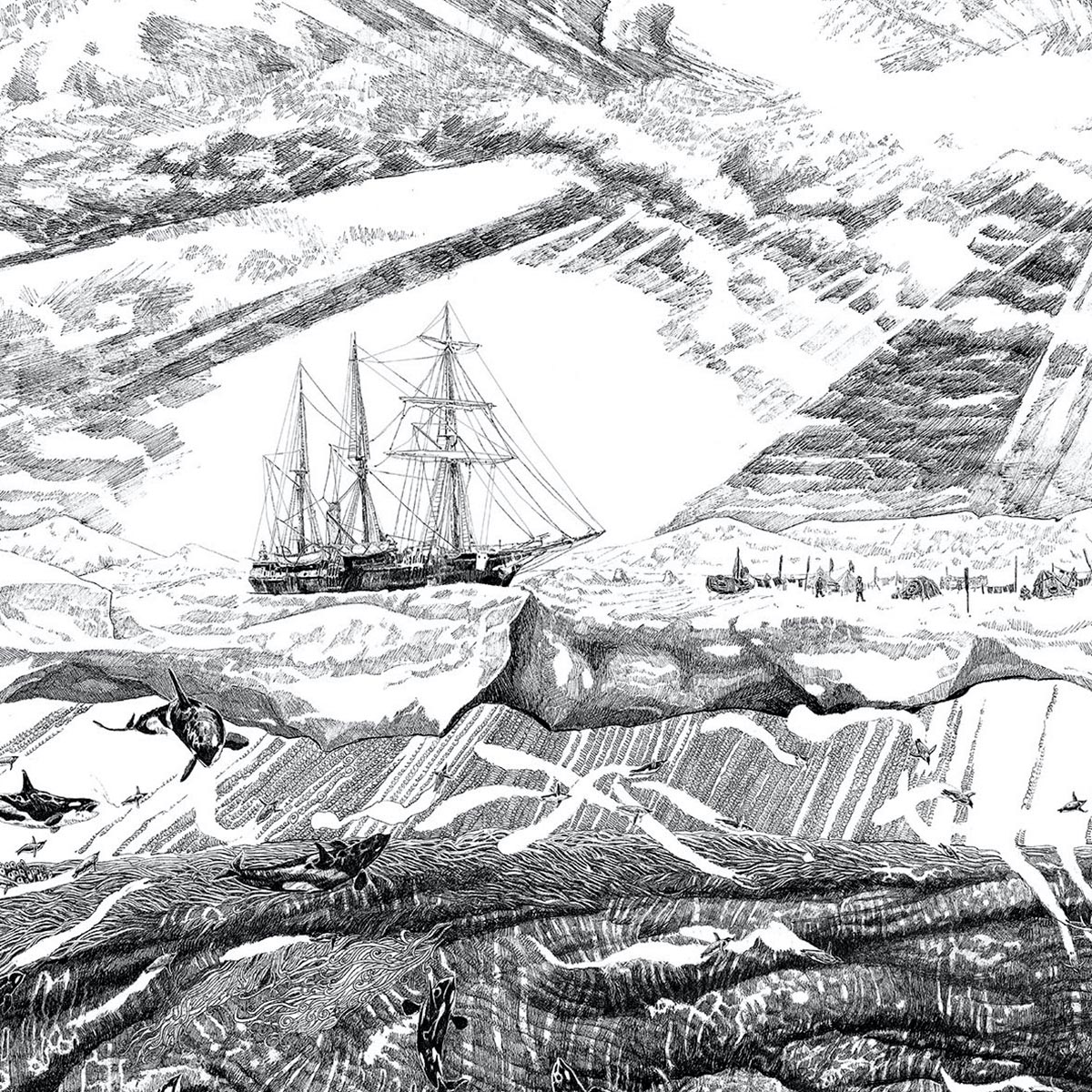
Into the Ice: The Search for the Endurance
Working from the South African polar research vessel SA Agulhas II, the team deployed autonomous underwater vehicles (AUVs) and a remotely operated underwater vehicle (ROV) into dangerous sea ice conditions similar to those that destroyed the Endurance more than 100 years earlier. The heavy, multi-year pack ice prevented the crew from finding the wreck during the 2019 mission.
Even so, the challenges they overcame and the expertise gained in navigating the ice and operating advanced submersibles proved critical. That experience directly supported the planning of the Endurance22 expedition, which returned on the same ship and succeeded in locating the exceptionally well-preserved wreck in March 2022 at a depth of 3,008 meters.
The Architects of the Ice Nests
The architects of these nests are a species of rockcod known as the yellowfin notie (Lindbergichthys nudifrons). Each nest would have been guarded by a parent fish, protecting their eggs from predators. This remarkable organization is thought to be a survival strategy.
The dense clusters demonstrate the ‘selfish herd’ theory in action: individuals in the center of the group gain protection, shielded by their neighbors. The solitary nests on the outskirts are thought to be occupied by larger, stronger individuals better able to defend their nests. The entire community is a dynamic interplay between cooperation and self-preservation.
Protecting Antarctica’s Hidden Ecosystems
This find is more than a scientific observation; it has critical implications for conservation. It provides evidence that this area contains a Vulnerable Marine Ecosystem, a unique and fragile habitat that is crucial for biodiversity. Importantly, it builds on previous work in the Weddell Sea, such as Purser et al. (2022), who revealed one of the largest known fish breeding colonies on Earth.
These discoveries are vital to support the formal designation of the Weddell Sea as a Marine Protected Area. Protecting this area means safeguarding not just the iconic penguins and seals, but also these hidden nurseries that form part of the Antarctic food web. These underwater environments are a powerful reminder that even in the planet’s most extremes, life finds a way to build complex, resilient communities.
Reference: “A finding of maintained cryonotothenioid nesting sites in the Western Weddell Sea” by Russell B. Connelly, Lucy C. Woodall, Alex David Rogers and Michelle L. Taylor, 29 August 2025, Frontiers in Marine Science.
DOI: 10.3389/fmars.2025.1648168
Never miss a breakthrough: Join the SciTechDaily newsletter.
Follow us on Google and Google News.