
Close Menu
    Facebook X (Twitter) Instagram
    SciTechDaily
    • Biology
    • Chemistry
    • Earth
    • Health
    • Physics
    • Science
    • Space
    • Technology
    Facebook X (Twitter) Pinterest YouTube RSS
    SciTechDaily
    Home»Biology»Humans Are a Greater Disturbance to Elk Than Natural Predators
    Biology

    Humans Are a Greater Disturbance to Elk Than Natural Predators

    By SciTechDailyDecember 4, 20121 Comment2 Mins Read
    Facebook Twitter Pinterest Telegram LinkedIn WhatsApp Email Reddit
    Share
    Facebook Twitter LinkedIn Pinterest Telegram Email Reddit
    vigilant-elk
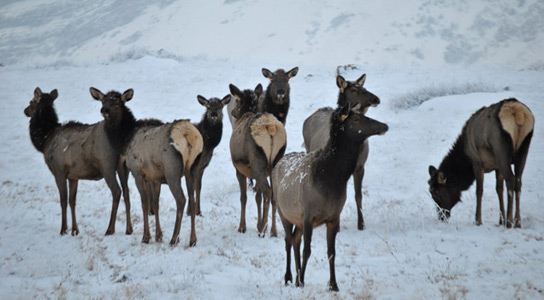
    Elk entering vigilance mode. Credit: Simone Ciuti

    A new study has shown that elk become more fearful when people are around because they perceive humans as predators.

    The scientists published their findings in the journal PLOS ONE. The researchers studied elk (Cervus canadensis) in Alberta, Canada. The results come from a year-long study that tracked 424 herds and 870 individuals on public, private, and protected land. The scientists observed the animals from a safe distance and recorded their behavior. The researchers found that humans accounted for the greatest degree of disturbance to the elk, even more so than natural predators, such as wolves, cougars, and grizzly bears.

    When elk encountered humans, especially on public lands where hunting and ATV use were permitted, the animals snapped quickly into vigilance mode, scanning for danger. One car passing every 2 hours was enough to induce this behavior, which detracts from feeding and leaves females in a less healthy state for breeding.

    “Humans are playing the same role as a natural predator, but probably at even higher levels,” states Simone Ciuti, a behavioral ecologist at the University of Alberta, and lead author. Ciuti and her colleagues plan on investigating how different human activities, like hunting and hiking impact the animals’ behavior. They also plan on finding out whether this applies to species like caribou (Rangifer tarandus), possibly helping to explain the caribou’s decline in recent years.

    Reference: “Effects of Humans on Behaviour of Wildlife Exceed Those of Natural Predators in a Landscape of Fear” by Simone Ciuti, Joseph M. Northrup, Tyler B. Muhly, Silvia Simi, Marco Musiani, Justin A. Pitt and Mark S. Boyce, 28 November 2012, PLOS ONE.
    DOI: 10.1371/journal.pone.0050611

    Never miss a breakthrough: Join the SciTechDaily newsletter.
    Follow us on Google and Google News.

    Behavioral Science Ecology Wildlife Zoology
    Share. Facebook Twitter Pinterest LinkedIn Email Reddit

    Related Articles

    Wild Animals Lose Fear of Predators Quickly After They Start Encountering Humans

    Elephants Make the Long Trek Across Deserts for Survival

    Birdsongs Elicit “Emotional” Response From Birds

    European Catfish Learn to Catch Pigeons

    Eurasian Jays Aware When Others Are Listening

    Kitti’s Hog-Nosed Bat Is World’s Smallest Mammal

    Hunters Kill Yellowstone Park Research Wolves

    Blood-Thinning Rodenticide is Killing Birds

    Bonobo Great Apes Are Domesticating Themselves

    1 Comment

    1. seth scheller on December 4, 2012 3:40 pm

      caribou! it look like they got their facts wrong because where caribou live where no one lives and caribou can be semi-domesticated. their is also place in kentucky called LBL they have elk and bison prairie where you can drive a car around and look at the elk and the elk dont stop feeding. heck the elk could care less that your even their. next time you have hypothesis on some thing dont forget to add in your control.

      Reply
    Leave A Reply Cancel Reply

    • Facebook
    • Twitter
    • Pinterest
    • YouTube

    Don't Miss a Discovery

    Subscribe for the Latest in Science & Tech!

    Trending News

    Beyond Pain Relief: Scientists Discover a Protein That Could Stop Osteoarthritis in Its Tracks

    Scientists Discover Why Alcohol Prevents the Liver From Healing, Even After You Quit

    Scientists Stunned As Volcano Removes Methane From the Air

    Scientists Discover Signs Africa May Be Splitting Apart Beneath Zambia

    Common Blood Pressure Drug Supercharges Cancer Treatment in Surprising New Study

    540-Million-Year-Old Fossils Reveal a Huge Surprise About Early Life on Earth

    Scientists Reverse Stroke Damage Using Stem Cells in Breakthrough Study

    Eating One Egg a Day Could Cut Alzheimer’s Risk by 27%

    Follow SciTechDaily
    • Facebook
    • Twitter
    • YouTube
    • Pinterest
    • Newsletter
    • RSS
    SciTech News
    • Biology News
    • Chemistry News
    • Earth News
    • Health News
    • Physics News
    • Science News
    • Space News
    • Technology News
    Recent Posts
    • Strange “Worm Towers” Found in the Wild for the First Time May Be Hitchhiking on Beetles
    • Scientists Finally Solve the Mystery of South Africa’s Tiny Leopards
    • This Strange “Golden Orb” Found 2 Miles Deep Stumped Scientists for Years
    • Giant “Last Titan” Dinosaur Discovered in Thailand Was Bigger Than 9 Elephants
    • This “Longevity Gene” May Protect the Brain From Aging and Dementia
    Copyright © 1998 - 2026 SciTechDaily. All Rights Reserved.
    • Science News
    • About
    • Contact
    • Editorial Board
    • Privacy Policy
    • Terms of Use

    Type above and press Enter to search. Press Esc to cancel.