
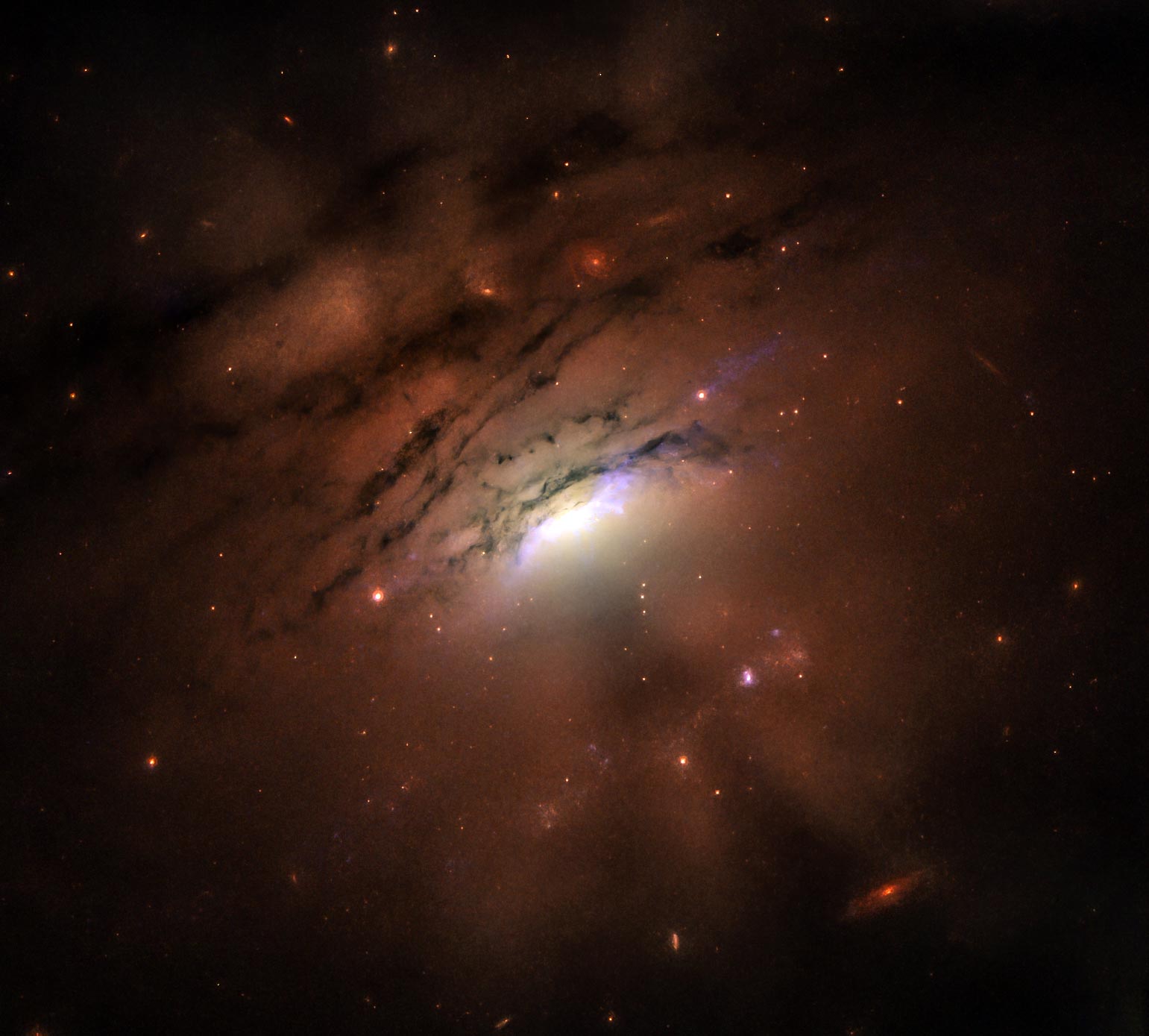
Hubble spotted striking light rays in galaxy IC 5063, likely caused by a warped, dusty disk around a black hole. Gaps in the disk allow light to shine through, casting shadow beams across the galaxy.
Some of the most stunning views of our sky occur at sunset, when sunlight pierces the clouds, creating a mixture of bright and dark rays formed by the clouds’ shadows and the beams of light scattered by the atmosphere.
Astronomers studying nearby galaxy IC 5063 are tantalized by a similar effect in images taken by NASA’s Hubble Space Telescope. In this case, a collection of narrow bright rays and dark shadows is seen beaming out of the blazingly bright center of the active galaxy.
A team of astronomers, led by Peter Maksym of the Center for Astrophysics | Harvard & Smithsonian (CfA), in Cambridge, Massachusetts, has traced the rays back to the galaxy’s core, the location of an active supermassive black hole. A black hole is a dense, compact region of space that swallows light and matter under the crushing pull of gravity. The monster object is frenetically feeding on infalling material, producing a powerful gusher of light from superheated gas near it.
Although the researchers have developed several plausible theories for the light show, the most intriguing idea suggests that an inner-tube-shaped ring, or torus, of dusty material surrounding the black hole is casting its shadow into space.
Light Escapes Through Gaps in the Dust Ring
According to Maksym’s proposed scenario, the dust disk around the black hole doesn’t block all of the light. Gaps in the disk allow light to beam out, creating brilliant cone-shaped rays similar to the fingers of light sometimes seen at sunset. However, the rays in IC 5063 are happening on a vastly larger scale, shooting across at least 36,000 light-years.
Some of the light hits dense patches in the ring, casting the ring’s shadow into space. These shadows appear as dark finger shapes interspersed with bright rays. These beams and shadows are visible because the black hole and its ring are tipped sideways relative to the plane of the galaxy. This alignment allows the light beams to extend far outside the galaxy.
This interplay of light and shadow offers a unique insight into the distribution of material encircling the black hole. In some areas, the material may resemble scattered clouds. If this interpretation is correct, the observations may provide an indirect probe of the disk’s mottled structure.
“I’m most excited by the shadow of the torus idea because it’s a really cool effect that I don’t think we’ve seen before in images, although it has been hypothesized,” Maksym said. “Scientifically, it’s showing us something that is hard—usually impossible—to see directly. We know this phenomenon should happen, but in this case, we can see the effects throughout the galaxy. Knowing more about the geometry of the torus will have implications for anybody trying to understand the behavior of supermassive black holes and their environments. As a galaxy evolves, it is shaped by its central black hole.”
A Thin, Warped Disk May Let Light Escape
Studying the torus is important because it funnels material toward the black hole. If the “shadow” interpretation is accurate, the dark rays provide indirect evidence that the disk in IC 5063 could be very thin, which explains why light is leaking out all around the structure.
Observations of similar black holes by NASA’s Chandra X-ray Observatory detected X-rays leaking out of holes in the torus, making the structure appear like Swiss cheese. The holes may be caused by the disk being torqued by internal forces, causing it to warp, Maksym said. “It’s possible that the warping creates big enough gaps for some of the light to shine through, and as the torus rotates, beams of light could sweep across the galaxy like lighthouse beams through the fog,” he added.
Citizen Science Serendipity
Although astronomers have been studying the galaxy for decades, it took a non-scientist to make the surprising discovery. Judy Schmidt, an artist and amateur astronomer based in Modesto, California, uncovered the dark shadows when she reprocessed Hubble’s exposures of the galaxy in December 2019. Schmidt routinely culls the Hubble archive for interesting observations that she can turn into beautiful images. She shares those images on her Twitter feed with her many followers, who include astronomers such as Maksym.
Schmidt selected the Hubble observations of IC 5063 from the archive because she is interested in galaxies that have active cores. The cone-shaped shadows were not apparent in the original exposures, so she was surprised to see them in her reprocessed image. “I had no idea they were there, and even after I’d processed it, I kept blinking my eyes wondering if I was seeing what I thought I was seeing,” she said.
A Tweet That Launched a Scientific Investigation
She immediately posted her image to her Twitter account. “It was something I’d never seen before, and even though I had strong suspicions about them being shadow rays or ‘crepuscular rays,’ as Peter has dubbed them, it’s easy to let one’s imagination and wishful thinking run wild,” she explained. “I figured if I was wrong, someone would come to ground me.”
The image prompted a lively Twitter discussion among her astronomer followers, including Maksym, who debated the rays’ origin. Maksym had already been analyzing Hubble images of the jets produced by the galaxy’s black hole. So he took the lead in studying the rays and writing a science paper. His study is based on near-infrared observations made by Hubble’s Wide Field Camera 3 and Advanced Camera for Surveys in March and November 2019. Red and near-infrared light pierces the dusty galaxy to reveal the details that may be enshrouded in dust.
This discovery would not have been possible without Hubble’s sharp vision. The galaxy is also relatively nearby, only 156 million light-years from Earth. “Older images from telescopes on the ground showed maybe hints of this kind of structure, but the galaxy itself is such a mess that you’d never guess that this is what’s going on without Hubble,” Maksym explained. “Hubble has sharp pictures, is sensitive to faint things, and has a big enough field of view to image the entire galaxy.”
Maksym hopes to continue his study of the galaxy to determine whether his scenario is correct. “We will want to keep investigating, and it will be great if other scientists try to test our conclusions, too, with new observations and modeling,” he said. “This is a project that is just begging for new data because it raises more questions than it answers.”
The team’s results were published in The Astrophysical Journal Letters.
Reference: “Crepuscular Rays from the Highly Inclined Active Galactic Nucleus in IC 5063” by W. Peter Maksym, Judy Schmidt, William C. Keel, Giuseppina Fabbiano, Travis C. Fischer, Joss Bland-Hawthorn, Aaron J. Barth, Martin Elvis, Tom Oosterloo, Luis C. Ho, Minjin Kim, Hyunmo Hwang and Evan Mayer, 8 October 2020, The Astrophysical Journal Letters.
DOI: 10.3847/2041-8213/abb9b6
The Hubble Space Telescope is a project of international cooperation between NASA and ESA (European Space Agency). NASA’s Goddard Space Flight Center in Greenbelt, Maryland, manages the telescope. The Space Telescope Science Institute (STScI) in Baltimore, Maryland, conducts Hubble science operations. STScI is operated for NASA by the Association of Universities for Research in Astronomy in Washington, D.C.
Never miss a breakthrough: Join the SciTechDaily newsletter.
Follow us on Google and Google News.
1 Comment
Really enjoy reading your articles.Please keep sending them.