
Close Menu
    Facebook X (Twitter) Instagram
    SciTechDaily
    • Biology
    • Chemistry
    • Earth
    • Health
    • Physics
    • Science
    • Space
    • Technology
    Facebook X (Twitter) Pinterest YouTube RSS
    SciTechDaily
    Home»Space»How Stars Form in Nearby Galaxies
    Space

    How Stars Form in Nearby Galaxies

    By University of ZurichJanuary 3, 20211 Comment3 Mins Read
    Facebook Twitter Pinterest Telegram LinkedIn WhatsApp Email Reddit
    Share
    Facebook Twitter LinkedIn Pinterest Telegram Email Reddit
    Star Formation
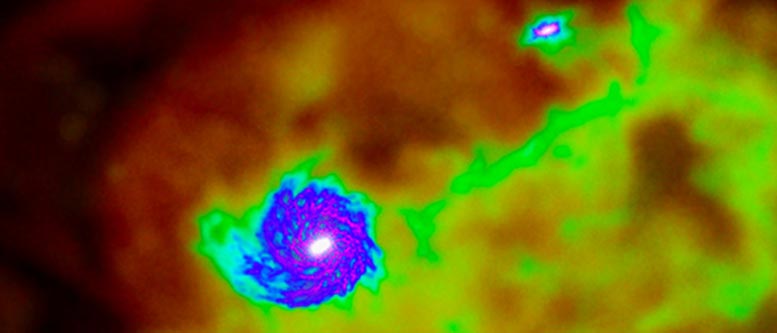
    Star formation. Credit: University of Zurich

    How stars form in galaxies remains a major open question. Robert Feldmann sheds new light on this topic with the help of a data-driven re-analysis of observational measurements.

    Stars are born in dense clouds of molecular hydrogen gas that permeates interstellar space of most galaxies. While the physics of star formation is complex, recent years have seen substantial progress towards understanding how stars form in a galactic environment. What ultimately determines the level of star formation in galaxies, however, remains an open question.

    In principle, two main factors influence the star formation activity: the amount of molecular gas that is present in galaxies and the timescale over which the gas reservoir is depleted by converting it into stars. While the gas mass of galaxies is regulated by a competition between gas inflows, outflows, and gas consumption, the physics of the gas-to-star conversion is currently not well understood. Given its potentially critical role, many efforts have been undertaken to determine the gas depletion timescale observationally. However, these efforts resulted in conflicting findings partly because of the challenge in measuring gas masses reliably given current detection limits.
    Visualization of Gas in and Around a Milky-Way-Like Galaxy
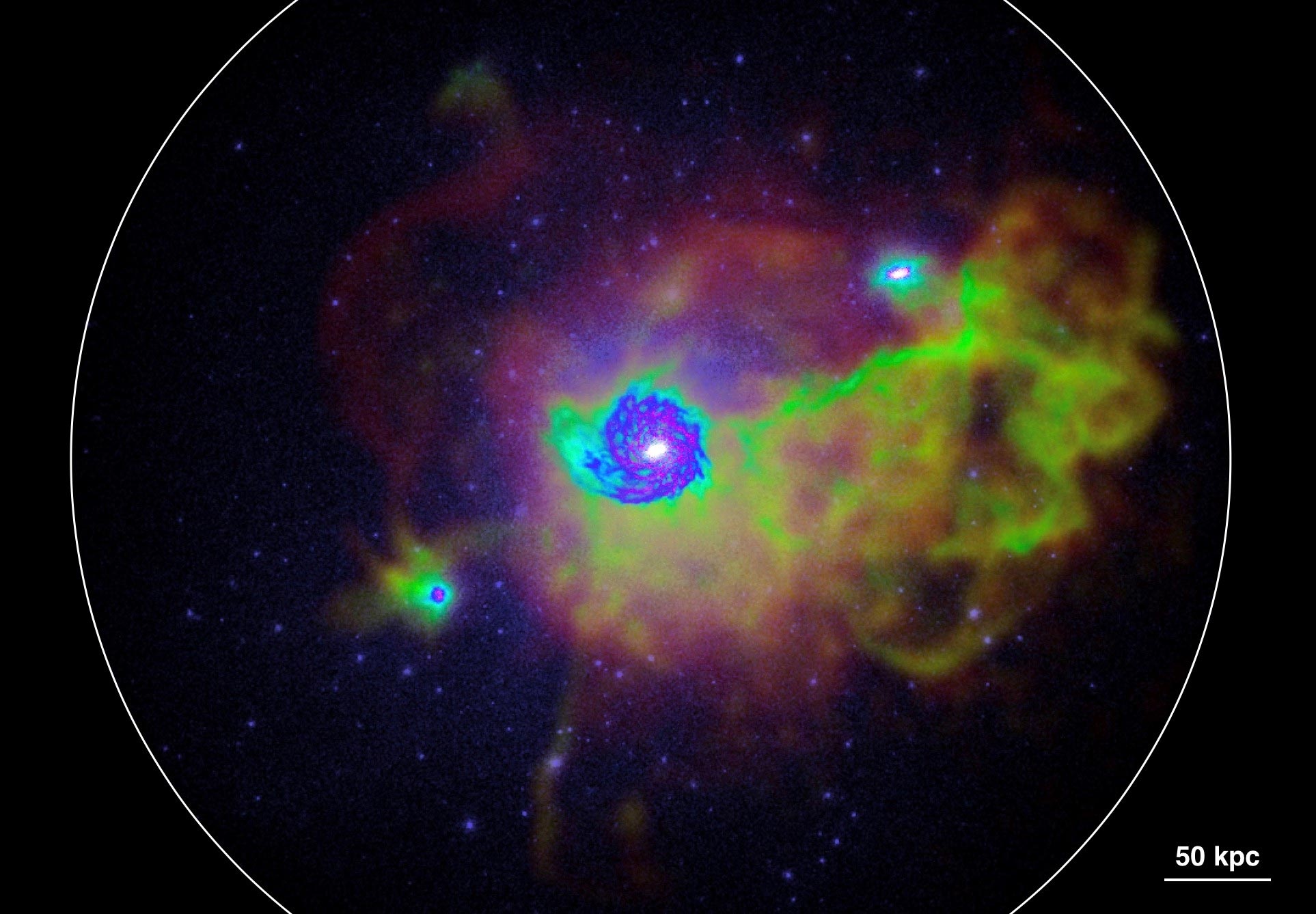
    Figure 1. Visualization of gas in and around a Milky-Way-like galaxy (center) in today’s Universe as predicted by a cosmological simulation run by the author. Dense, atomic, and molecular hydrogen typically forms an extended disk, here seen in bluish-purple at the center of the image. Stars (white) form throughout the gas disk. Additional star formation may take place in satellite galaxies, here seen at the top right and bottom left positions. Hot, low-density gas (green and red hues) can be found at large distances, out to the edge of the dark matter halo surrounding the main galaxy (white circle). The image also shows a large number of dark matter substructures (purple) most of which are devoid of gas and stars. Credit: University of Zurich

    Typical Star Formation Is Linked to the Overall Gas Reservoir

    The present study uses a new statistical method based on Bayesian modeling to properly account for galaxies with undetected amounts of molecular or atomic hydrogen to minimize observational bias. This new analysis reveals that, in typical, star-forming galaxies, molecular and atomic hydrogen are converted into stars over approximately constant timescales of 1 and 10 billion years, respectively. However, extremely active galaxies (`starbursts’) are found to have much shorter gas depletion timescales.

    These findings suggest that star formation in typical galaxies is indeed directly linked to the overall gas reservoir and thus set by the rate at which gas enters or leaves a galaxy. In contrast, the dramatically higher star formation activity of starbursts has likely a different physical origin, such as galaxy interactions or instabilities in galactic disks.

    This analysis is based on observational data of nearby galaxies. Observations with the Atacama Large Millimeter/submillimeter Array, the Square Kilometer Array, and other observatories promise to probe the gas content of large numbers of galaxies across cosmic history. It will be paramount to continue the development of statistical and data science methods to accurately extract the physical content from these new observations and to fully uncover the mysteries of star formation in galaxies.

    Reference: “The link between star formation and gas in nearby galaxies” by Robert Feldmann, 7 December 2020, Communications Physics.
    DOI: 10.1038/s42005-020-00493-0

    Never miss a breakthrough: Join the SciTechDaily newsletter.
    Follow us on Google and Google News.

    Astronomy Astrophysics Stars University of Zurich
    Share. Facebook Twitter Pinterest LinkedIn Email Reddit

    Related Articles

    Study of Supergiant Star Betelgeuse Unveils the Cause of Its Pulsations – Not at All Close to Exploding

    Distant Colliding Galaxy Dying Out As It Loses the Ability to Form Stars – Ejecting 10,000 Suns-Worth of Gas a Year

    Massive Rotating Stars in the Pleiades Cluster

    All 468 Stars in Milky Way Stellar Stream Theia 456 Are Related – “It’s Like Finding a Needle in a Haystack”

    A Star Dying Soon After the Beginning of the Universe Could Be Disrupting Mobile Phone Reception Today

    “This Galaxy Is Witnessing a Truly Extreme Event” – Galaxy Mergers Could Limit Star Formation

    Cosmic Neon Lights: Strange New Type of Star Revealed in X-ray Light

    Striped or Spotted? Planetary Scientists Solve a Brown Dwarf Mystery

    Chandra Studies Extraordinary Magnetar: Fastest Spinning and Possibly the Youngest Magnetar Known

    1 Comment

    1. MMR on January 4, 2021 2:52 pm

      Nice pics

      Reply
    Leave A Reply Cancel Reply

    • Facebook
    • Twitter
    • Pinterest
    • YouTube

    Don't Miss a Discovery

    Subscribe for the Latest in Science & Tech!

    Trending News

    First-of-Its-Kind Discovery: Homer’s Iliad Found Embedded in a 1,600-Year-Old Egyptian Mummy

    Beyond Inflammation: Scientists Uncover New Cause of Persistent Rheumatoid Arthritis

    A Simple Molecule Could Unlock Safer, Easier Weight Loss

    Scientists Just Built a Quantum Battery That Charges Almost Instantly

    Researchers Unveil Groundbreaking Sustainable Solution to Vitamin B12 Deficiency

    Millions of People Have Osteopenia Without Realizing It – Here’s What You Need To Know

    Researchers Discover Boosting a Single Protein Helps the Brain Fight Alzheimer’s

    World-First Study Reveals Human Hearts Can Regenerate After a Heart Attack

    Follow SciTechDaily
    • Facebook
    • Twitter
    • YouTube
    • Pinterest
    • Newsletter
    • RSS
    SciTech News
    • Biology News
    • Chemistry News
    • Earth News
    • Health News
    • Physics News
    • Science News
    • Space News
    • Technology News
    Recent Posts
    • Scientists Flip Immune System “Switch,” Uncover Surprising Path To Stop Gut Inflammation
    • Magnesium Magic: New Drug Melts Fat Even on a High-Fat, High-Sugar Diet
    • Weight-Loss Drugs Like Ozempic May Come With an Unexpected Cost
    • After Decades, MIT Researchers Capture the First 3D Atomic View of a Mysterious Material
    • Your Favorite Fishing Spot Is Turning Brown – and the Fish Are Changing
    Copyright © 1998 - 2026 SciTechDaily. All Rights Reserved.
    • Science News
    • About
    • Contact
    • Editorial Board
    • Privacy Policy
    • Terms of Use

    Type above and press Enter to search. Press Esc to cancel.