
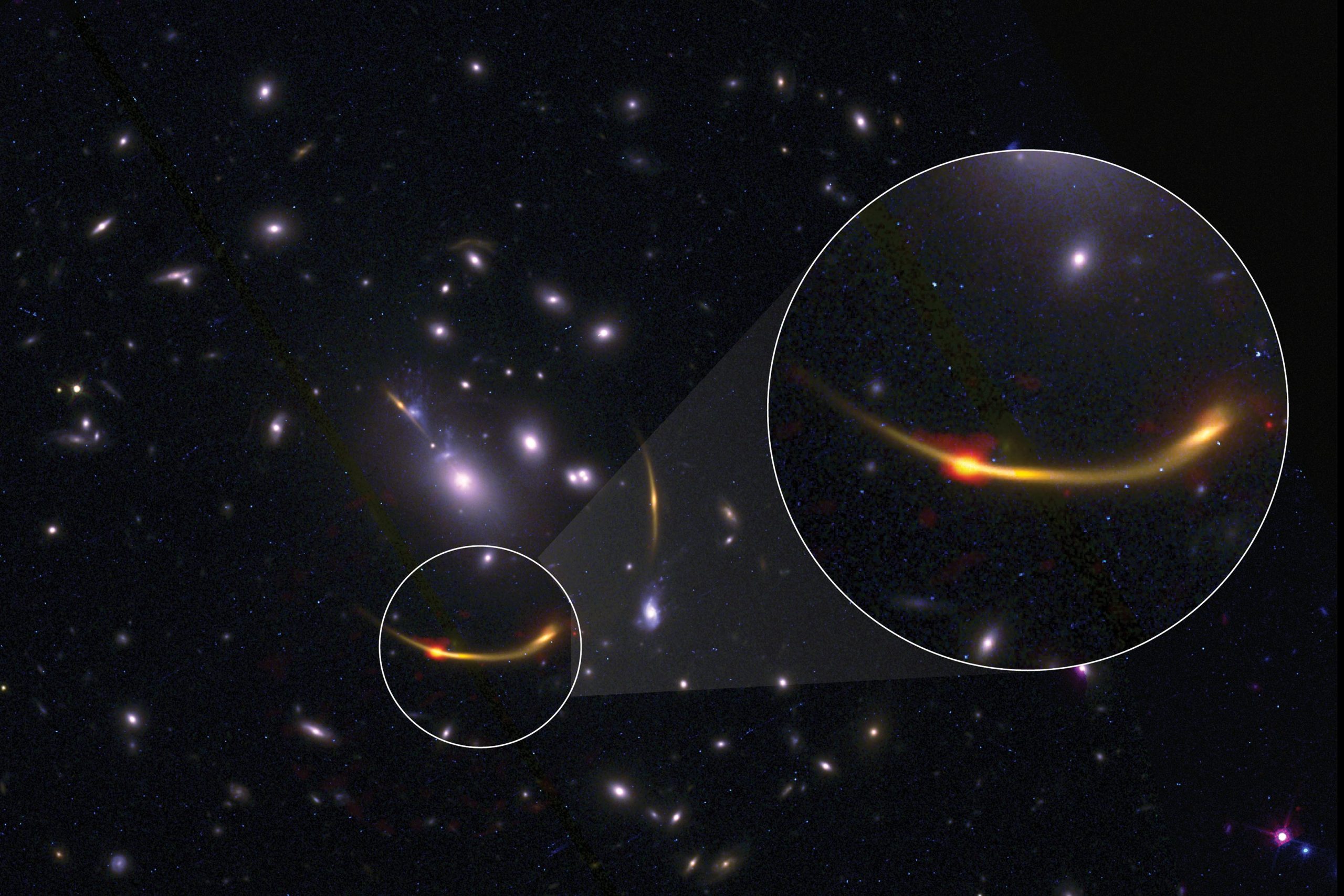
New study reveals that early galaxies have no fuel, and something is stopping them from refilling the tank.
Early massive galaxies—those that formed in the three billion years following the Big Bang—should have contained large amounts of cold hydrogen gas, the fuel required to make stars. But scientists observing the early Universe with the Atacama Large Millimeter/submillimeter Array (ALMA) and the Hubble Space Telescope have spotted something strange: half a dozen early massive galaxies that ran out of fuel. The results of the research are published today in Nature.
Known as “quenched” galaxies—or galaxies that have shut down star formation—the six galaxies selected for observation from the REsolving QUIEscent Magnified galaxies at high redshift, or the REQUIEM survey, are inconsistent with what astronomers expect of the early Universe.
“The most massive galaxies in the Universe lived fast and furious, creating their stars in a remarkably short amount of time. Gas, the fuel of star formation, should be plentiful at these early times in the Universe,” said Kate Whitaker, lead author on the study, and assistant professor of astronomy at the University of Massachusetts, Amherst. “We originally believed that these quenched galaxies hit the brakes just a few billion years after the Big Bang. In our new research, we’ve concluded that early galaxies didn’t actually put the brakes on, but rather, they were running on empty.”
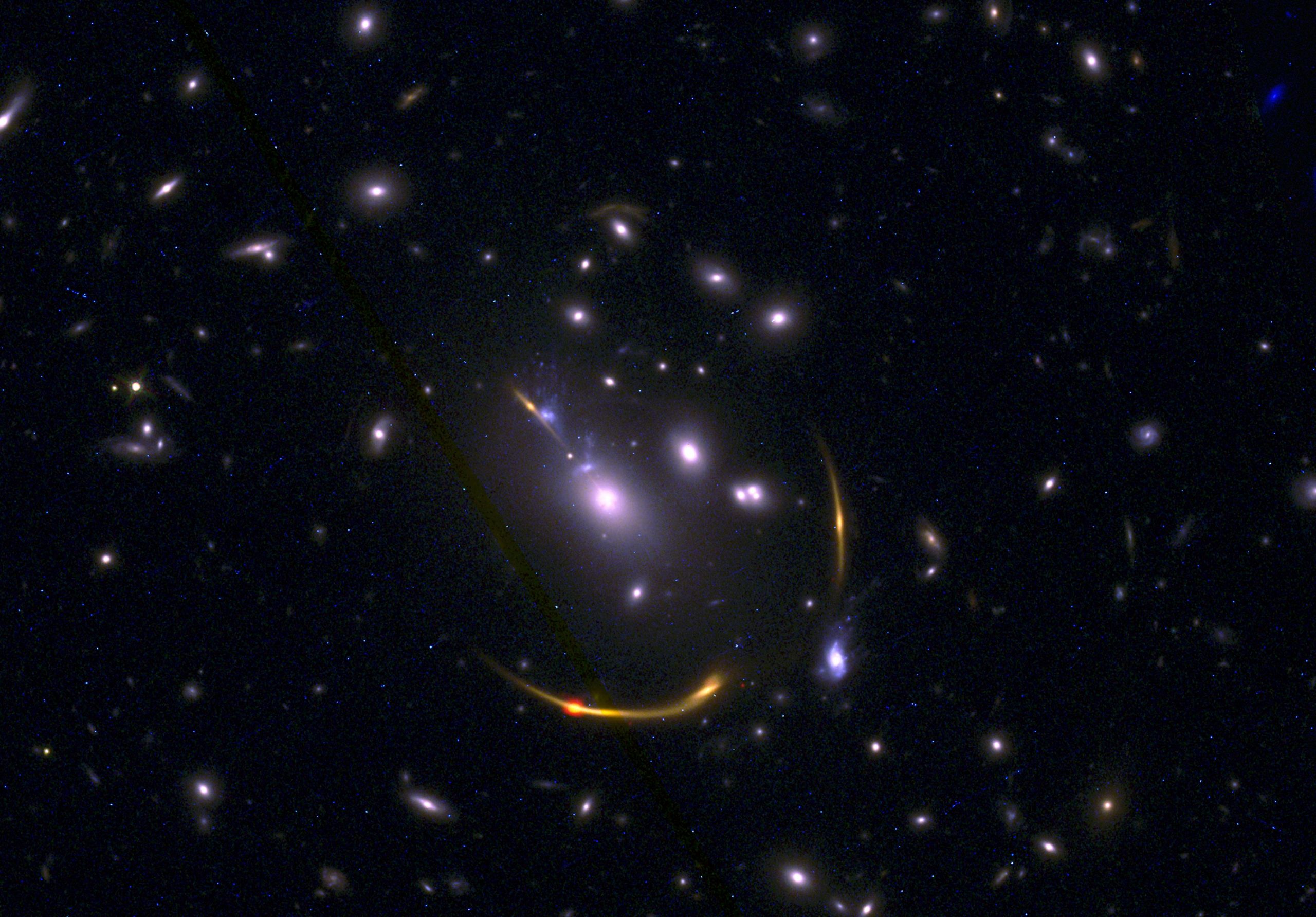
To better understand how the galaxies formed and died, the team observed them using Hubble, which revealed details about the stars residing in the galaxies. Concurrent observations with ALMA revealed the galaxies’ continuum emission—a tracer of dust—at millimeter wavelengths, allowing the team to infer the amount of gas in the galaxies. The use of the two telescopes is by careful design, as the purpose of REQUIEM is to use strong gravitational lensing as a natural telescope to observe dormant galaxies with higher spatial resolution. This, in turn, gives scientists a clear view of galaxies’ internal goings-on, a task often impossible with those running on empty.
“If a galaxy isn’t making many new stars it gets very faint very fast so it is difficult or impossible to observe them in detail with any individual telescope. REQUIEM solves this by studying galaxies that are gravitationally lensed, meaning their light gets stretched and magnified as it bends and warps around other galaxies much closer to the Milky Way,” said Justin Spilker, a co-author on the new study, and a NASA Hubble postdoctoral fellow at the University of Texas at Austin. “In this way, gravitational lensing, combined with the resolving power and sensitivity of Hubble and ALMA, acts as a natural telescope and makes these dying galaxies appear bigger and brighter than they are in reality, allowing us to see what’s going on and what isn’t.”
Gas Depletion Halts Star Formation
The new observations showed that the cessation of star formation in the six target galaxies was not caused by a sudden inefficiency in the conversion of cold gas to stars. Instead, it was the result of the depletion or removal of the gas reservoirs in the galaxies. “We don’t yet understand why this happens, but possible explanations could be that either the primary gas supply fueling the galaxy is cut off, or perhaps a supermassive black hole is injecting energy that keeps the gas in the galaxy hot,” said Christina Williams, an astronomer at the University of Arizona and co-author on the research. “Essentially, this means that the galaxies are unable to refill the fuel tank, and thus, unable to restart the engine on star production.”
The study also represents a number of important firsts in the measurement of early massive galaxies, synthesizing information that will guide future studies of the early Universe for years to come. “These are the first measurements of the cold dust continuum of distant dormant galaxies, and in fact, the first measurements of this kind outside the local Universe,” said Whitaker, adding that the new study has allowed scientists to see how much gas individual dead galaxies have. “We were able to probe the fuel of star formation in these early massive galaxies deep enough to take the first measurements of the gas tank reading, giving us a critically missing viewpoint of the cold gas properties of these galaxies.”
Although the team now knows that these galaxies are running on empty and that something is keeping them from refilling the tank and from forming new stars, the study represents just the first in a series of inquiries into what made early massive galaxies go, or not. “We still have so much to learn about why the most massive galaxies formed so early in the Universe and why they shut down their star formation when so much cold gas was readily available to them,” said Whitaker. “The mere fact that these massive beasts of the cosmos formed 100 billion stars within about a billion years and then suddenly shut down their star formation is a mystery we would all love to solve, and REQUIEM has provided the first clue.”
For more on this research:
- “Dead” Galaxies Mysteriously Ran Out of Fuel To Make Stars in the Early Universe
- Running on Empty: Astronomers Solve 12-Billion-Year-Old Mystery of Stalled Galaxies
Reference: “Exhausted gas reservoirs drive massive galaxy quenching in the early universe” by Katherine E. Whitaker, Christina C. Williams, Lamiya Mowla, Justin S. Spilker, Sune Toft, Desika Narayanan, Alexandra Pope, Georgios E. Magdis, Pieter G. van Dokkum, Mohammad Akhshik, Rachel Bezanson, Gabriel B. Brammer, Joel Leja, Allison Man, Erica J. Nelson, Johan Richard, Camilla Pacifici, Keren Sharon & Francesco Valentino, 22 September 2021, Nature.
DOI: 10.1038/s41586-021-03806-7
Never miss a breakthrough: Join the SciTechDaily newsletter.
Follow us on Google and Google News.
1 Comment
If there’s one thing that annoys me about these articles that refer to the ‘Big Bang’, it’s that they NEVER give reference to the location of the observations. It always takes a bit of sleuthing to reveal where in the sky these observations are.