
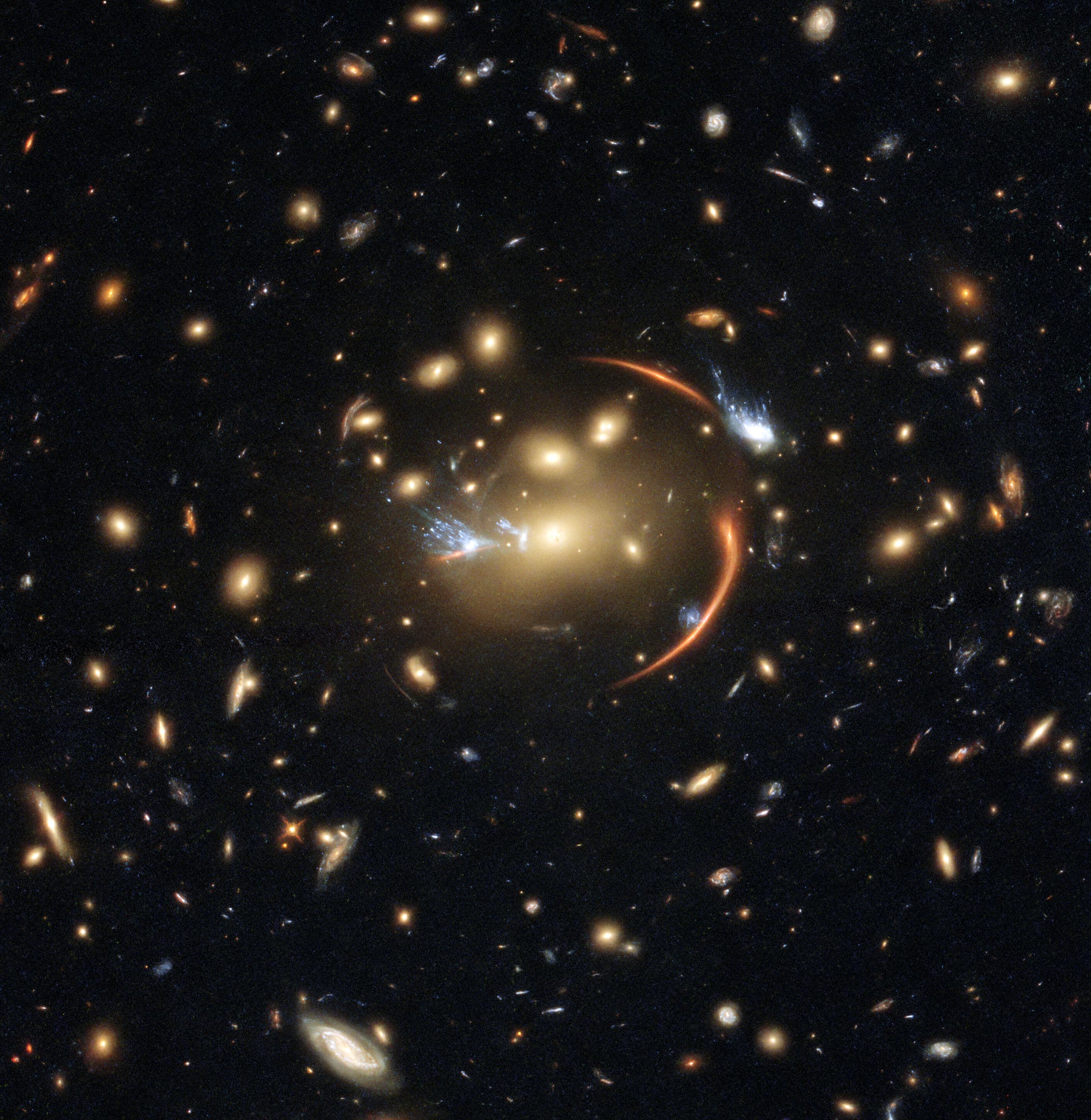
Unprecedent measurements confirm galaxies idle when they run out of cold gas.
New research, published in Nature and led by the University of Massachusetts Amherst, has just answered one of the fundamental questions about our universe: Why did some of the oldest, most massive galaxies go quiescent early in their formation? The answer, we now know, is because they ran out of cold gas.
“The most massive galaxies in our universe formed incredibly early, just after the Big Bang happened, 14 billion years ago,” says Kate Whitaker, professor of astronomy at UMass Amherst. “But for some reason, they have shut down. They’re no longer forming new stars.” Star formation is one of the key ways that galaxies grow, and they’re said to have gone quiescent when they cease forming stars. Astronomers have known that these early, massive galaxies had gone quiescent, but until now, no one knew why.
To find the answer, Whitaker’s team, which includes Alexandra Pope, associate professor of astronomy, and Christina C. Williams, who received her Ph.D. in astronomy at UMass, devised an innovative pairing of telescopes. They used the Hubble Space Telescope, which sees ultraviolet to near-infrared light, including the light we can see with our own eyes, to detect these distant galaxies, which are so far away that we’re only just now seeing the light they emitted 10 billion to 12 billion years ago, when the universe was in its infancy. In effect, Whitaker’s team is looking into the deep past.
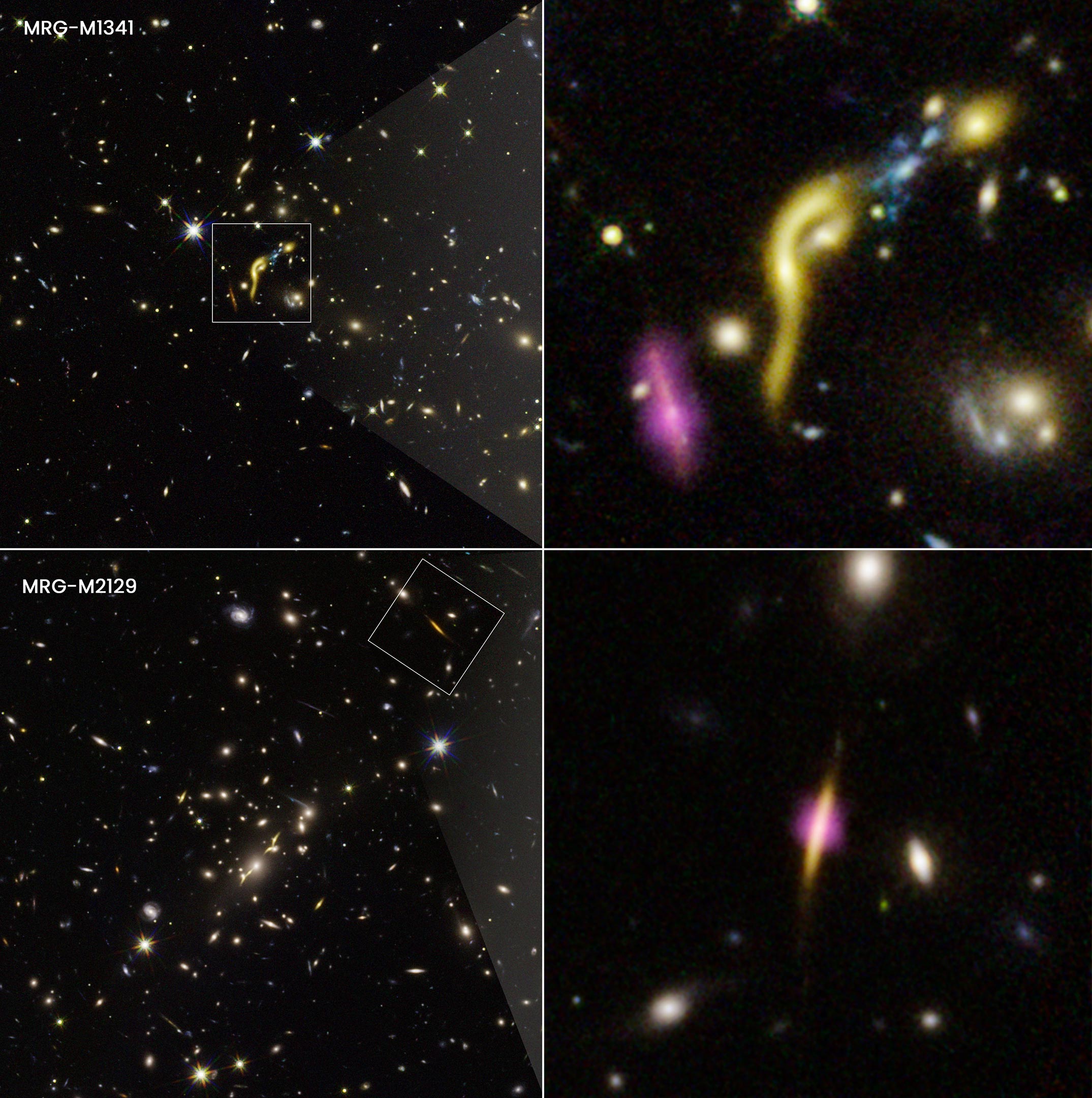
These galaxies should appear young and vigorous, with evidence of constant star formation. But they don’t, and Whitaker’s team combined Hubble’s images with extraordinarily sensitive readings from ALMA, the Atacama Large Millimeter/submillimeter Array, which detects radiation invisible to the naked eye.
The Search for Cold Gas
ALMA let Whitaker’s team look for tiny amounts of cold gas — the main energy source fueling new star formation. “There was copious cold gas in the early universe, so these galaxies, from 12 billion years ago, should have plenty left in the fuel tank.” Instead, Whitaker and her team found only traces of cold gas located at each galaxy’s center. This means that, within the first few billion years of the universe’s existence, these galaxies either burned through their energy supplies, or ejected them and, furthermore, that something may be physically blocking each galaxy’s replenishment of cold gas.
Taken together, the research helps us to rewrite the early history of the universe so that we can get a clearer idea of how galaxies evolve. The team’s next step is to figure out how compact the remaining gas is in these quiescent galaxies and why it exists only in the galaxies’ center.
For more on this research, read “Dead” Galaxies Mysteriously Ran Out of Fuel To Make Stars in the Early Universe.
Reference: “Exhausted gas reservoirs drive massive galaxy quenching in the early universe” by Katherine E. Whitaker, Christina C. Williams, Lamiya Mowla, Justin S. Spilker, Sune Toft, Desika Narayanan, Alexandra Pope, Georgios E. Magdis, Pieter G. van Dokkum, Mohammad Akhshik, Rachel Bezanson, Gabriel B. Brammer, Joel Leja, Allison Man, Erica J. Nelson, Johan Richard, Camilla Pacifici, Keren Sharon & Francesco Valentino, 22 September 2021, Nature.
DOI: 10.1038/s41586-021-03806-7
This research was supported by the Alfred P. Sloan Foundation, National Science Foundation, NASA Goddard Space Flight Center, European Research Council, Carlsberg Foundation, Villum Fonden, Canadian Space Agency, NASA and the Dunlap Institute for Astronomy & Astrophysics.
Never miss a breakthrough: Join the SciTechDaily newsletter.
Follow us on Google and Google News.
2 Comments
two galaxies of how many out there
plus something may be physically blocking each galaxies replenishment of cold gas
it might be worse than that
it must be sterile
clean room
gas tight
dust proof
ignition gas proof
inert gas flame proof
fire proof
heat resistant
ignition spark plug proof
explosion proof
thermo nuclear safe zone
uranium radiation proofed
single hyrdrogen neutral zone in perfect harmony
God created the universe
We never be able to see the edge of the universe