
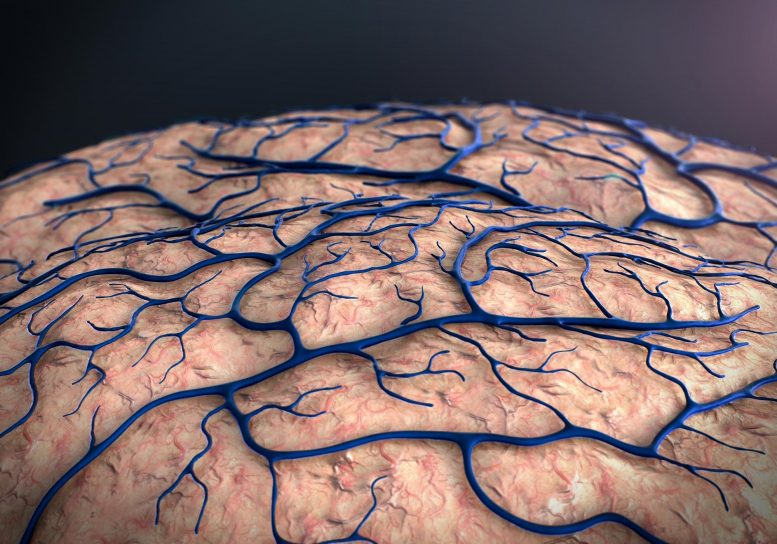
Brain scans show capillary curvature tracks with twisted neuron shapes in schizophrenia, suggesting structural and metabolic irregularities.
Drs. Itokawa, Mizutani and colleagues performed microtomography experiments the BL20XU beamline of the SPring-8 synchrotron radiation facility and found that brain capillary structures show a correlation with their neuron structures.
Brain blood vessels constitute a micrometer-scale vascular network responsible for supply of oxygen and nutrition. In this study, we analyzed cerebral tissues of the anterior cingulate cortex and superior temporal gyrus of schizophrenia cases and age/gender-matched controls by using synchrotron radiation microtomography or micro-CT in order to examine the three-dimensional structure of cerebral vessels.
All post-mortem human cerebral tissues were collected with informed consent from the legal next of kin using protocols approved by the Clinical Study Reviewing Board of Tokai University School of Medicine (application no. 07R-018) and the Ethics Committee of Tokyo Metropolitan Institute of Medical Science (approval no. 17-18). This study was conducted according to the Declaration of Helsinki under the approval of the Ethics Committee for the Human Subject Study of Tokai University (approval nos. 11060, 11114, 12114, 13105, 14128, 15129, 16157, 18012, 19001, 20021, and 20022). The schizophrenia patients S1-S4 and control cases N1-N4 of this study are the same as those analyzed in our previous report on neuron structure. Cerebral tissues of Brodmann area 22 (BA22) of the superior temporal gyrus and BA24 of the anterior cingulate cortex were collected from the left hemispheres of the post-mortem brains and subjected to Golgi impregnation. The Golgi-stained tissues were then embedded in borosilicate glass capillaries using epoxy resin.
Three-dimensional structures of blood vessel networks in the brain tissues of BA22 of the superior temporal gyrus and BA24 of the anterior cingulate cortex were visualized by using synchrotron radiation microtomography or micro-CT. Over 1 m of cerebral blood vessels was traced to build Cartesian-coordinate models, which were then used for calculating structural parameters including the diameter and curvature of the vessels.
Curvature Correlation with Neuronal Tortuosity
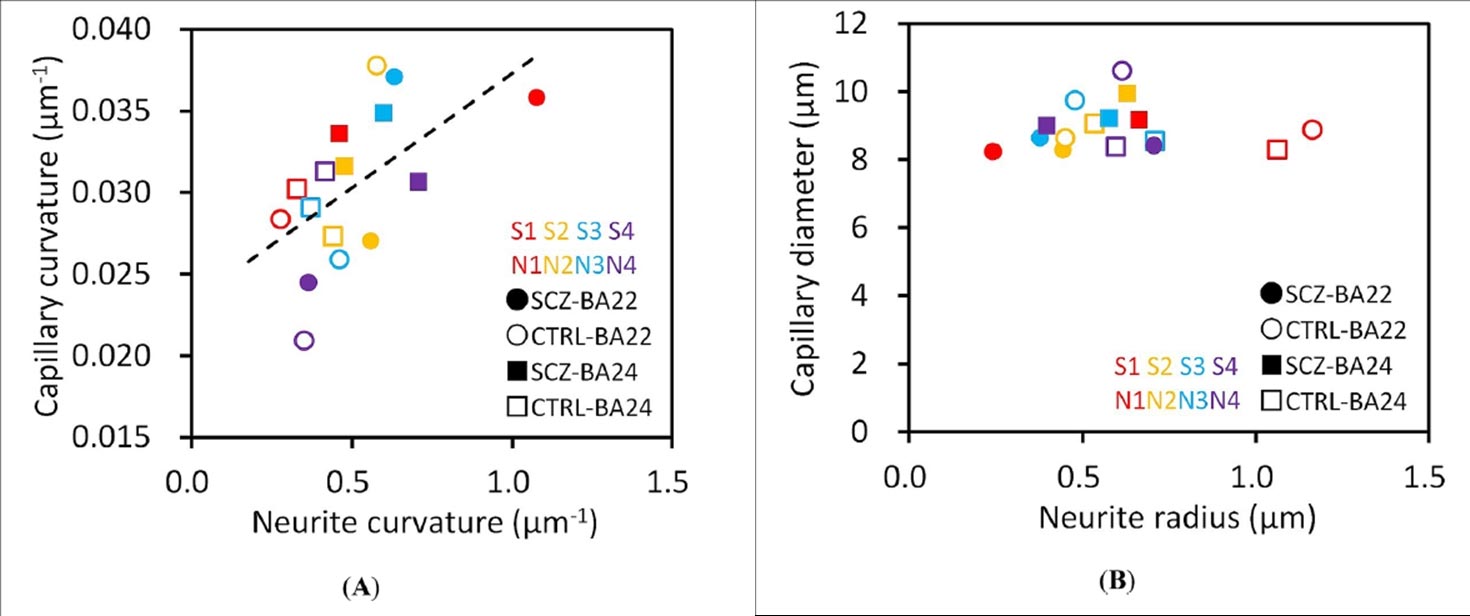
The curvature plot illustrates a significant correlation of the mean curvature of capillary vessels to that of neurites (Spearman’s ρ = 0.63, p = 0.011, n = 16), indicating that the brain tissues with tortuous neuronal networks have tortuous capillary vessels. No significant difference in the slope was observed between the schizophrenia and control groups. The mean capillary curvature showed a difference in its variance between brain areas. The capillary curvatures of BA22 were widely distributed, while those of BA24 were limited to a confined range (Fig. A), resulting in a significant difference in variance (p = 0.019, Bartlett’s test, n = 8). We also examined the relation between the capillary diameter and neurite thickness radius (Fig. B). In contrast to the curvature correlation, the mean capillary diameter showed no correlation with the neurite thickness radius, but was rather constant regardless of neurite thickness. This result indicates that the capillary vessel size is determined independently of the neuron structure.
Implications for Neurovascular Imbalance in Schizophrenia
Our previous studies indicated that the neurites of schizophrenia cases are thin and tortuous compared to controls. The curved capillaries with a constant diameter should occupy a nearly constant volume, while neurons suffering from neurite thinning should have reduced volumes, resulting in a volumetric imbalance between the neurons and the vessels. We suggest that the observed structural correlation between neurons and blood vessels is related to neurovascular abnormalities in schizophrenia.
Kraepelin placed schizophrenia in a chapter on metabolic disorders in the fifth edition of his Psychiatrie published in 1896. He predicted metabolic dysfunction and neuropathological change as the basis of schizophrenia. we can regard the above-mentioned results as the first example suggesting metabolic abnormality due to capillary and neuron imbalance.
Reference: “Brain capillary structures of schizophrenia cases and controls show a correlation with their neuron structures” by Rino Saiga, Masayuki Uesugi, Akihisa Takeuchi, Kentaro Uesugi, Yoshio Suzuki, Susumu Takekoshi, Chie Inomoto, Naoya Nakamura, Youta Torii, Itaru Kushima, Shuji Iritani, Norio Ozaki, Kenichi Oshima, Masanari Itokawa, Makoto Arai and Ryuta Mizutani, 3 June 2021, Scientific Reports.
DOI: 10.1038/s41598-021-91233-z
Never miss a breakthrough: Join the SciTechDaily newsletter.
Follow us on Google and Google News.