
Close Menu
    Facebook X (Twitter) Instagram
    SciTechDaily
    • Biology
    • Chemistry
    • Earth
    • Health
    • Physics
    • Science
    • Space
    • Technology
    Facebook X (Twitter) Pinterest YouTube RSS
    SciTechDaily
    Home»Biology»Human Cocaine and Heroin Addiction Is Tied to Impairments in Specific Brain Circuit
    Biology

    Human Cocaine and Heroin Addiction Is Tied to Impairments in Specific Brain Circuit

    By The Mount Sinai Hospital / Mount Sinai School of MedicineNovember 1, 2022No Comments4 Mins Read
    Facebook Twitter Pinterest Telegram LinkedIn WhatsApp Email Reddit
    Share
    Facebook Twitter LinkedIn Pinterest Telegram Email Reddit
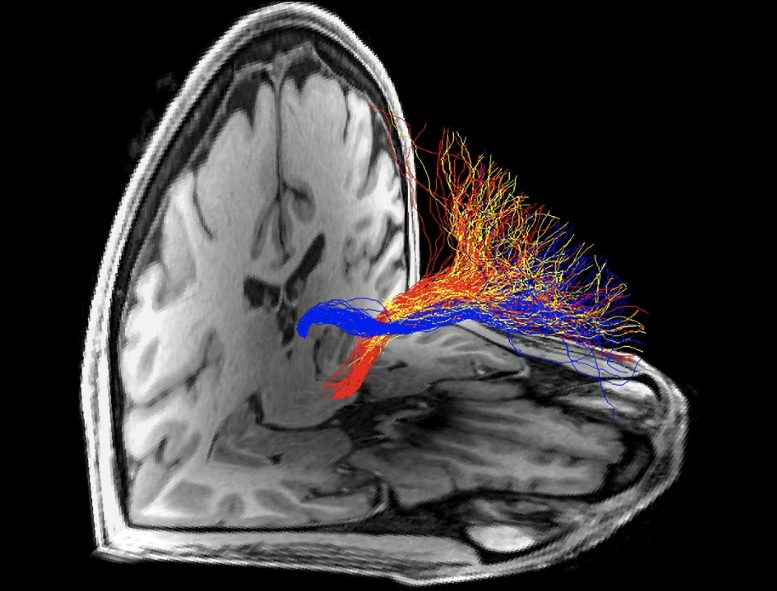
    Human Cocaine and Heroin Addiction Brain Circuit
    A new study reveals that impairment in a specific brain circuit in people is linked to addiction to cocaine or heroin. Credit: Mount Sinai Health System

    Researchers identified a brain circuit impairment related to addiction, offering insights into future treatment options.

    According to a new study, white matter in the brain that was previously implicated in animal studies has now been suggested to be specifically impaired in the brains of people with addiction to cocaine or heroin. The research, which was published on October 6 in the journal Neuron, was conducted by scientists from the Icahn School of Medicine at Mount Sinai and Baylor College of Medicine.

    In the study, investigators examined the connectivity of the tract between the prefrontal cortex (PFC), a brain region critical for regulating higher-order executive functions, and the habenula, a region that plays a critical role in reward and reward-associated learning. In animal models of addiction, the habenula has emerged as a key driver of drug-seeking behaviors. Specifically, signaling from the PFC to the habenula is disrupted in rodent cocaine addiction models, implicating this PFC-habenula circuit in withdrawal and cue-induced relapse behaviors. However, until now, the PFC-habenula path has remained poorly understood in the human brain. Furthermore, its involvement in the neuropathological effects of drugs other than cocaine has not been previously explored.
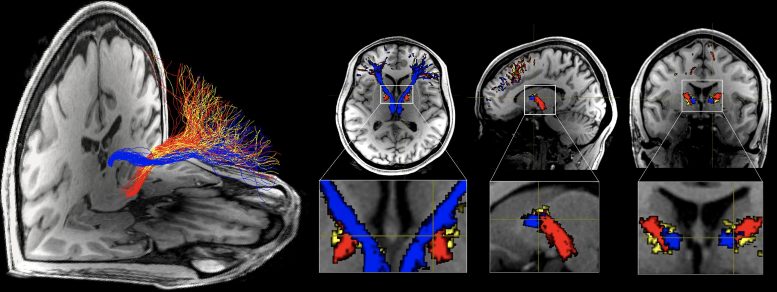
    Structural Connections With Prefrontal Cortex
    Structural connections with the prefrontal cortex modeled from targeted nuclei in the subcortex (blue: habenula, yellow: anterior thalamus, red: ventral tegmental area) using diffusion MRI tractography. Microstructural properties of the habenula tract were uniquely reduced in individuals with cocaine or heroin use disorder. Results highlight the potential specificity of distinct prefrontal cortical connections to the neuropathology of drug addiction. Credit: Mount Sinai Health System

    For the first time in the human brain, a team of scientists used diffusion magnetic resonance imaging (MRI) tractography to investigate the microstructural features of the PFC-habenula circuit in people with cocaine or heroin addiction compared to healthy control participants. Diffusion MRI tractography uses noninvasive brain imaging to model fiber bundles in the living human brain.

    The researchers were led by Rita Z. Goldstein, PhD, and Junqian Xu, PhD. Dr. Goldstein is the Mount Sinai Professor in Neuroimaging of Addiction and Director of the Neuroimaging of Addictions and Related Conditions Research Program at Icahn Mount Sinai. Dr. Xu is Associate Professor of Radiology, and Psychiatry, at Baylor College of Medicine.

    “In addition to identifying microstructural differences, specifically reduced coherence in the orientation of the white matter fibers in the cocaine-addicted group that comprised both current cocaine users and those with short-term abstinence, we extended results beyond cocaine (a stimulant) to heroin (an opioid), suggesting that abnormalities in this path may be generalized in addiction,” said Sarah King, who led the analyses and is first author of the paper. “Importantly, we found that across all addicted individuals, greater impairment was correlated with earlier age of first drug use, which points to a potential role for this circuit in developmental or premorbid risk factors.” King is a PhD student in Neuroscience in the Graduate School of Biomedical Sciences at Icahn Mount Sinai.

    The results advance ongoing research in the field by targeting a previously unexplored circuit in the pathophysiology of addiction in humans, where deficits may predispose an individual to both the development of drug addiction and to relapse and which may be potentially amenable for individually tailored treatment or prevention efforts.

    Reference: “Prefrontal-habenular microstructural impairments in human cocaine and heroin addiction” by Sarah G. King, Pierre-Olivier Gaudreault, Pias Malaker, Joo-won Kim, Nelly Alia-Klein, Junqian Xu and Rita Z. Goldstein, 6 October 2022, Neuron.
    DOI: 10.1016/j.neuron.2022.09.011

    Never miss a breakthrough: Join the SciTechDaily newsletter.
    Follow us on Google and Google News.

    Addiction Brain Mount Sinai Hospital Mount Sinai School of Medicine Neuroscience
    Share. Facebook Twitter Pinterest LinkedIn Email Reddit

    Related Articles

    Brain’s Reward Pathway Unlocked: Revealing the Secrets of the Dopaminergic System

    Unmasking Addiction: Scientists Discover Common Brain Network Among People With Substance Use Disorder

    This Protein Could Be the Key to Turning Back Your Brain’s Aging Clock

    Decoding Treatment-Resistant Depression: Researchers Identify Crucial Biomarker That Tracks Recovery

    Researchers Have Identified Two Previously Unknown Genes Linked to Schizophrenia

    Good and Bad Feelings for Brain Stem Serotonin Could Lead to New Treatments for Addiction and Depression

    Stem Cells Reveal: How Neurons From PTSD Patients React to Stress

    Drug (Cocaine, Methamphetamine, or Nicotine) Withdrawal Morphs Brain Communication Networks in Mice

    Gene Changes Linked to Severe Repetitive Behaviors Seen in Autism, Schizophrenia, and Drug Addiction

    Leave A Reply Cancel Reply

    • Facebook
    • Twitter
    • Pinterest
    • YouTube

    Don't Miss a Discovery

    Subscribe for the Latest in Science & Tech!

    Trending News

    Scientists Say This Natural Hormone Reverses Obesity by Targeting the Brain

    35-Million-Year-Old Mystery: Strange Arachnid Discovered Preserved in Amber

    Is AI Really Just a Tool? It Could Be Altering How You See Reality

    JWST Reveals a “Forbidden” Planet With a Baffling Composition

    The Protein “Sabotaging” Aging Muscle Recovery Could Be Key to Surviving Aging

    This Diet–Gut Interaction Could Transform Fat Into a Calorie-Burning Machine

    Scientists Discover Hidden Virus Linked to Colorectal Cancer

    Scientists Discover 132-Million-Year-Old Dinosaur Tracks on South Africa’s Coast

    Follow SciTechDaily
    • Facebook
    • Twitter
    • YouTube
    • Pinterest
    • Newsletter
    • RSS
    SciTech News
    • Biology News
    • Chemistry News
    • Earth News
    • Health News
    • Physics News
    • Science News
    • Space News
    • Technology News
    Recent Posts
    • Beyond “Safe Levels”: Study Challenges What We Know About Pesticides and Cancer
    • Researchers Have Found a Dietary Compound That Increases Longevity
    • 5 Things Experts Say You’re Getting Wrong About Protein
    • Scientists Create “Optical Tornadoes” That Twist Light Into a Swirling Vortex
    • Scientists Uncover Hidden Superconductivity in Material Once Thought Only Magnetic
    Copyright © 1998 - 2026 SciTechDaily. All Rights Reserved.
    • Science News
    • About
    • Contact
    • Editorial Board
    • Privacy Policy
    • Terms of Use

    Type above and press Enter to search. Press Esc to cancel.