
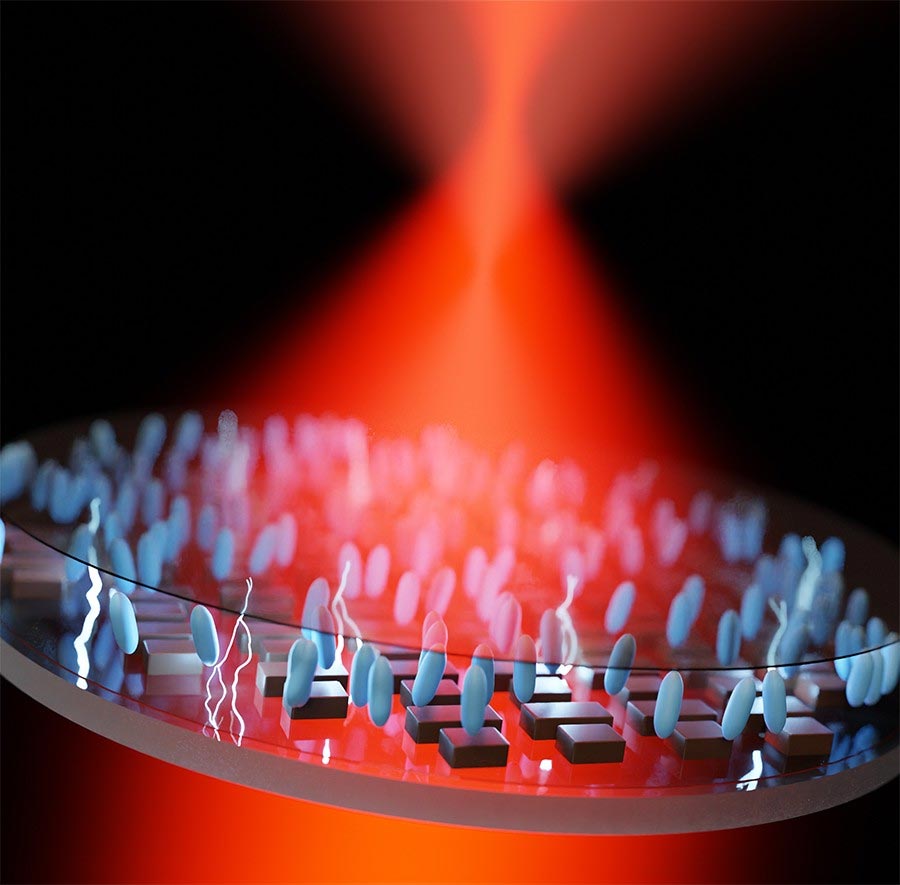
Researchers created a flat, voltage-adjustable metalens with zoom capability, ideal for lightweight imaging devices like satellites and AR wearables.
Researchers from Cornell’s School of Applied and Engineering Physics and Samsung’s Advanced Institute of Technology have created a first-of-its-kind metalens – a metamaterial lens – that can be focused using voltage instead of mechanically moving its components.
The proof of concept opens the door to a range of compact varifocal lenses for possible use in many imaging applications such as satellites, telescopes and microscopes, which traditionally focus light using curved lenses that adjust using mechanical parts. In some applications, moving traditional glass or plastic lenses to vary the focal distance is simply not practical due to space, weight or size considerations.
Metalenses are flat arrays of nano-antennas or resonators, less than a micron thick, that act as focusing devices. But until now, once a metalens was fabricated, its focal length was hard to change, according to Melissa Bosch, doctoral student and first author of a paper detailing the research in the American Chemical Society’s journal Nano Letters.
The innovation, developed in the collaboration between Samsung and Cornell researchers, involved merging a metalens with the well-established technology of liquid crystals to tailor the local phase response of the metalens. This allowed the researchers to vary the focus of the metalens in a controlled way by varying the voltage applied across the device.
Achieving Tunable Zoom Through Voltage
“This combination worked out as we hoped and predicted it would,” said Bosch, who works in the lab of Gennady Shvets, professor of applied and engineering physics and senior author of the paper. “It resulted in an ultrathin, electrically tunable lens capable of continuous zoom and up to 20% total focal length shift.”
Samsung researchers are hoping to develop the technology for use in augmented reality glasses, according to Bosch. She sees many other possible applications such as replacing the optical lenses on satellites, spacecraft, drones, night-vision goggles, endoscopes and other applications where saving space and weight are priorities.
Maxim Shcherbakov, postdoctoral associate in the Shvets lab and corresponding author of the paper, said that researchers have made progress in marrying liquid crystals to nanostructures for the past decade, but nobody had applied this idea to lenses. Now the group plans to continue the project and improve the prototype’s capabilities.
“For instance,” Shcherbakov said, “this lens works at a single wavelength, red, but it will be much more useful when it can work across the color spectrum – red, green, blue.”
Full-Color, Multiwavelength Functionality
The Cornell research group is now developing a multiwavelength varifocal version of the metalens using the existing platform as a starting point.
“The optimization procedure for other wavelengths is very similar to that of red. In some ways, the hardest step is already finished, so now it is simply a matter of building on the work already done,” Bosch said.
Reference: “Electrically Actuated Varifocal Lens Based on Liquid-Crystal-Embedded Dielectric Metasurfaces” by Melissa Bosch, Maxim R. Shcherbakov, Kanghee Won, Hong-Seok Lee, Young Kim and Gennady Shvets, 26 April 2021, Nano Letters.
DOI: 10.1021/acs.nanolett.1c00356
This work was supported by the Global Research Outreach program of the Samsung Advanced Institute of Technology and, in part, by the Cornell Center for Materials Research with funding from the National Science Foundation and the U.S. Office of Naval Research.
Never miss a breakthrough: Join the SciTechDaily newsletter.
Follow us on Google and Google News.
2 Comments
You might be able to make a voltage tuned lens with proteins in some liquid. Particularly if you could make them somewhat electrically conductive, or connect resonators onto them.
Instead of using liquid crystal, why not use MEMS???