
Close Menu
    Facebook X (Twitter) Instagram
    SciTechDaily
    • Biology
    • Chemistry
    • Earth
    • Health
    • Physics
    • Science
    • Space
    • Technology
    Facebook X (Twitter) Pinterest YouTube RSS
    SciTechDaily
    Home»Earth»Between Fire and Hurricane: US West Coast on Fire While Hurricane Sally Hits Gulf Shores
    Earth

    Between Fire and Hurricane: US West Coast on Fire While Hurricane Sally Hits Gulf Shores

    By European Space AgencySeptember 20, 2020No Comments5 Mins Read
    Facebook Twitter Pinterest Telegram LinkedIn WhatsApp Email Reddit
    Share
    Facebook Twitter LinkedIn Pinterest Telegram Email Reddit
    Between Fire and Hurricane
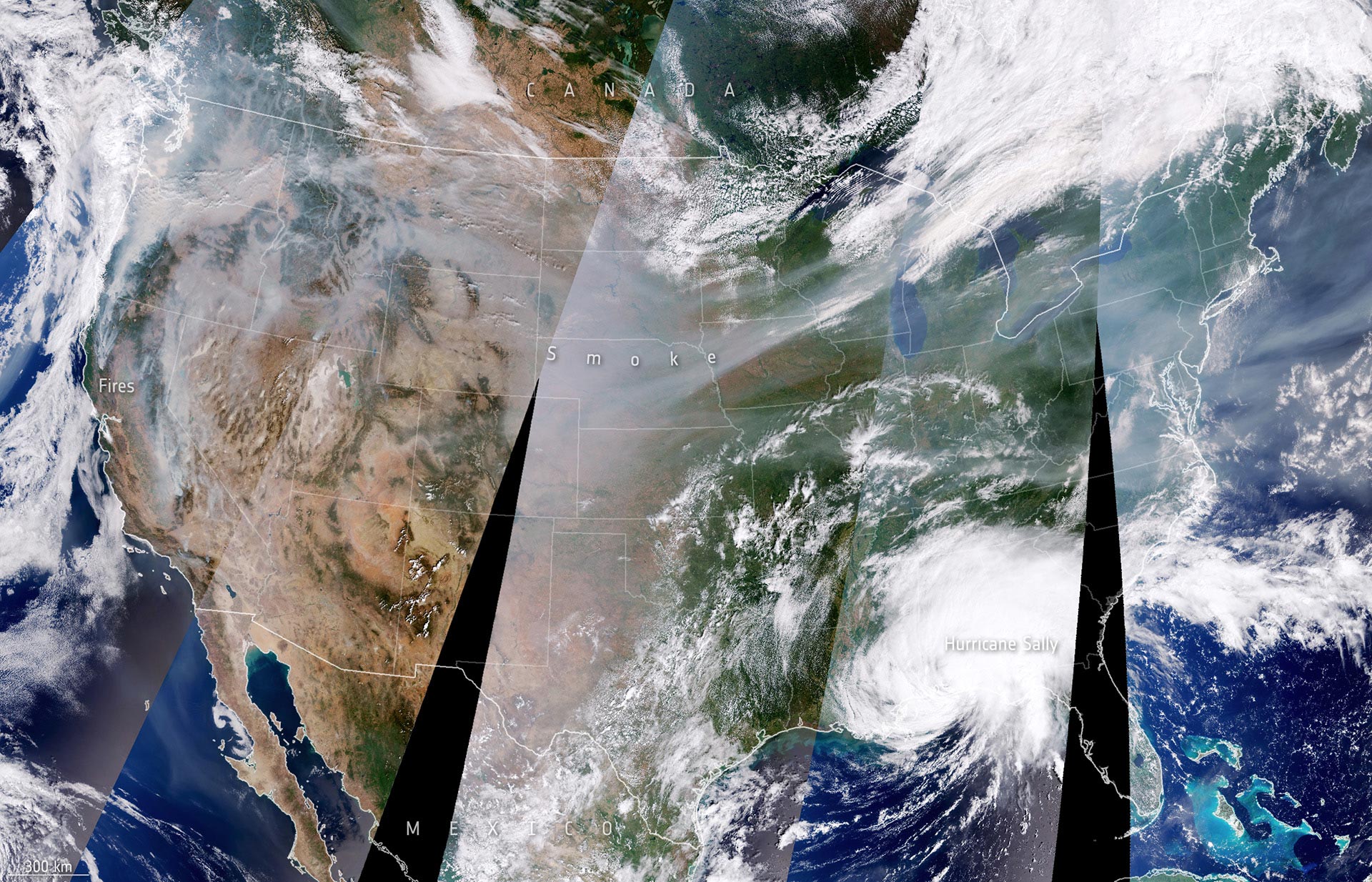
    In this image, captured by the Copernicus Sentinel-3 mission on September 16, fires can be seen burning on the west coast of the US, with smoke traveling eastwards across the country. Meanwhile, Hurricane Sally is visible making landfall on the east coast in the right of the image. Hurricane Sally hit Gulf Shores in Alabama on Wednesday, with wind speeds of around 169 km/hr recorded, before decreasing into a tropical depression. The black patches in the image indicate a lack of data. Credit: Contains modified Copernicus Sentinel data (2020), processed by ESA, CC BY-SA 3.0 IGO

    Over the past month, dozens of wildfires have burned vast swathes of land in California, Oregon, and Washington State, killing more than 30 people and smothering the majority of the western United States in smoke. While photographs have circulated online showing the apocalyptic orange skies, satellites in orbit around Earth carry different instruments that can provide not only images, but a wealth of complementary information needed to monitor the blazes.

    Record high temperatures, strong winds, and thunderstorms have created the dangerous conditions that have allowed fires in western United States to ignite and spread. Plumes of smoke from the fires are so large, they have traveled across the US, even reaching New York on the east coast. According to the Copernicus Atmosphere Monitoring Service (CAMS), the smoke is forecasted to reach Europe this weekend.

    In this spectacular image, captured by the Copernicus Sentinel-3 mission on 16 September, fires can be seen burning on the west coast of the US, with smoke traveling eastwards across the country. Meanwhile, Hurricane Sally is visible making landfall on the east coast. Hurricane Sally hit Gulf Shores in Alabama on Wednesday, with wind speeds of around 169 km/hr recorded, before decreasing into a tropical depression.

    While the image above was captured by the mission’s ocean and land color instrument, which provides camera-like images, the mission’s sea and land surface temperature radiometer instrument records fire hotspots. The instrument works similar to a thermometer – measuring thermal infrared radiation to take the temperature of Earth’s land surfaces.
    Fire Hotspots Detected by Sentinel-3 World Fire Atlas Prototype
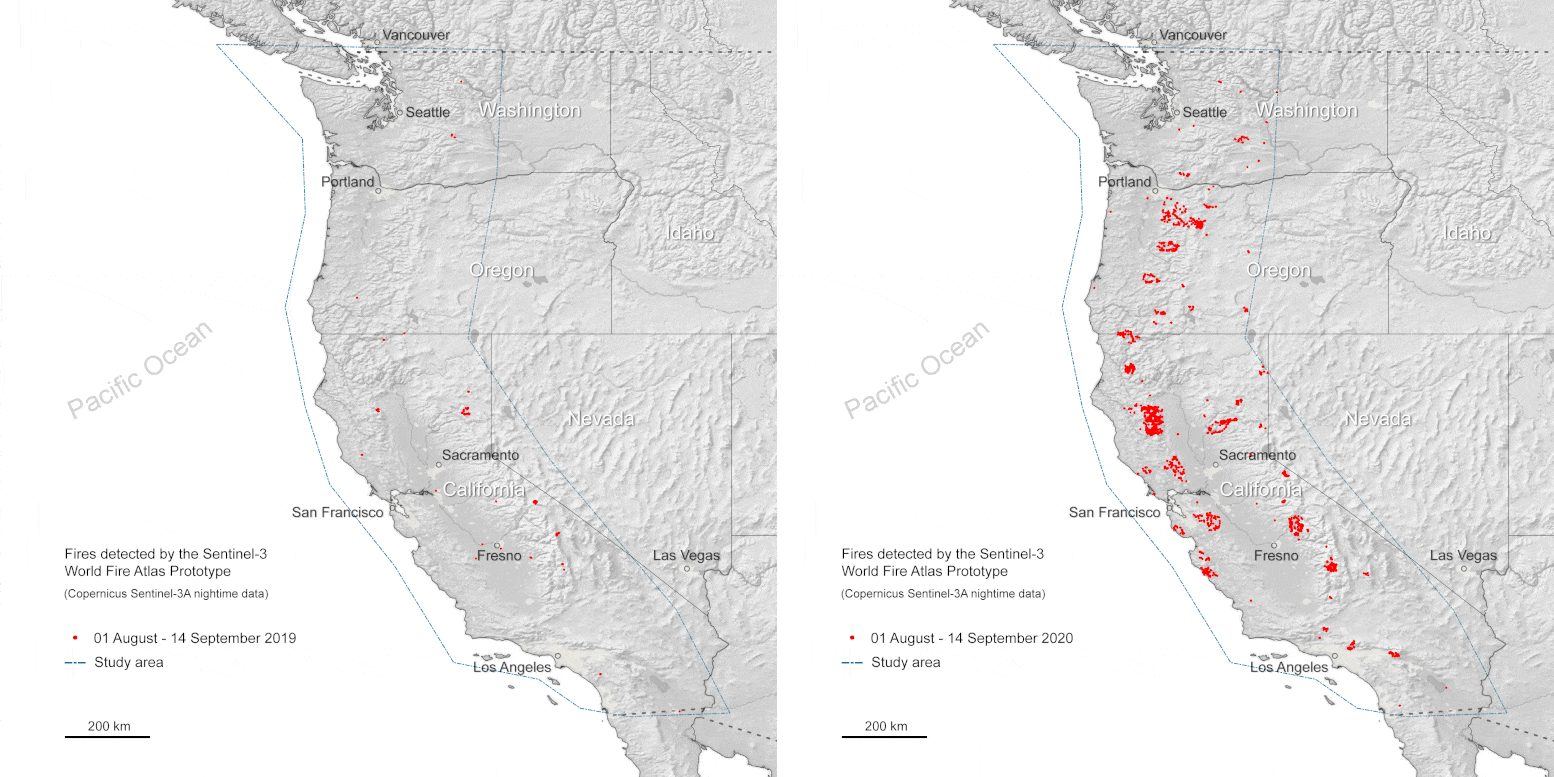
    This animation shows the number of fire hotspots detected between August 1 — September 14, 2019, compared to August 1 — September 14, 2020. These measurements were taken by the Copernicus Sentinel-3A satellite at night only. Comparing fire activity with the previous year, the data suggests that there have been hundreds more fire hotspots in 2020 compared to the same period last year. Credit: Contains modified Copernicus Sentinel data (2020), processed by ESA, CC BY-SA 3.0 IGO

    This information is used to detect and monitor the heat emitted by fires. These two dedicated fire channels are used to compile the World Fire Atlas.

    The animation shows the number of fire hotspots detected between August 1 —September 14, 2019, compared to August 1 — September 14, 2020.
    Carbon Monoxide From West Coast Fires
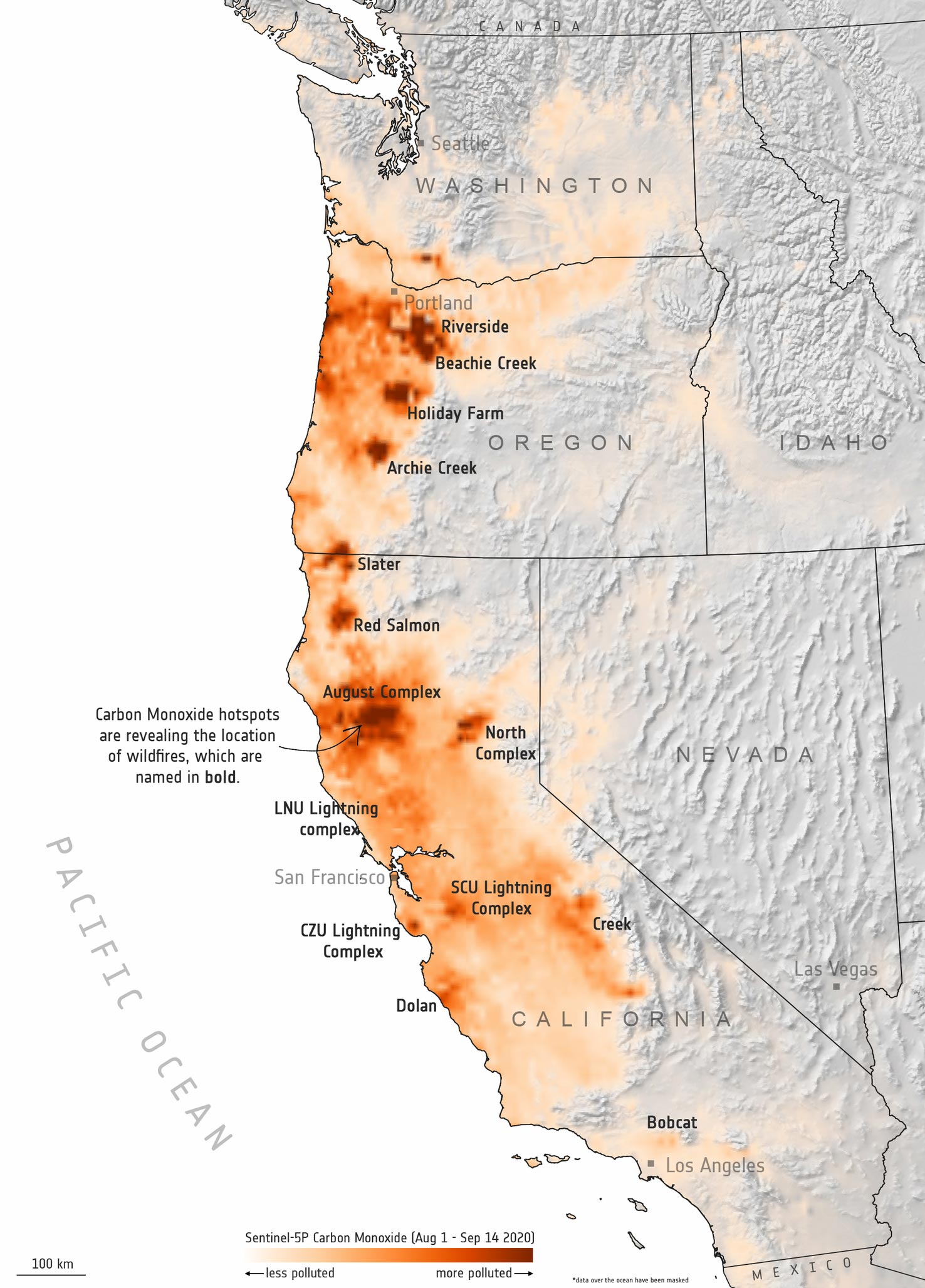
    The Copernicus Sentinel-5P satellite, dedicated to monitoring air pollution, has detected the increased concentrations of carbon monoxide along the west coast. The hotspots visible in the image show the precise locations of the wildfires, which have been identified in bold. Credit: Contains modified Copernicus Sentinel data (2020), processed by ESA, CC BY-SA 3.0 IGO

    These measurements were taken by the Copernicus Sentinel-3A at night only. Comparing fire activity with the previous year, the data suggests that there have been hundreds of more fire hotspots in 2020 compared to the same period last year.

    The Copernicus Sentinel-5P satellite, dedicated to monitoring air pollution, has detected the increased concentrations of carbon monoxide along the west coast.

    The hotspots visible in the image show the precise locations of the wildfires, which have been identified in bold.

    While carbon monoxide is commonly associated with traffic, the increase in concentrations comes from the fires. Once in the air, carbon monoxide can cause problems for humans by reducing the amount of oxygen that can be transported in the bloodstream.

    Optical images captured by the Copernicus Sentinel-2 mission have also been used to image the fires. Each of the two satellites carry a high-resolution camera that images Earth’s surface in 13 spectral bands.

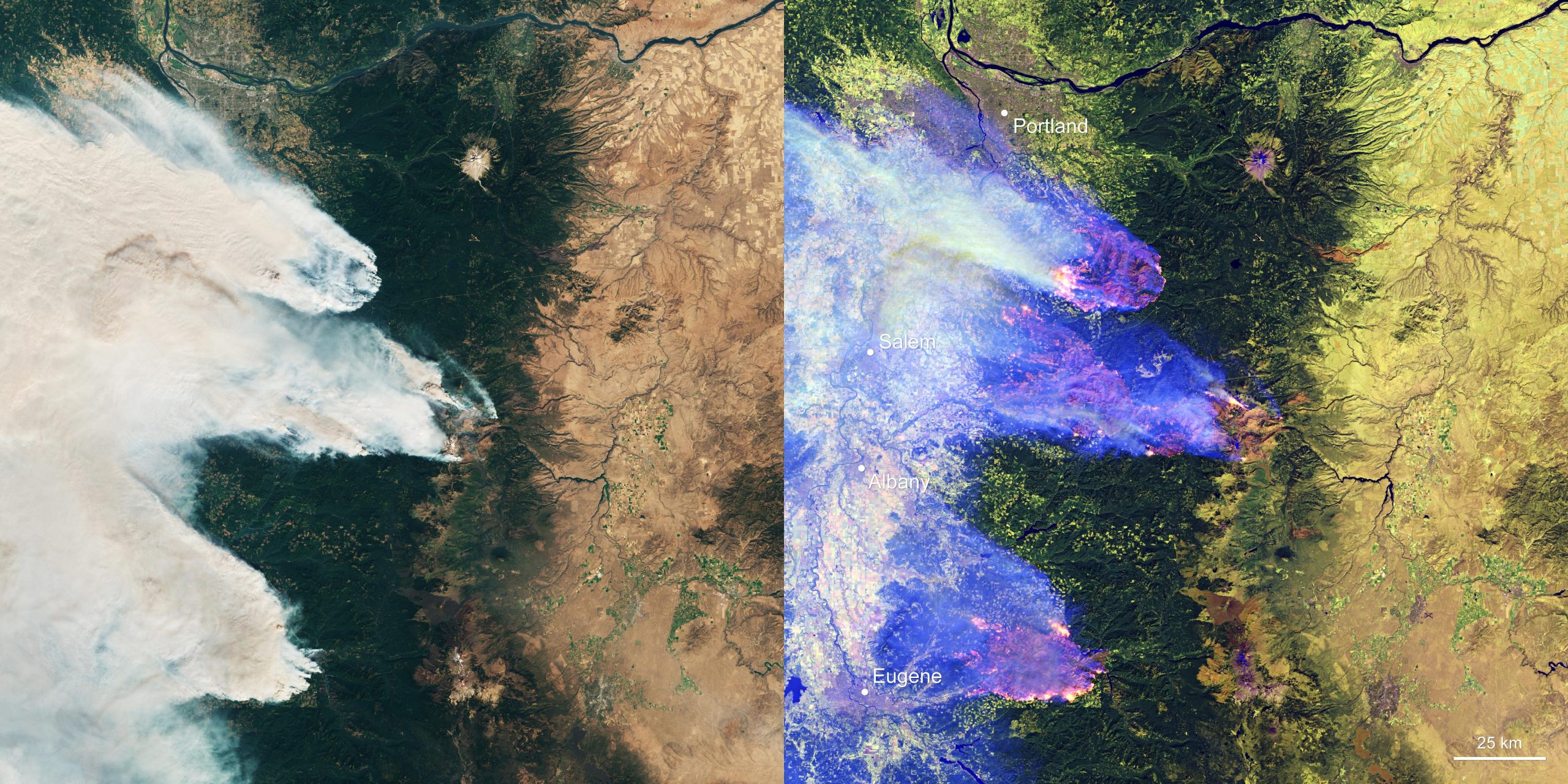
    The image below , captured on September 9, 2020, shows some of the wildfires over Oregon. The view on the left shows the affected area captured by the camera-like instrument onboard the satellite, while the composite on the right utilizes the SWIR bands of the same instrument which penetrate the smoke of the fire, and provide a clearer view of the fire front and affected area at the time of the acquisition.
    Wildfires Over Oregon
    Optical images captured by the Copernicus Sentinel-2 mission have been used to image the fires in the United States. Each of the two satellites carry a high-resolution camera that images Earth’s surface in 13 spectral bands. This image, captured on 9 September 2020, shows some of the wildfires over Oregon. The view on the left shows the affected area captured by the camera-like instrument onboard the satellite, while the composite on the right utilizes the SWIR bands of the same instrument which penetrate the smoke of the fire, and provide a clearer view of the fire front and affected area at the time of the acquisition. Credit: Contains modified Copernicus Sentinel data (2020), processed by ESA, CC BY-SA 3.0 IGO

    Never miss a breakthrough: Join the SciTechDaily newsletter.
    Follow us on Google and Google News.

    European Space Agency Hurricane Weather Wildfires
    Share. Facebook Twitter Pinterest LinkedIn Email Reddit

    Related Articles

    Global Wildfires Surge: A Comprehensive Analysis Through ESA’s World Fire Atlas

    California Continues To Burn – More Than 7000 Wildfires, Burning Over 900,000 Hectares

    Smoke Billows From Deadly Wildfires in Turkey

    Hurricanes Have Become More Destructive for USA – Climatic Increase in Frequency of Worst Storms

    NASA Satellite Captures 360-View of Hurricane Maria

    NASA Satellites Show Hurricane Florence Strengthening

    Space Storm Hunter Captures First Images and Data

    Hurricane Sandy Viewed From Space

    MSG-3 Weather Satellite Captures Its First Image of Earth

    Leave A Reply Cancel Reply

    • Facebook
    • Twitter
    • Pinterest
    • YouTube

    Don't Miss a Discovery

    Subscribe for the Latest in Science & Tech!

    Trending News

    The Universe Is Expanding Too Fast and Scientists Can’t Explain Why

    “Like Liquid Metal”: Scientists Create Strange Shape-Shifting Material

    Early Warning Signals of Esophageal Cancer May Be Hiding in Plain Sight

    Common Blood Pressure Drug Shows Surprising Power Against Deadly Antibiotic-Resistant Superbug

    Scientists Uncover Dangerous Connection Between Serotonin and Heart Valve Disease

    Scientists Discover a “Protector” Protein That Could Help Reverse Hair Loss

    Bone-Strengthening Discovery Could Reverse Osteoporosis

    Scientists Uncover Hidden Trigger Behind Stem Cell Aging

    Follow SciTechDaily
    • Facebook
    • Twitter
    • YouTube
    • Pinterest
    • Newsletter
    • RSS
    SciTech News
    • Biology News
    • Chemistry News
    • Earth News
    • Health News
    • Physics News
    • Science News
    • Space News
    • Technology News
    Recent Posts
    • A Common Diabetes Drug May Hold the Key to Stopping HIV From Coming Back
    • Ancient “Syphilis-Like” Disease in Vietnam Challenges Key Scientific Assumptions
    • Drinking Alcohol To Cope in Your 20s Could Damage Your Brain for Life
    • Scientists Crack Alfalfa’s Chromosome Mystery After Decades of Debate
    • Ancient Ant-Plant Alliance Collapses As Predatory Wasps Move In
    Copyright © 1998 - 2026 SciTechDaily. All Rights Reserved.
    • Science News
    • About
    • Contact
    • Editorial Board
    • Privacy Policy
    • Terms of Use

    Type above and press Enter to search. Press Esc to cancel.