
Close Menu
    Facebook X (Twitter) Instagram
    SciTechDaily
    • Biology
    • Chemistry
    • Earth
    • Health
    • Physics
    • Science
    • Space
    • Technology
    Facebook X (Twitter) Pinterest YouTube RSS
    SciTechDaily
    Home»Earth»Hurricane Sandy Viewed From Space
    Earth

    Hurricane Sandy Viewed From Space

    By SciTechDailyOctober 31, 2012No Comments2 Mins Read
    Facebook Twitter Pinterest Telegram LinkedIn WhatsApp Email Reddit
    Share
    Facebook Twitter LinkedIn Pinterest Telegram Email Reddit
    hurricane-sandy-space-NASA
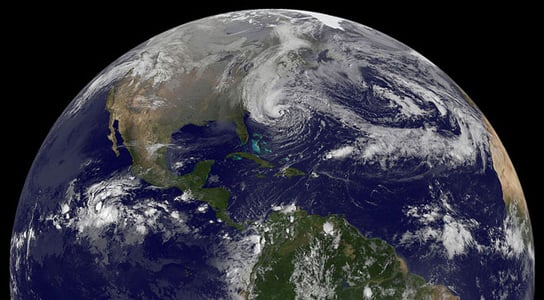
    Hurricane Sandy. Credit: NOAA/NASA GOES Project

    Hurricane Sandy has been downgraded to a post-cyclone storm, and most of the devastating effects of the hurricane are past, but people in 22 states in the USA are still dealing with the effects of its landfall.

    Hurricane Sandy grew big enough to become an awesome visual spectacle even from space, growing to an enormous mass of wind that stretched nearly 1,100 miles across.
    hurricane-sandy-path-noaa
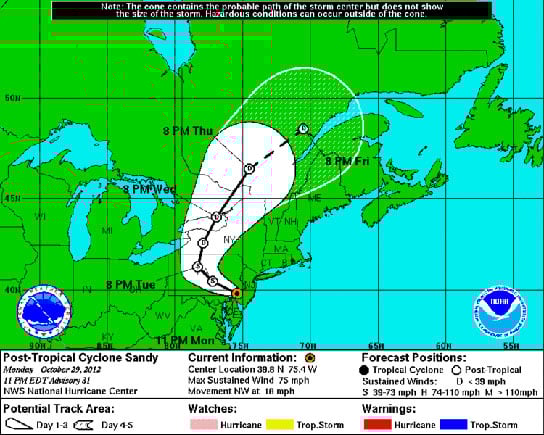
    Hurricane Sandy’s path. Credit: NOAA

    The image above was captured by NOAA’s GOES-13 satellite on October 28th, at 9:02 a.m. EDT. Sandy is a huge, swirly mass, centered just off the eastern coast of the United States, merging with a cold front on its western edge.

    As the largest hurricane on record, Hurricane Sandy is a late-season tropical cyclone that affected the Greater Antilles, the Bahamas, and Eastern Canada as well as the Eastern USA. It’s the 10th hurricane of the 2012 Atlantic hurricane season and it developed from a tropical wave in the western Caribbean on October 21. It became a tropical depression that quickly strengthened into a tropical storm.

    Sandy was upgraded to a hurricane on October 24, before making landfall in Jamaica. In the early morning of October 25, Sandy became a Category 2 hurricane. Sandy approached the US coast maintaining Category 1 strength and made landfall on October 29 at 8 p.m.

    Never miss a breakthrough: Join the SciTechDaily newsletter.
    Follow us on Google and Google News.

    Cyclone Hurricane Meteorology Weather
    Share. Facebook Twitter Pinterest LinkedIn Email Reddit

    Related Articles

    Scientists Discover Potential Key to Predicting Hurricanes Weeks in Advance

    Why Do Hurricanes Have Such Huge Destructive Energy?

    Record Greenland Ice Loss in 2019 Driven by Unusually Clear Skies

    Hurricanes Have Become More Destructive for USA – Climatic Increase in Frequency of Worst Storms

    NASA Satellite Captures 360-View of Hurricane Maria

    NASA Satellites Show Hurricane Florence Strengthening

    2015 El Niño Appears Likely to Equal the Event of 1997-98

    New NASA/NOAA Animations Reveal Water Vapor Over Oceans

    The Inherent Unpredictability of El Nino Events

    Leave A Reply Cancel Reply

    • Facebook
    • Twitter
    • Pinterest
    • YouTube

    Don't Miss a Discovery

    Subscribe for the Latest in Science & Tech!

    Trending News

    The Strange “Spacetime Crystal” That Can Suddenly Turn Into a Black Hole

    The Surprising Way Asteroids May Have Helped Life Begin on Earth

    Vast Hidden Structure Discovered Under Miles of Ice in East Antarctica

    A Surprising Discovery Suggests Autism Is Not One Condition

    New Alzheimer’s Discovery Could Change How Scientists Fight the Disease

    Yale Discovery Overturns Long-Held “Evolutionary Dead End” Theory

    UCLA Scientists Uncover a “Hidden Weakness” in Some of the World’s Deadliest Cancers

    Humpback Whale Stuns Scientists With 15,000 Kilometer Journey Across Oceans

    Follow SciTechDaily
    • Facebook
    • Twitter
    • YouTube
    • Pinterest
    • Newsletter
    • RSS
    SciTech News
    • Biology News
    • Chemistry News
    • Earth News
    • Health News
    • Physics News
    • Science News
    • Space News
    • Technology News
    Recent Posts
    • Scientists Develop a New Way To Measure Gravitational Waves in the Expanding Universe
    • MIT’s New Dual-Mode Rocket System Could Send Tiny Satellites to Mars
    • Scientists Discover a Biological Clock Unlike Anything Seen Before
    • This “Zombie” Sea Creature Keeps Growing After Being Cut Apart
    • The Brain May Not Need Full Sleep To Recover, New Research Finds
    Copyright © 1998 - 2026 SciTechDaily. All Rights Reserved.
    • Science News
    • About
    • Contact
    • Editorial Board
    • Privacy Policy
    • Terms of Use

    Type above and press Enter to search. Press Esc to cancel.