
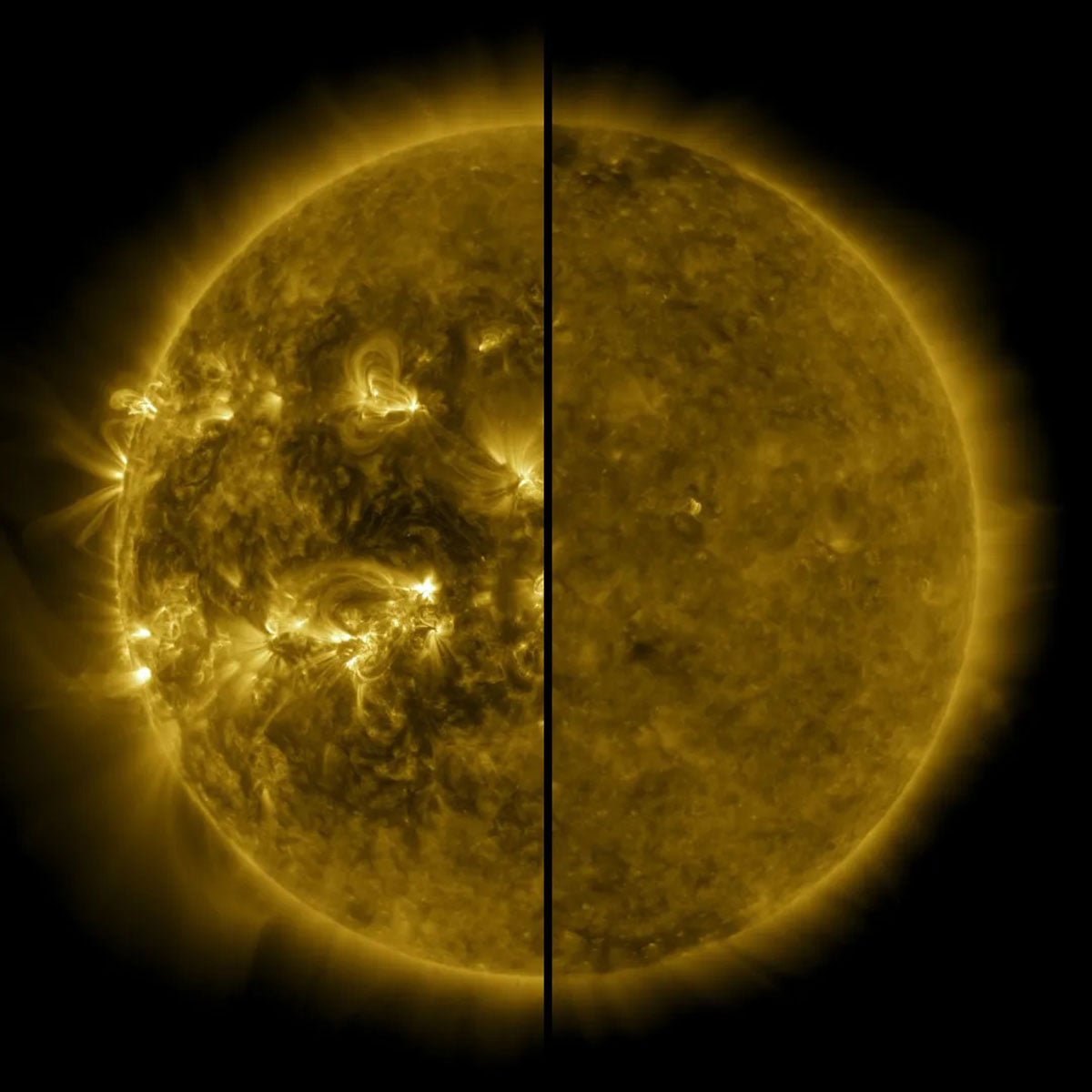
Sound waves echoing through the Sun indicate that its magnetic activity is progressively migrating toward the surface, altering how the star generates space weather.
Ninety-three million miles away, an eruption on the Sun can send clouds of charged particles toward Earth, threatening satellites, communications, GPS systems, and power grids. Forecasting these disturbances requires understanding the Sun’s 11-year magnetic cycle, yet the sunspots and eruptions astronomers routinely track cannot reveal how the activity is changing beneath the star’s bright surface.
Tuning in to sound waves reverberating through the Sun, an international team led by the University of Birmingham found evidence that changes linked to its magnetic activity are becoming concentrated closer to the surface. The researchers reported their findings in Monthly Notices of the Royal Astronomical Society (MNRAS).
Tracking magnetic shifts through internal solar vibrations
The Sun vibrates like a giant ringing bell, with sound waves whose frequencies shift in response to magnetic activity. Measuring those shifts through a technique called “helioseismology” gives researchers a way to follow changes beneath the bright surface.
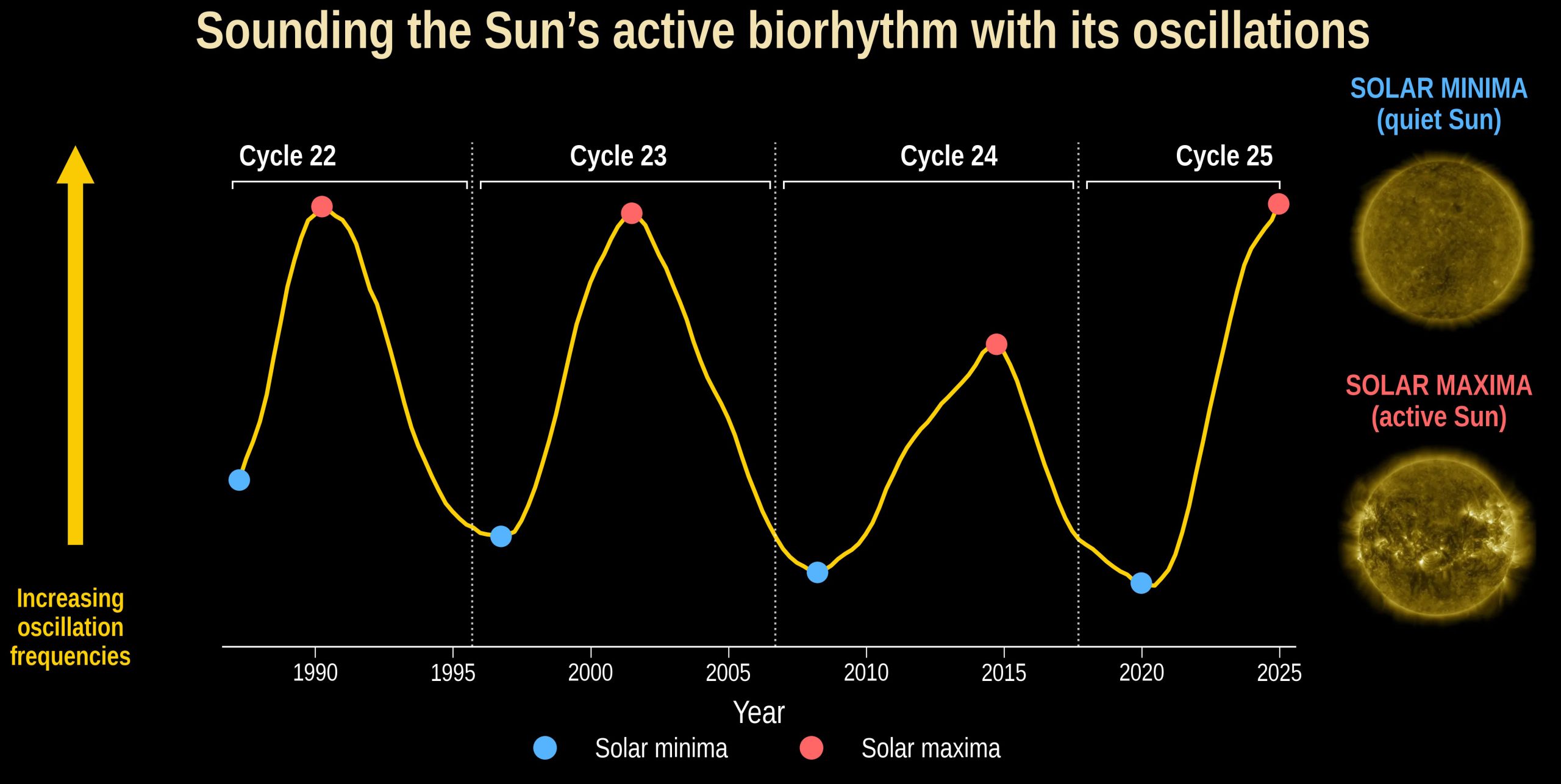
To see how closely those internal changes matched the Sun’s outward behavior, the team tracked the vibration frequencies alongside traditional activity measurements across four solar cycles. Both respond to magnetic activity, but their relationship can reveal changes that would be missed by watching the surface alone. Following that relationship over time led the researchers to three main findings:
- Since Cycle 23, the relationship between the Sun’s vibration frequencies and traditional activity measures has changed significantly, pointing to a long-term shift in its internal processes.
- The vibration measurements indicate that structural changes associated with the solar cycle are becoming increasingly confined to shallow layers within 1,000 kilometers, or about 620 miles, of the Sun’s surface.
- Cycle 25 appears weaker in traditional surface indicators, but its high-frequency oscillations suggest activity comparable in strength to earlier cycles.
Professor Sarbani Basu, from Yale University, said: “We discovered that the relationship between internal solar oscillations and surface activity has evolved over the past few cycles. This trend cannot be explained simply by weaker magnetic fields. Instead, it indicates a structural reorganization of how the Sun’s magnetic activity is stored beneath the surface.”
Probing varying depths across four solar cycles
Six telescopes around the world supplied nearly 40 years of observations through the Birmingham Solar Oscillations Network (BiSON). The team analyzed measurements from 1987 to 2025, covering solar cycles 22 through 25, with the latest cycle showing particularly strong signatures of the structural changes.
The researchers divided the Sun’s vibrations, known as p-mode oscillations, into bands of low, middle, and high frequencies to probe different depths beneath the surface. Comparing the behavior of those bands allowed them to locate the changing layers, while the long observational record showed how the pattern developed across successive cycles.
Professor Bill Chaplin, the study’s lead author at the University of Birmingham, said: “The Sun has its own ‘active biorhythm’ creating rising and falling magnetic activity that shapes space weather. However, traditional surface measures don’t capture the full story – that the Sun may be entering a different mode of behaviour unfolding over decades.
“We have uncovered evidence of systematic changes in the solar activity cycle. Crucially, magnetic activity is becoming more tightly confined near the surface with each cycle. This is the first such discovery and would have been impossible without the long BiSON observations.”
BiSON’s telescopes will continue collecting observations through the remainder of Cycle 25 and into Cycle 26, allowing researchers to test whether the pattern persists. As solar eruptions continue to threaten satellites and power grids, the vibrations beneath the Sun’s bright surface could reveal whether the magnetic activity driving those outbursts is undergoing a lasting change.
Reference: “Subsurface structural changes associated with successive 11-yr solar activity cycles have been progressively more confined near the surface: new helioseismic results on Cycles 22–25 from BiSON” by William J Chaplin, Sarbani Basu, Rachel Howe, Yvonne Elsworth, Steven J Hale and Eleanor Murray, 28 May 2026, Monthly Notices of the Royal Astronomical Society.
DOI: 10.1093/mnras/stag847
Never miss a breakthrough: Join the SciTechDaily newsletter.
Follow us on Google and Google News.