
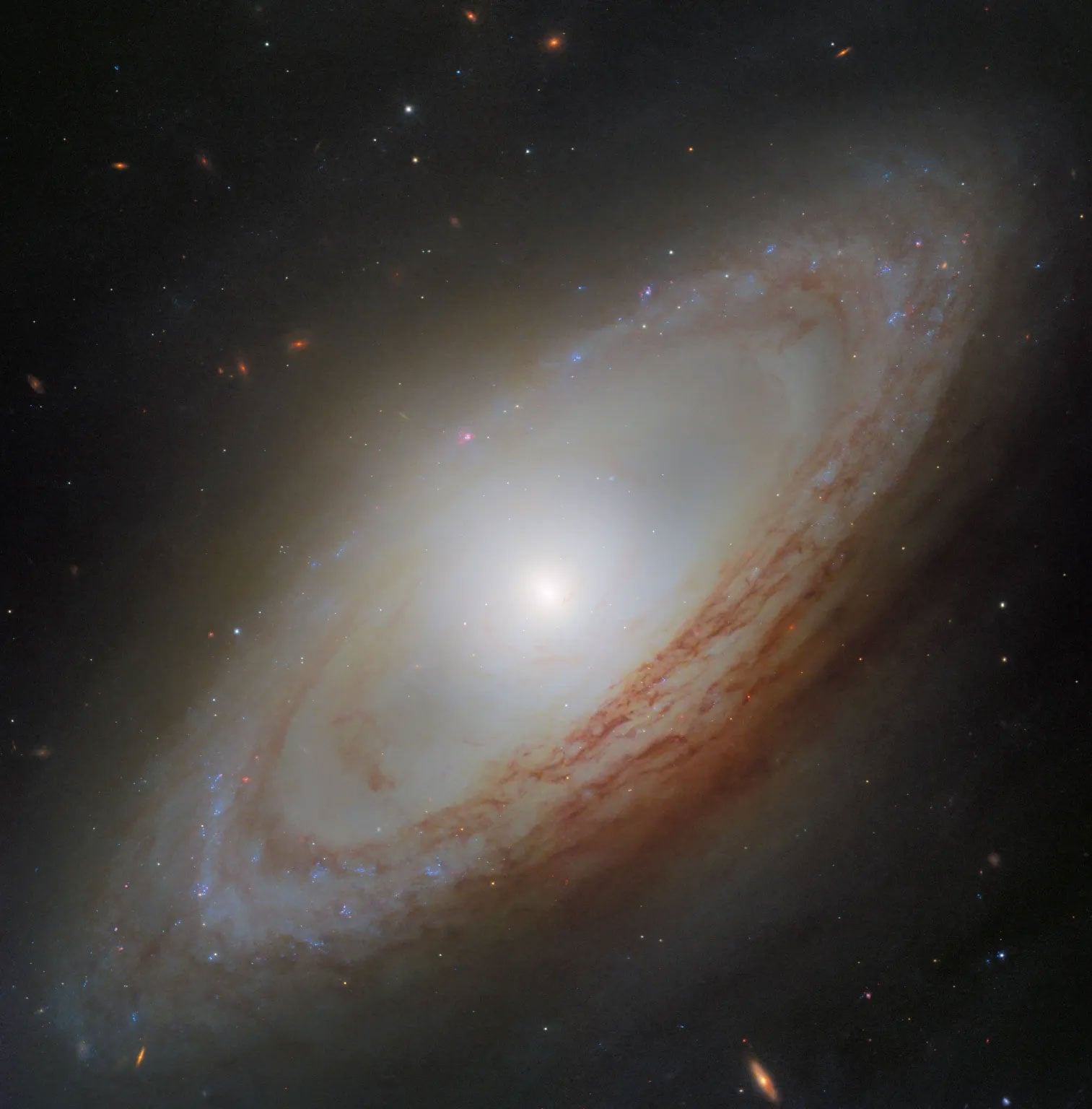
Hubble’s latest view of NGC 4698 reveals a sideways-spinning center that may bear the scars of an ancient merger.
A new image from the NASA/ESA Hubble Space Telescope reveals the unusual structure of NGC 4698, a spiral galaxy about 55 million light-years away in the constellation Virgo. Its tilted central arrangement may preserve evidence of an encounter that reshaped the galaxy.
NGC 4698 belongs to the Virgo Cluster, the nearest large cluster of galaxies held together by gravity. It is one of more than a thousand galaxies in this crowded cosmic neighborhood.
Spiral Arms Circle a Glowing Center
Like the Milky Way, NGC 4698 contains a thin disk of stars, gas, and dust threaded with spiral arms. Dark brown dust clouds mark those arms, while small groups of bright blue stars punctuate the outer disk.
The arms follow an unusual pattern. In many spiral galaxies, including this one recently photographed by Hubble, they wind inward toward the center. In NGC 4698, they stand out mainly along the outer disk, forming a loose ring around its perimeter.
Inside that ring, an elongated bulge produces a diffuse, off-white glow. Its tightly packed stars are smaller, older, and cooler than the massive blue stars farther out. At the heart of this stellar population lies a supermassive black hole containing millions of times the Sun’s mass. Scientists have detected signs that it is growing by drawing in gas.
A Galactic Center Turned Sideways
The bulge’s orientation sets NGC 4698 apart. It is among the few known spiral galaxies with a bulge that extends at a right angle to the disk. Hubble offers a subtle glimpse of this arrangement: pale starlight projects above and below the dusty disk.
Stars and gas nearest the center rotate perpendicular to the rest of the disk, suggesting that these central components did not develop in step with their surroundings.
Astronomers suspect gas arriving from outside the galaxy could explain the difference. Material captured on a different trajectory could have settled into a tilted central disk and formed stars, leaving two parts of the same galaxy rotating in different planes.
A Hydrogen Tail Hints At A Merger
A short tail of hydrogen extending from one side of NGC 4698 offers another clue to its past. Some observations suggest that the galaxy experienced a minor merger, an encounter that could help explain how outside material entered the system.
The Hubble observations come from a program examining galaxies across the Virgo Cluster. Their relative proximity allows researchers to resolve individual star clusters and nebulae, the clouds of gas and dust that reveal details of galactic structure and activity.
Never miss a breakthrough: Join the SciTechDaily newsletter.
Follow us on Google and Google News.