
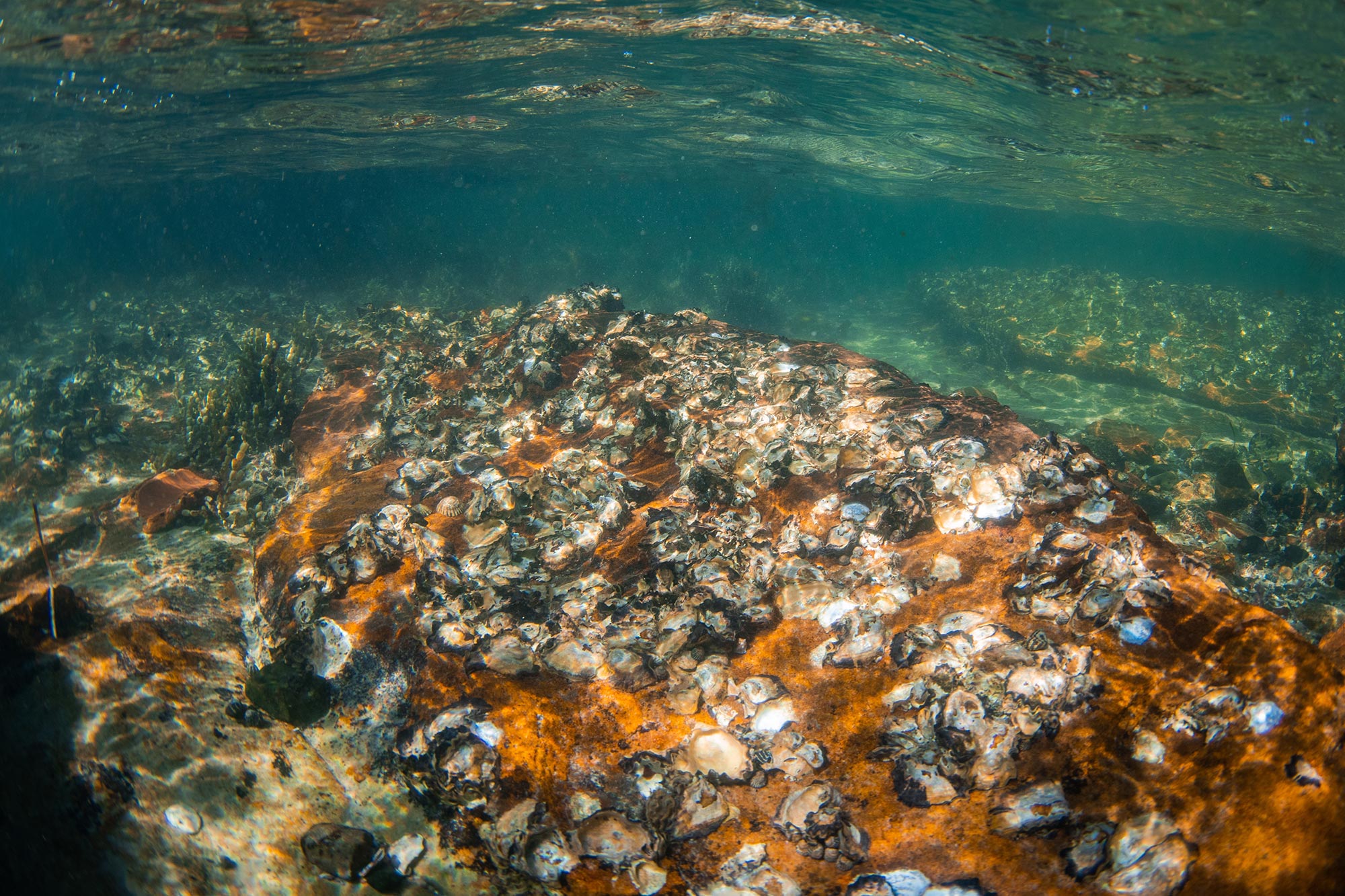
Scientists have identified vast coastal areas where oyster reefs could potentially thrive but are largely absent today.
An estimated 85% of the world’s oyster reefs have disappeared over the past century, taking with them ecosystems that protect coastlines, support marine life, and help keep coastal waters clean. A new study suggests that restoring these reefs could unlock ecological benefits worth trillions of dollars.
“Here we estimate that fully restored oyster reefs in the top ten hotspot countries worldwide would yield a GEP of $12 trillion,” said Dr Matteo Convertino, an associate professor at Tsinghua University and corresponding author of the study, published in Frontiers in Marine Science.
The researchers used gross ecosystem product (GEP) to estimate the value of benefits that nature provides to people and the environment. Unlike conventional measures of economic output, GEP accounts for ecological services such as water purification, carbon storage, and coastal protection.
The Hidden Value of Oyster Reefs
Oyster reefs do far more than supply seafood. As oysters filter water, they remove suspended particles, while the surrounding reef ecosystem helps regulate nutrients. These underwater structures also reduce wave energy along coastlines and provide feeding areas, shelter, and nursery habitat for fish and invertebrates.
The researchers calculated that reefs occupying all suitable areas identified in their analysis could filter enormous quantities of water. In the United States alone, the estimated potential reached 77.58 quadrillion liters (20.5 quadrillion gallons). Across the modeled areas, restored reefs could also sequester as much as 12.3 million metric tons (13.6 million U.S. tons) of carbon annually.
For the United States, the combined potential annual value of water purification, nitrogen removal, and carbon sequestration was estimated at $25.1 billion. These figures represent modeled ecological benefits under extensive reef restoration, not services currently being delivered.
Scientists Identify Vast Areas for Reef Restoration
To identify places where oyster reefs could thrive, the research team analyzed thousands of geographically referenced reef records from two public databases. They used machine learning to predict suitable habitats based on environmental conditions, including water temperature, salinity, light availability, nutrient concentrations, and dissolved oxygen.
The analysis identified ten countries with particularly high potential: the United States, Australia, Chile, China, Japan, South Korea, Argentina, France, Germany, and Italy. Together, these countries contain approximately 295,000 square kilometers (114,000 square miles) of suitable reef habitat, representing about 6% of their coastal zones. Yet known oyster reefs currently occupy only about 10% of that suitable area, primarily in bays, lagoons, estuaries, and river deltas.
Most Suitable Reef Habitats Remain Unprotected
Restoring oyster reefs on such a large scale would require substantial conservation efforts. Only 23% of the identified suitable habitat currently falls within marine protected areas, leaving much of the potential restoration area without formal protection.
“We estimated that 90% of sites suitable for oyster reefs require restoration, while 80% need protection through conservation efforts. In other words, the current oyster situation is very suboptimal but there is a huge opportunity, considering the benefits,” said Convertino.
The study’s $12 trillion estimate also carries substantial uncertainty. Its calculations rely on global averages for ecosystem services rather than direct measurements at every location. Changes in oyster populations, local environmental conditions, and the success of restoration efforts could all affect the benefits ultimately delivered.
Climate Change Could Reshape the Future of Oyster Reefs
Rising temperatures and other climate-related changes threaten the long-term survival of oyster reefs in many coastal environments. However, the effects are unlikely to be uniform, and some regions could become more suitable for oyster growth as environmental conditions shift.
“Because global warming generally decreases the habitat quality of oyster reefs, we expect that their global GEP will go down from the current potential value of $12 trillion. But some countries may see an expansion of reefs due to more favorable conditions for the growth and dispersal of oysters: in particular, this could happen in Australia, Indonesia, South Korea, Japan, and France.”
Reference: “The gross ecosystem product of oyster reefs” by Yuhan Wu and Matteo Convertino, 12 August 2026, Frontiers in Marine Science.
DOI: 10.3389/fmars.2026.1900813
Never miss a breakthrough: Join the SciTechDaily newsletter.
Follow us on Google and Google News.